(Jan. 21, 2022) Federal credit union (FCU) operating fees will decrease by an average of 23.7% in 2022, NCUA told the FCUs in a letter Thursday (letter to FCUs 22-FCU-01). About half of the 2022 operating fee reduction results from the NCUA Board applying a $15 million credit to amounts that would otherwise be due to support the approved 2022 operating and capital budgets, which came from previously collected operating fees that were unspent at year-end 2021, NCUA said. The remainder of the fee reduction, the agency said, came from budget surplus, growth in credit union assets – and “a slight increase to the share of the Operating Budget funded from the Share Insurance Fund through the Overhead Transfer Rate (OTR) methodology.” … NCUA and the federal banking agencies were all dinged in a congressional watchdog’s report on privacy protection for not fully implementing key practices. The report from the Governmental Accountability Office (GAO) notes that the agencies, among other things, have not maintained a full “personally identifiable information” (PII) inventory for all agency-owned applications. The agencies also did not document steps taken to minimize the collection and use of PII, the report asserts … A 2019 CFPB taskforce, ostensibly focusing on federal consumer financial law, did not comply with federal “sunshine” law requirements and the report of the group, issued about a year ago, will say so under a settlement announced late last week by the agency. Under that settlement, all taskforce records that would have been made public if the CFPB had complied with FACA’s requirements will be released publicly March 22. The records will also be made publicly available on the CFPB’s website, the agency said.
LINKS:
NCUA Letter 22-FCU-01: Operating Fee Schedule Adjusted for 2022
CFPB Announces Settlement Regarding the 2019 Taskforce on Federal Consumer Financial Law
(Dec. 17, 2021) An increased overhead transfer rate (OTR) for 2022, a final operating budget of $320 million for next year, and three final rules – on the complex credit union leverage ratio (CCULR), subordinated debt and mortgage servicing assets — were all approved by the NCUA Board at a busy meeting this week.
All actions by the board (including new rules, see items) were approved unanimously.
In a U-turn, the board voted to reduce the staff-proposed OTR, but it is still higher than the last two years.
The board gave the nod to a 62.7% OTR to partially fund its 2022 budget of $320.1 million. The board’s action on the OTR, which represents the rate at which funds are transferred from the National Credit Union Share Insurance Fund (NCUSIF) to pay for “insurance related” expenses of the agency, is the third straight year that the rate has been raised (at 40 basis points higher than 2021, and 140 bp higher than 2020).
Although the OTR is higher again for 2022, the figure the board ultimately approved was lower than that proposed last month when the budget was unveiled. Originally, the agency recommended a 63.4% rate.
As recently as last week, during the agency’s briefing and public comment on its 2022 budget, NASCUS asserted that every dollar that is transferred from the insurance fund to fund NCUA expenses is one dollar not available to cover losses in the system, and subsequently a dollar that may need to be replenished in the NCUSIF by the charging of a premium.
NASCUS also urged the agency to do a more complete job in explaining how and why the OTR changes from year to year. “Credit unions should also be interested in what additional costs NCUA is now covering with NCUSIF dollars,” NASCUS President and CEO Lucy Ito said in prepared comments for last week’s briefing. In that regard, she was repeating the view of the state system that the agency needs to do better in communicating what goes into the OTR.
In response, NCUA indicated it is listening. “The NCUA will also look to provide better explanation for the drivers behind the year-over-year OTR changes in budget documents going forward, rather than just reporting on the level of the change,” agency staff said in background materials submitted for this week’s board meeting.
LINK:
NCUA’s 2022-2023 Budget: Board Action memorandum
(Dec. 10, 2021) Every dollar transferred from the federal credit union savings insurance fund to fund NCUA expenses is one dollar not available to cover losses in the system and subsequently a dollar that may need to be replenished in the NCUSIF by the charging of a premium, NASCUS President and CEO Lucy Ito told the agency this week.
And that’s why it is so important for both state and federally chartered credit unions to understand and closely monitor how the agency moves money from the insurance fund and into its operating budget via the overhead transfer rate (OTR), Ito said.
Acknowledging that any discussion of the OTR is lackluster (she said, at worst, such dialog can leave stakeholders “bleary-eyed” or lull credit unions into a “deep, deep coma”), credit unions need to know and comprehend: every National Credit Union Share Insurance Fund (NCUSIF) dollar that NCUA uses to cover its expenses is one dollar less in the NCUSIF’s equity level. “This is the fundamental reason why both state and federal credit unions should take serious interest in the OTR,” she asserted.
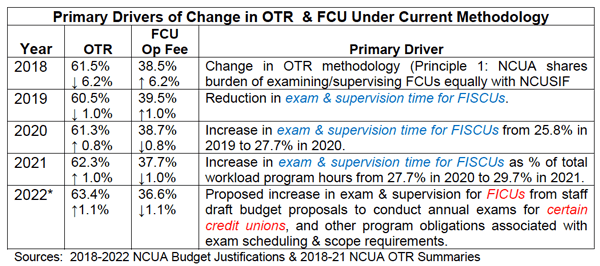
Ito made the comments this week during a public briefing and comment opportunity about the NCUA 2022 budget. The agency has proposed a 63.4% OTR for 2022, meaning that nearly two-thirds of the 2022 operating budget will be paid out of the share insurance fund (the remainder comes from federal credit union (FCU) operating fees). The operating spending plan – at $326 million — makes up 94.4% of the overall NCUA budget.
The 2022 OTR will be 110 basis points higher than the previous year’s and will be the third straight year that an increased transfer has been proposed by the agency (at 61.3% in 2020, 62.3% in 2021, and the proposed 63.4% for 2022).
Aside from taking funds from the insurance fund that could cover credit union losses, Ito said, there are two other reasons credit unions should monitor the OTR. First, NCUA’s use of NCUSIF dollars versus use of FCU operating fees to cover its expenses has the potential to imbalance the dual chartering system by disadvantaging the state system. “This is a threat to both state and federal credit unions,” she said, “because the dual charter framework is the credit union system’s most dynamic source of innovation and charter modernization.”
The third reason, she said, is the equity level of the insurance fund and the NCUA Board’s thought of raising the normal operating level (NOL) of the fund in anticipation of economic uncertainties related to the ongoing COVID-19 event. “Given the NCUA Board’s deliberations on changing the NOL to bolster NCUSIF equity, it behooves credit unions to monitor more than OTR as a mere formula used to transfer funds from the NCUSIF,” she said. “Credit unions should also be interested in what additional costs NCUA is now covering with NCUSIF dollars.”
Ito said her comments were made in the “pure spirit of state-federal regulator collaboration and in support of our shared objectives to foster a safe and sound and vibrant dual charter system that protects member-consumer best interests.”
In a nod to her impending retirement at year’s end, she thanked the board members for their “collegiality and commitment to forging a robust federal credit union system and a robust state credit union system” with state regulatory agencies during her seven-year run as NASCUS leader.
LINK:
President and CEO Lucy Ito Testifies on OTR During the 2022 NCUA Budget Briefing
(Nov. 24, 2021) The state system is seeking to provide its views of the proposed NCUA 2022 budget at the agency’s public briefing in two weeks, particularly the proposed increased in the overhead transfer rate (OTR) – for the third straight year — in the spending plan.
If approved, NASCUS President and CEO Lucy Ito will provide the state system’s perspective at the briefing, scheduled for Dec. 8 at 2 p.m. (and to be live-streamed via the Internet).
The overhead transfer rate (OTR) provides a portion of the funding for NCUA’s “operating budget” of $326 million (which makes up 94.4% of the overall agency budget). For 2022, the OTR will be set at 63.4%, according to the budget papers posted by NCUA. The transfer means that nearly two-thirds of the 2022 operating budget ($206.7 million) will be paid out of the share insurance fund. The remainder of the operating budget comes from “operating fees” paid by federal credit unions.
The OTR represents money that is transferred from NCUSIF to the operating budget of the agency to cover “insurance-related” expenses of the agency. The remainder of the operating budget is covered by the operating fee paid by federal credit unions.
NASCUS President and CEO Lucy Ito pointed out that the proposed 2022 OTR will be the third straight year that an increased transfer rate has been proposed by the agency (at 61.3% in 2020, 62.3% in 2021, and the proposed 63.4% for 2022). She also noted that the number of federally insured, state-chartered credit unions has been declining. At year-end 2019, there were (according to NCUA quarterly call report data) 1,953 FISCUs. By the end of the next year (2020), the number had fallen to 1,914. At mid-year 2021, total FISCUs were 1,886.
Federal credit union (FCU) numbers are also in decline, she noted – but there are still many more of those charters than FISCUs: 3,383 at year-end 2019, 3,185 at year-end 2020, and 3,143 at mid-year 2021.
LINK:
NCUA Posts 2022-2023 Proposed Budget, Sets Dec. 8 Public Briefing
(Nov. 19, 2021) A $345.3 million 2022 proposed budget, funded partially from an increased amount of funds transferred from the federal credit union savings insurance program, was posted this week by NCUA; a public briefing is set for Dec. 8, the agency said.
According to NCUA, its budget for next year is 1.2% higher than the previous year’s. However, components of the overall spending plan show significant changes from the previous year. For example, the agency’s capital budget (which funds such things as purchases of new equipment) is down 30.7% from the previous year (for a total of $13.1 million). The administrative budget for the National Credit Union Share Insurance Fund (NCUSIF) is down by 21.7% (to $6.2 million) from the previous year.
The overhead transfer rate (OTR), which provides funding for the NCUA’s “operating budget” of $326 million (and makes up 94.4% of the overall agency budget) will be set at 63.4%, according to the budget papers posted by NCUA. Essentially, that means the nearly two-thirds of the 2022 “operating budget” (or $206.7 million) will be paid out of the share insurance fund. The remainder of the operating budget comes from “operating fees” paid by federal credit unions.
The 2021 OTR, adopted in December last year, was 62.3%. NCUA acknowledges in its budget posting this week that the 2022 OTR will be 101 basis points higher than the previous year’s.
The OTR represents money that is transferred from NCUSIF to the operating budget of the agency to cover “insurance-related” expenses of the agency. The remainder of the operating budget is covered by the operating fee paid by federal credit unions.
NASCUS President and CEO Lucy Ito pointed out that the proposed 2022 OTR will be the second year in a row that the OTR has been increased by the agency. She also noted that, as the 2021 OTR was approved last December, that NCUA needed to reconsider how it allocates expenses.
LINK:
Agency Accepting Comments and Budget Briefing Presentation Requests
(Sept. 24, 2021) In other action Thursday, the NCUA Board:
- Approved “midsession budget review” action that will use a $15 million 2021 budget surplus (realized through savings on curtailed travel during the coronavirus pandemic) to add seven new positions to the agency’s employment roster, among other things. Those positions will be added to the agency’s cybersecurity program (three new positions), the NCUA Board secretary (one position), and the agency’s office of ethics counsel (three positions), taking up $11 million of the surplus. The balance will be “reprogrammed,” with $2.4 million going to address cybersecurity support, employee relocations, and “human capital analytical support” (for analysis of compensation plans and diversity/equity/ inclusion programs and practices), and approximately $1.6 million to cover employee leave payouts.
- Considered a staff projection that, by year’s end, a “residual budget balance” (or surplus) of about $24.6 million will be left, which the agency said “can be used to offset future budget needs by the agency.”
- Heard a quarterly report on the National Credit Union Share Insurance Fund (NCUSIF), which noted an equity ratio for the fund, as of June 30, at 1.23% — three basis points above the minimum allowed by law before a “restoration plan” (including assessment of a premium) can be established by the board, but well below the fund’s current “normal operating level” (NOL) of 1.38%. Along those lines, Board Member Hood said he wants the board to consider resetting the NOL to 1.3% at either the October or November board meetings (staff project the equity ratio to rise to 1.28% at the end of December 2021).
Regarding the budget review, NASCUS’ Lucy Ito urged NCUA to apply any surplus in 2021 to offset the overhead transfer rate (OTR) for 2022. “Additionally, surplus in the share insurance fund’s admin budget, which largely represents savings in state examiner training, should either be reserved for future training needs or also used to offset the OTR even more,” Ito said.
LINKS:
Board Briefing, Share Insurance Fund Quarterly Report
Oregon Member Business Lending Rule
NASCUS’ Lucy Ito discusses achievements and NASCUS, and the outlook for credit unions, during her interview with Mike Lawson, CUBroadcast.com (click on the arrow to view the complete video)
(June 4, 2021) Bringing attention to the overhead transfer rate (OTR) policies of NCUA, and securing authority for credit unions to issue subordinated debt, are two of the achievements NASCUS President and CEO Lucy Ito cited as attained during her tenure as leader of the state system organization during a video interview this week.
In May, Ito announced that she would retire from her position at the association, effective at the beginning of 2022.
Responding to questions from Mike Lawson of CUBroadcast (a web-based video interview program) Ito said that raising awareness of the OTR – the rate at which the agency transfers funds from National Credit Union Share Insurance Fund (NCUSIF) to cover insurance-related operating costs of the agency – ultimately resulted in the agency making changes to the formula for determining the rate.
In 2017, the NCUA Board voted to adopt a “simplified approach” to setting the rate, reflecting that “safety and soundness is not the sole domain of the insurer.” Reform of the OTR methodology had been a target for NASCUS and the state system for more than 20 years.
She also noted as an achievement the new subordinated debt rule, which was finalized by NCUA in December and is scheduled to take effect at the beginning of 2022. The rule would allow well-capitalized, federally insured credit unions to count subordinated debt as capital for risk-based net worth purposes. It was long sought by the state system, which has argued that such a rule would bring regulation of federally insured credit unions in line with regulations of some states that already allow their credit unions to issue secondary capital, including in the form of subordinated debt.
However, in her interview this week, Ito said the state system continues to look for changes in the rule. She noted the benefit of having a rule in place, and that “that’s something we can work with.”
In other comments during the 20-minute interview, Ito:
- Noted the common denominators of people who work in credit unions as being “service and duty.”
- Reflected on the commonalities of state regulators and leaders of credit unions, as both groups are service oriented and really feel a responsibility to protect and help others.”
- Suggested that the best way for the credit union community to succeed and maintain relevancy to consumers — in the face of mounting competition from such things as digital currencies and players such as PayPal – is collaboration among themselves and their related organizations (including associations). “Where there are shared problems, and shared objectives, let’s work together to address both,” she said.
(Dec. 23, 2020) A 2021 budget of $341.4 million – with an overhead transfer rate (OTR) of 62.3% — was approved by the NCUA Board on a split vote of 2-1 at its meeting late last week, with barely two weeks to go until that budget takes effect for the new year.
The agency’s budget for next year is down about 1.7% from the 2020 budget, but the OTR went up by 100 basis points. Board Chairman Rodney Hood and (now) Vice Chairman Kyle Hauptman voted for the 2021 budget; Member Todd Harper against it.
The OTR represents money that is transferred from the National Credit Union Share Insurance Fund (NCUSIF) to the operating budget of the agency to cover “insurance-related” expenses of the agency. The remainder of the operating budget is covered by the operating fee paid by federal credit unions, resulting in a split of 62.3% (from the OTR) and 37.7%, respectively.
NASCUS President and CEO Lucy Ito said the OTR increase for next year is a sign of the need for NCUA to reconsider how it allocates expenses.
In a press statement following last Friday’s board meeting, Ito said what appears counterintuitive to the state system in the 2021 NCUA budget is that the projected increase in workload for state exams is not matched with an at least equal if not greater increase in workload for federal credit union exams. She noted that assets between state and federal CUs are approximately equal, yet FCUs outnumber FISCUs by more than 1,000 (3,213 FCUs versus 1,920 FISCUs as of the end of the 2020 third quarter).
Further, she said, the 1-point OTR increase will essentially mean there will be $3.3 million less to cover losses by the National Credit Union Share Insurance Fund should those materialize as the result of an economic downturn due to the financial impact of the coronavirus pandemic
“NASCUS will continue to work with NCUA to allocate expenses to the OTR in a way that safeguards balance and equity, and that ensures that the insurance fund has the resources necessary to protect the savings of credit union members,” she said.
Along those lines, she added, NASCUS welcomes the formation of an OTR working group comprised of NCUA, state regulators, and NASCUS to assure transparency in and reasonableness of cost allocation assumptions to foster equity between federal and state credit unions.
LINKS:
Notice: Overhead transfer rate
Board action memorandum — 2020-2021 budget
NCUA 2021-2022 budget justification (Dec. 18, 2020)
(Dec. 18, 2020) With a rare second monthly meeting scheduled for today (Friday, Dec. 18), the full-complement NCUA Board will consider the 2021 budget for the agency, which includes an increase of 1 percentage point for the overhead transfer rate (OTR), the rate at which the agency transfers funds from the federal savings insurance fund to the operating budget of the agency to cover its “insurance-related costs.”
More coverage of the meeting, which ensues after NASCUS Report’s deadline, will be included in next week’s report.
The board is expected to approve the $342.5 million budget as proposed, although likely on a split vote. Board Member Todd Harper has voiced objection to the lack of funding for consumer protection compliance staff in the budget and has said he would not support the budget unless that funding was put into place. Board Chairman Rodney Hood has no such objections; newest Board Member Kyle Hauptman (a Republican appointee like Hood) is expected to follow Hood’s lead on the budget.
For its part, NASCUS has taken no position on the budget, except with respect to the increase in the OTR, which would be 62.3% in 2021 (up from 61.3% in 2020).
In testimony two weeks ago before the NCUA Board at its public briefing about the 2021 budget, NASCUS urged NCUA to consider making changes to how it allocates expenses through the OTR to insurance-related activities, in order to ensure balance, equity and that more funds are available to cover any losses that may occur due to the financial impact of the coronavirus crisis.
“The 1% increase in the OTR for 2021 means there will be $3.3 million less to cover losses by the fund,” NASCUS’s Lucy Ito told the board. She noted that NASCUS recognized its recommendations cannot be implemented for 2021, but that the state system hopes they would be considered for future budgets. “We want to work with NCUA,” she said.
Friday’s board session is scheduled to get underway at 10 a.m. ET, and is being live-streamed via the Internet.
LINK:
NCUA Board Agenda for the Dec. 18, 2020 meeting
Dec. 4, 2020) NCUA should reconsider how it allocates expenses to the federal insurance fund for credit unions to pay for agency operations, in order to safeguard balance, equity – and ensure that more funds are available to cover any losses that may occur due to the financial impact of the coronavirus crisis, NASCUS told the agency this week.
In a presentation before the NCUA Board, NASCUS’ Lucy Ito made two key recommendations for expense allocations made by NCUA to cover its “insurance related costs” paid for by the National Credit Union Share Insurance Fund (NCUSIF) through transfers to the agency’s operating budget. The transfers are made via the overhead transfer rate (OTR), which NCUA is proposing be 1 percentage point higher in 2021 from this year, or 62.3%. The OTR represents the rate at which NCUA transfers money from the insurance fund to its operating budget to cover insurance-related costs.
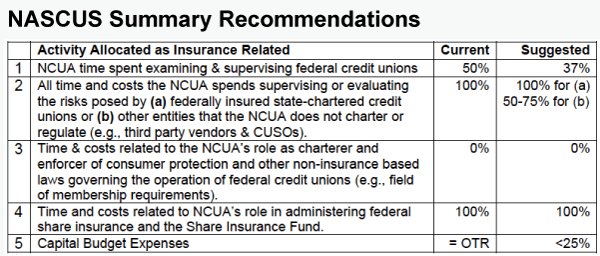
The two key recommendations Ito made were: reduce the amount of the funds transferred to cover costs for examining federal credit unions (FCUs) from 50% to 37% of those costs, and reduce the amount of funds transferred to cover costs of evaluating risks of entities that NCUA does not charter or regulate (such as third-party vendors and CUSOs) from 100% to a range of between 50% and 75%.
Ito, providing the state system’s view of the agency budget, focused in her remarks exclusively on the OTR and costs that are allocated to it by the agency. She was one of three to make presentations to the NCUA Board members attending the meeting, Chairman Rodney Hood and Member Todd Harper. The others making presentations represented the Credit Union Natl. Assn. (CUNA) and Natl. Assn. of Federally Insured Credit Unions (NAFCU).
In recommending changes to the expense allocations, Ito said every dollar the agency transfers from the fund to cover expenses of the agency in “insurance-related costs” is a dollar that is not available to pay for credit union losses that are likely to arise as a result of the financial impact of the pandemic.
“The 1% increase in the OTR for 2021 means there will be $3.3 million less to cover losses by the fund,” Ito said.
In other comments, Ito recommended the agency reconsider how it allocates expenses paid by the fund for capital budget costs of its operations. For example, Ito said, given increasing state agency assumption of computer and other capital costs, “it would seem that the insurance fund would carry a much smaller percentage of NCUA’s computer software and other capital charges than the agency allocates to its role as the FCU chartering authority.”
She also suggested that the agency work with state supervisory authorities to validate their time allocation assumptions that make up portions of the OTR calculations. “We noted in last year’s budget briefing we would very much welcome the opportunity to sit with NCUA and understand out how NCUA reconciles the budgetary OTR with actual time allocations,” she said, adding that the invitation remains open from the association.
LINK:
NASCUS presentation, NCUA 2021 budget briefing (Dec. 2, 2020)
(Nov. 20, 2020) NASCUS President and CEO Lucy Ito shared the board members’ call for vigilance, but also urged the agency to husband its resources, as NASCUS did in a comment letter last month. Writing to the agency on its proposed methodology to calculate the overhead transfer rate (OTR) – the rate at which the agency transfers dollars from the insurance fund to the agency’s operating budget to cover “insurance-related costs” – NASCUS wrote that a higher rate means the insurance fund has less resources to face financial troubles for credit unions.
“As we wrote earlier this month, every dollar the agency pulls from the insurance fund to cover the expenses of the agency is a dollar not available to cover credit union losses, such as those resulting from the financial impact of the coronavirus pandemic,” Ito said. “It also means that’s a dollar that may need to be replaced in the insurance fund through an insurance premium being charged.”
LINK:
NASCUS Comment: Request for Comment, OTR and Operating Fee Schedule Methodologies
(Nov. 20, 2020) NCUA joined the federal banking agencies Thursday in releasing a fact sheet meant to clarify Bank Secrecy Act due diligence requirements for credit unions and banks that offer services to charities and non-profits. The fact sheet, the agencies said in a release, highlights the importance of legitimate charities and nonprofit organizations having access to financial services. It also addresses the ability of those groups to transmit funds through legitimate and transparent channels, especially in the context of responding to the coronavirus. Further, the agencies said, the fact sheet clarifies that charities and nonprofit organizations as a whole do not present a “uniform or unacceptably high risk of being used or exploited for money laundering, terrorist financing, or sanctions violations, and that banks and credit unions must develop risk profiles that are appropriate for the risks presented by each customer” … With the Thanksgiving holiday coming up next week, look for NASCUS Report to be published on Wednesday, rather than Friday as per usual.
LINK:
Agencies release fact sheet clarifying BSA requirements with charities, non-profits