Financial struggles in Puerto Rico bite deeper than the rest of the United States
Our research shows that people in Puerto Rico have lower financial well-being compared to people in the rest of the United States, and they struggle more to make ends meet and participate in mainstream financial services. The CFPB works to ensure fair and equal access to financial products and services, especially among those who have been historically left out of full participation in the marketplace. This includes making a concerted effort to ensure that Puerto Rico and the territories are being analyzed and served just as other regions of the United States. In a recent study, we looked at how people living in Puerto Rico use financial products and services, as well as their financial well-being.
When landlords use information from a rental background check that qualifies as a “consumer report” against a tenant, they are required to tell the tenant of their decision and how to contact the company that created the background check. The federal housing agencies encourage landlords to provide this information to renters in writing. The United States Department of Housing and Urban Development, the Federal Housing Finance Agency, and the United States Department of Agriculture are reminding landlords of their obligation to inform tenants and prospective tenants of their rights. When landlords use information from a consumer report, like a rental background check, against a tenant, the Fair Credit Reporting Act requires landlords to tell the tenant of their decision and how the tenant can contact the company that created the background check. This obligation, known as the adverse action notice requirement, applies to any action against a tenant based on information from the background check, including denying a rental application, increasing the rent charged or security deposit, or requiring a co-signer. As the agencies state, providing this information in writing is the best way to ensure that tenants get the information they need, and for landlords to demonstrate they are meeting their legal obligations.
Looking at credit scores only tells part of the story – cashflow data may tell another part
Cashflow data (regular savings, accumulated savings, paying bills on time) helps predict ability to repay and repayment risk, even when accounting for credit scores. Most loan underwriting in the United States makes use of credit reporting data to evaluate repayment risk. Lenders frequently use third party credit scores, and many also develop their own proprietary models. Credit reporting data include individuals’ performance on a variety of credit products, such as mortgages, credit cards, auto loans, and student loans, as well as certain public records and some other forms of lending.1
The Consumer Financial Protection Bureau (CFPB) released a new Supervisory Highlights report which found unfair, deceptive, and abusive acts or practices across many consumer financial products. For example, auto lenders have originated loan balances above the real value of the car being purchased and engaged in illegal collection practices while servicing these loans. The latest edition of the Supervisory Highlights report covers findings from CFPB supervisory examinations completed from July 2022 to March 2023.
Director Chopra provided prepared remarks at an event hosted by the U.S. Department of Housing and Urban Development on tenant rights.
 Midsession Budget Reprograms Funds for Mission Critical Priorities
July 20, 2023 – The National Credit Union Administration Board held its seventh open meeting of 2023 and approved a final rule on member expulsion. The NCUA’s Chief Financial Officer also briefed the Board on the agency’s midsession budget, and the Board approved the reprogramming of surplus funds for priority and mission critical areas.
Final Rule Balances Member Rights and Congressional Intent
The NCUA Board unanimously approved a final rule that amends the standard federal credit union bylaws to adopt a policy by which a federal credit union member may be expelled for cause by a two-thirds vote of a quorum of the credit union’s board of directors.
“The final rule we are considering today strikes a balance between addressing the legitimate concerns over providing services to violent and disruptive members and providing due process rights to credit union member-owners. These rights include proper disclosures, hearings, and an appeals process,” NCUA Chairman Todd M. Harper said. “The powers granted in the Credit Union Governance Modernization Act must not be used as a tool to facilitate financial exclusion. What’s more, a federal credit union must ensure its implementation of the authority to expel members for cause is consistent and does not violate anti-discrimination laws or regulations.”
Under the Credit Union Governance Modernization Act of 2022, enacted by Congress on March 15, 2022, the NCUA had until September 15, 2023, to develop a final rule that federal credit unions may adopt to expel a member for cause.
The final rule is effective 30 days after publication in the Federal Register.
Reprogramming of Surplus Funds Supports Cybersecurity Specialists and Chartering Efforts
The Chief Financial Officer reported(opens new window) the NCUA will have an estimated $5.1 million surplus in the agency’s Operating Fund at the end of the year. Approximately one-third of the surplus is attributable to slightly lower-than-projected pay and benefit costs for 2023. Non-payroll categories, including travel, make up the remaining surplus.
The Chief Financial Officer recommended the NCUA Board approve the midsession reprogramming of $737,000 to fund four new cybersecurity support positions and two positions to assist with the NCUA’s field-of-membership and charter-expansion efforts. These reprogrammed funds will also support reasonable accommodations for employees and expenses associated with the background and security investigation for new hires.
The Board unanimously approved this request.
Said Chairman Harper, “These fiscally responsible and mission critical changes in our 2023 budget will ensure the NCUA, the credit union system, and the National Credit Union Share Insurance Fund can continue to adapt to the evolving financial, economic, and market conditions brought on by various external events and pressures, including growing cybersecurity threats and increasing applications for changes in federal credit union’s fields of membership.”
The Chief Financial Officer also reported that no Board action was needed on the capital budget and National Credit Union Share Insurance Fund’s operating budget. Additional information about the agency’s budget and expenses is available at https://ncua.gov/news/budget-supplementary-materials.
Board Meeting Speeches
 PUBLISHED
 CFPB Report Shows Workers Face Risks from Employer-Driven Debt
The Consumer Financial Protection Bureau (CFPB) published a report highlighting the risks employer-driven debt poses to workers. After a review of responses to the CFPB’s public inquiry, the analysis describes the growing prevalence of employer-driven debt and challenges workers and consumers face when they become indebted to an employer or an employer’s affiliate as a condition of employment. The issue spotlight delves into the use of training repayment agreement provisions (TRAPs), which can impede worker mobility, particularly when it comes to obtaining higher wages. Read more
The Consumer Financial Protection Bureau (CFPB) today sued lease-to-own finance company Snap Finance for deceiving consumers, obscuring the terms of its financing agreements, and making false threats. In a lawsuit filed in federal district court, the CFPB alleges that Snap Finance has offered and provided millions of “lease-purchase” and “rental-purchase” financing agreements in ways that have harmed consumers, including through misleading advertisements, insufficient disclosures, and interfering with consumers’ ability to understand the terms and conditions of its financing agreements. The CFPB further alleges Snap Finance’s illegal conduct continued in its servicing of those agreements, including misrepresenting consumers’ payment obligations and making false threats in collections. Read more
Today, Rohit Chopra, Director of the United States Consumer Financial Protection Bureau, and Didier Reynders, Commissioner for Justice and Consumer Protection of the European Commission, announced the start of an informal dialogue between the CFPB and the European Commission on a range of critical financial consumer protection issues. Read more
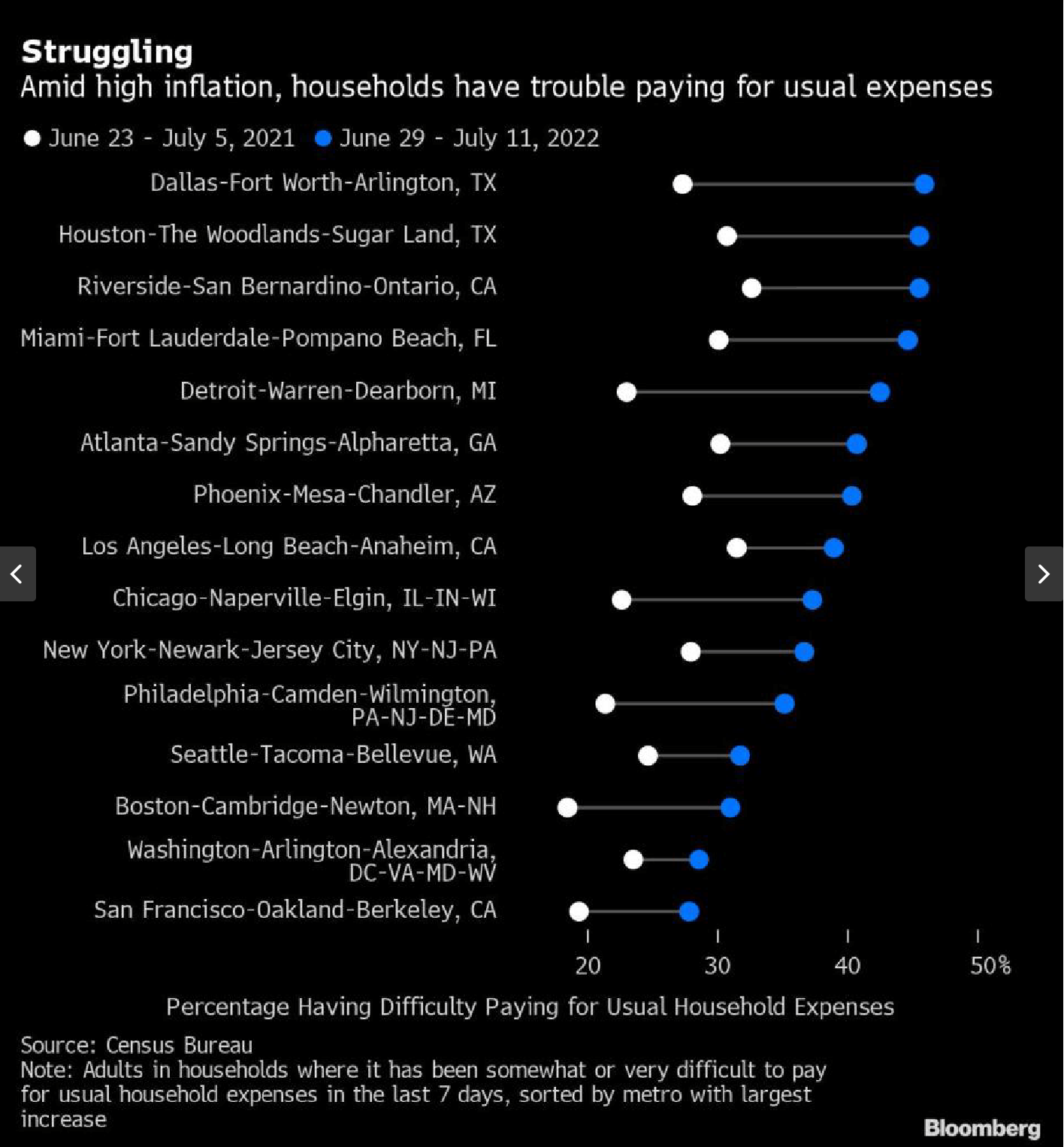 (Bloomberg) — The share of Americans who report having difficulties paying their bills has surpassed its 2020 pandemic peak in a US Census Bureau survey, underscoring the toll of soaring prices on budgets.
Four in ten adults said it has been somewhat or very difficult to cover usual household expenses in a poll conducted end of June and early July. That’s the highest since the Census started asking the question in August 2020. It implies that more than 90 million families are struggling, up from about 60 million a year ago.
When the Census first asked the question two years ago, a third of respondents reported difficulties in covering usual household bills. The share fell over the following year but started rising about a year ago after government pandemic relief ended and inflation took hold.
Millions of households with student loans are expected to face an additional monthly expense Sept. 1, when a Covid moratorium on servicing that debt ends.
The survey shows a sharp increase in financial stress in all of the country’s large metropolitan areas. In Dallas, for example, the share of respondents having difficulty paying bills jumped to about to 45.9% from 27.9% a year earlier. The share in Detroit rose by almost 20 percentage points.
A report last week from New York State Comptroller Thomas P. DiNapoli showed that one in eight residents were behind on paying their utility bills as of March. More than 1.2 million customers statewide owed $1.8 billion, with residents of New York City and Long Island accounting for 68% of the total.
The average amount owed by residents in the state doubled in two years, to $1,467 in March from $768 in March 2020.
“The pandemic’s effects continue to be felt in multiple aspects of life, including the elevated number of New Yorkers who continue to have trouble paying their utility bills,” DiNapoli said in the report.
Nationally, the latest Census survey shows that more than one third of households reduced or forwent expenses for basic household necessities, such as medicine or food, in order to pay an energy bill. More than one in five families kept their home at a temperature that felt unsafe or unhealthy for at least one month, and a similar share hasn’t been able to pay at least part of an energy bill.
Courtesy of Alex Tanzi, Yahoo Finance
After a decline in consumer spending during the pandemic, the end of government relief programs has contributed to an increase in credit card usage – and a rise in delinquencies.
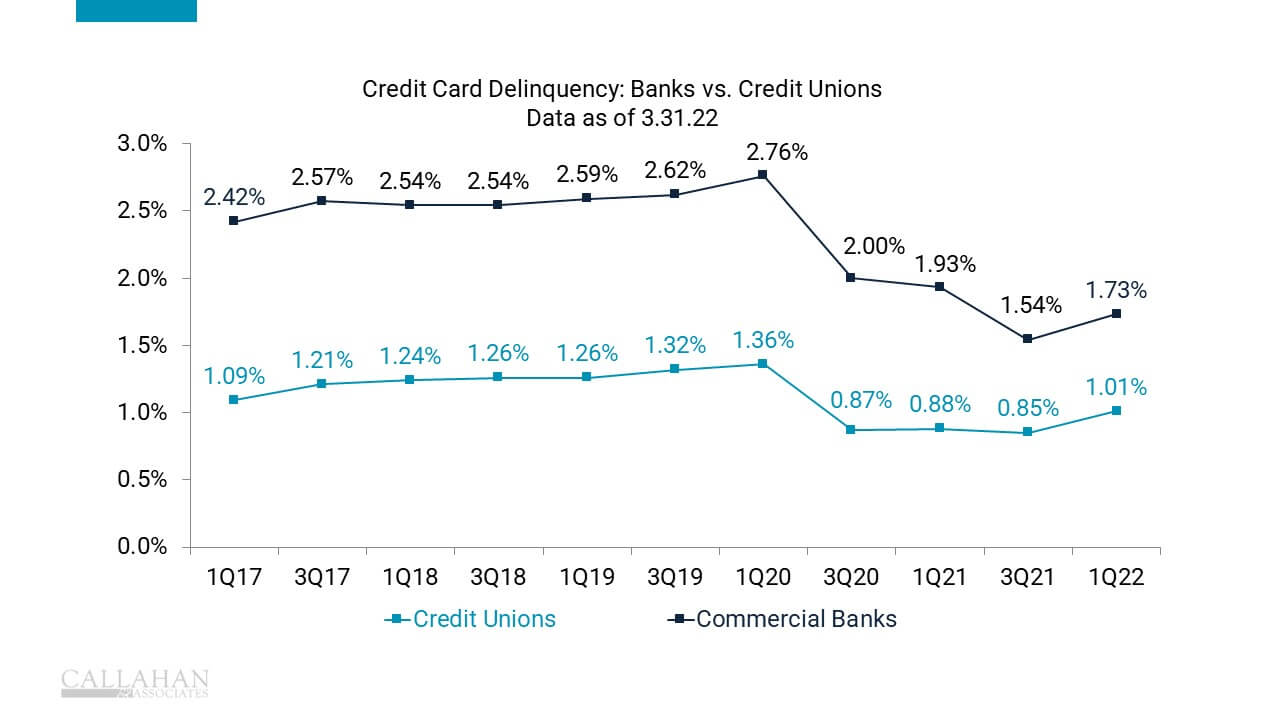
CREDIT CARD SPENDING, DELINQUENCIES RETURNING TO NORMAL FOR U.S. CREDIT UNIONS | DATA AS OF 03.31.22
© CALLAHAN & ASSOCIATES| CREDITUNIONS.COM
- Credit card delinquencies at credit unions and commercial banks are back on the rise after unexpectedly improving during the pandemic, thanks to expanded unemployment benefits and stimulus checks from the federal government.
- At just 1.01%, credit card delinquency rates at credit unions at the end of the first quarter were nearly three quarters of a point below their for-profit counterparts, though for now credit unions are closer to reaching pre-pandemic delinquency levels than banks.
- Delinquency rates at banks and credit unions alike have been on the rise for the last four quarters following the end of government-backed pandemic-relief programs.
- The increase in delinquencies is largely a good thing. Credit card spending among credit union members fell $5.8 billion during the first year of the pandemic as lockdowns and social distancing led to a decline in consumer spending.
Courtesy of Sophie Monroe, CreditUnions.com
 Cryptocurrency insider-trading case could have broad ramifications for industry.
Federal authorities brought the first-ever cryptocurrency insider-trading case Thursday, accusing a former Coinbase Global Inc. COIN 5.43%▲ manager of tipping off his brother and a friend with confidential information, and signaling in a companion case an aggressive new push to police digital tokens.
Prosecutors in Manhattan filed wire-fraud charges against the three men, and, at the same time, the Securities and Exchange Commission brought a civil case against them in which it alleged that nine cryptocurrencies, including seven that are currently available on Coinbase, are unregistered securities.
The SEC’s classification of the digital tokens as unregistered securities could have wide-ranging effects on the cryptocurrency industry and expose Coinbase and other platforms to new legal liabilities and regulatory requirements.
An indictment unsealed in federal court in Manhattan alleged that Ishan Wahi, a former product manager at Coinbase, his brother Nikhil Wahi and his friend Sameer Ramani netted about $1.5 million in illegal profits.
The Wahi brothers were arrested Thursday morning in Seattle. Mr. Ramani remained at large, prosecutors said.
“Our message with these charges is clear: fraud is fraud is fraud, whether it occurs on the blockchain or on Wall Street,” said Damian Williams, the U.S. attorney for the Southern District of New York.
Lawyers for Ishan Wahi said the charges were meritless. “Ishan Wahi is innocent of all wrongdoing and intends to defend himself vigorously against these charges and in the SEC action,” said lawyers Andrew St. Laurent and Marc Axelbaum.
Priya Chaudhry, a lawyer for Nikhil Wahi, said prosecutors were trying to criminalize innocent behavior “because they are looking for a scapegoat because so many people have lost money in cryptocurrency recently.”
A lawyer for Mr. Ramani couldn’t be identified.
Coinbase said in a statement on its blog that it had conducted an investigation on the three men and had provided information about the individuals to the Justice Department. The platform also said it fired Ishan Wahi.
“Coinbase takes this type of illicit behavior super seriously,” said Paul Grewal, the company’s chief legal officer. “We have zero tolerance for it.”
Mr. Grewal said Coinbase invests heavily in systems and policies to prevent employees from taking advantage of confidential information, such as asset-listing plans.
Ishan Wahi, who worked on Coinbase’s asset-listing team, had advance knowledge of the timing and public announcements of assets the exchange planned to list, prosecutors alleged. He was one of a small number of employees who belonged to a private messaging channel used to discuss launch dates and timelines, according to the indictment.
Starting in June 2021, the three defendants used the confidential information to make trades in advance of at least 14 public-listing announcements by Coinbase, the indictment alleged. The men concealed the trades through a web of crypto accounts and anonymous digital wallets, prosecutors alleged.
Some of the trades drew public scrutiny. In April, a Twitter account well known in the crypto community flagged the purchase of hundreds of thousands of tokens about 24 hours before they were named in a public-listing announcement, prosecutors alleged. Later in the month, Coinbase said it was investigating whether someone inside the company had leaked confidential company information.
On May 11, the exchange’s security-operations director emailed Ishan Wahi, telling him to attend an in-person meeting, prosecutors said. The day before the meeting, Mr. Wahi bought a one-way flight to India scheduled to depart the next day, according to prosecutors. They said that before the flight departed, Mr. Wahi called and texted his brother and Mr. Ramani about Coinbase’s investigation.
Law-enforcement agents stopped Mr. Wahi and prevented him from leaving the country, according to prosecutors.
The case is the latest signal that federal prosecutors in Manhattan are making an enforcement push on alleged insider-trading schemes of digital assets. Prosecutors last month charged a former employee of an NFT marketplace with using inside information to profit on NFTs, or nonfungible tokens.
The SEC charges are likely to turn up the pressure on Coinbase, which had previously disclosed it was under investigation by the agency. SEC Chair Gary Gensler has said he plans to pursue enforcement actions against crypto-trading platforms that facilitate trading in unregistered securities.
Thursday’s civil complaint marked the first time the SEC under Mr. Gensler has formally identified cryptocurrencies it believes to be securities that are offered on a major trading platform. It raises the possibility that Coinbase could face penalties for violating federal laws that require securities exchanges to register with the SEC.
Coinbase disputed the SEC’s assessment and criticized the agency’s decision to get involved in the case.
Mr. Grewal, Coinbase’s chief legal officer, said the firm has no plans to remove the cryptocurrencies from its trading platform.
“We have reviewed these assets carefully in advance of our listing,” he said, though he declined to share the firm’s legal analysis.
For each of the cryptocurrencies it alleged to be securities, the SEC applied a legal test developed by the Supreme Court in the 1940s. The commission said the tokens were all offered and sold to investors by issuers hoping to raise money. The issuers and promoters of the offerings touted the potential profits that investors might earn from the assets based on the efforts of others, the SEC said in its complaint.
“Those realities affirm that a number of the crypto assets at issue were securities, and, as alleged, the defendants engaged in typical insider trading,” SEC enforcement chief Gurbir Grewal said.
Courtesy of Corinne Ramey, James Fanelli, and Paul Kiernan, Wall Street Journal
Budget Briefing
The NCUA board was briefed on the budget and current operating budget surplus. The surplus is primarily from lower staffing levels and vacancy rates resulting in decreased pay and benefits and continued travel reduction. The board anticipates this to shift as they fill vacant positions and travel ramps up into 2023.
There was also discussion surrounding transparency over the 2023 budget to ensure an opportunity for the industry to ask questions etc. The anticipated release to the public of the 2023 proposed budget is expected to be the end of September.
Vice Chair Hauptman also inquired if there would be a reduction in the operating fee imposed to credit unions due to the surplus.
Final Rule Parts 700,701,702,708a, 708b, 750 and 790 – Asset Threshold for Determination the Appropriate Supervisory Office – (Final ONES Rule)
As expected, at the NCUA Board meeting today, the board members unanimously passed a final rule regarding ONES supervision. Vice Chair Hauptman expressed his concerns that the rule doesn’t go far enough in terms of regulatory relief and pushed the board to identify means of regulatory relief for well-run institutions in a future discussion. Board Member Hood agreed and stated this isn’t the end of this rule, and it’s likely to see further iterations down the road as they continue to evaluate the industry as it evolves.
- No substantive changes to the final rule from the proposed rule.
Proposed Rule Part 748 – Cyber Incident Notification Requirements
Also, as expected, the board unanimously approved a proposed rule under Part 748 addressing cyber incident notification requirements, similar to those of the federal banking regulators. The timing for notification would be 72 hours from the date a FICU determines an incident has occurred.
From the NCUA: NCUA Board Issues Proposed Rule on Cyber Incident Reporting Requirements
The proposed rule and request for comment will have a 60-day comment window upon publication in the Federal Register. The NCUA has stated that to be reported, an incident must be considered “substantial.” The definition of what is considered “substantial” will be included in the request for public comment. It was discussed at the meeting that 3 incident types would be deemed substantial and reportable incidents:
- Federally Insured Credit Union identifies substantial loss of confidentiality/sensitive data as a result of unauthorized access/disruption of member services or integrity of a network or changed
- cyber-attack or exploitation of a vulnerability that disrupts business operations/member services
- Third-party service provider informs credit union data compromised by the third party – or upon a CU forming reasonable belief of compromise by a third party (whichever comes first)
Vice Chair Hauptman requested that if/when the rule is finalized, the NCUA must send out something directly to the industry – not just on the website – outlining examples of when to report and incidents that would not require reporting
 Bank of America (BAC.N) has set aside around $200 million for a regulatory matter connected to the unauthorized use of personal phones, its chief financial officer Alastair Borthwick said on Monday, adding that he expects the matter to be settled soon.
Last year, Reuters reported that the U.S. Securities and Exchange Commission (SEC) was looking into whether Wall Street banks have been adequately documenting employees’ work-related communications, such as text messages and emails, during the work-from-home period of the pandemic. read more
The remainder, roughly $200 million, is earmarked for other probes into how the bank kept track of employee communications on their personal devices, like cell phones, Borthwick said.
“The balance of the expense relates to an industry-wide issue and it concerns the use of unapproved personal devices,” he said on a call with reporters. “We hope to finalize that in the coming weeks,” he said.
During its second-quarter earnings on Monday, Bank of America recorded $425 million in expenses to address regulatory matters, $225 million of which related to federal regulatory fines issued last week over the bank’s handling of pandemic jobless benefits, Borthwick said. read more
In December, the SEC and the Commodity Futures Trading Commission fined J.P. Morgan Securities $200 million for “widespread” failures to preserve staff communications on personal mobile devices, messaging apps and emails. read more
Other major investment banks including Morgan Stanley (MS.N) and Citigroup (C.N) have also put aside cash to cover similar expected fines, the banks have said.
Regulators require banks to keep records of all business-related communications and as a result financial firms typically ban the use of personal email, texts and other social media channels for work purposes, although bankers do not always comply with those rules.
The SEC’s head of enforcement has said banks’ failure to fully record all staff communications has hampered its probes into other, unrelated issues.
Courtesy of Elizabeth Dilts Marshall, Reuters
 The gains in the amount spent far outpace gains in the number of transactions.
PSCU reported Tuesday that the value of purchases it handles for affiliated credit unions rose much faster than the number of transactions in June, which it said indicated inflation was a growing factor in purchasing growth.
The St. Petersburg, Fla., payments CUSO found members whose credit unions use PSCU services spent 16% more by credit cards in value and 12% more in the number of transactions in June than they did in June 2021. By debit, they spent 7% more by value and 3% more by number.
“While overall consumer spending remained strong throughout June, current inflationary pressures are keeping growth in purchases outpacing growth in transactions,” Brian Scott, PSCU’s chief growth officer, said.
The U.S. Bureau of Labor Statistics reported July 13 that inflation rose a seasonally adjusted 1.3% from May to June, and rose 9.1% from June 2021 to June 2022 — the largest 12-month gain since November 1981.
“With another record Consumer Price Index increase announced this month, the Federal Reserve is under continued significant pressure to tame soaring inflation,” Scott said.
Overall spending by credit union members served through PSCU seemed to trend higher that retail spending among all U.S. consumers.
The U.S. Census Bureau reported July 15 that retail spending — excluding automobiles, auto parts and gasoline — rose 7% from June 2021 to June 2022. The seasonally adjusted increase from May to June was 0.7%.
In particular categories, the 12-month gains reported by PSCU bracketed those reported by Census:
- Grocery spending rose 8.9% from June 2021 to June 2022, according to the Census Bureau. PSCU reported a purchase gain of 15% by credit and 5% by debit. Transactions rose 11% by credit and 2% by debit.
- Gasoline spending rose 49.9%, according to the Census Bureau. PSCU reported purchase gains of 59% by credit and 35% by debit. Transactions rose 15% by credit and 5% by debit.
- Restaurant spending rose 13.7%, according to the Census Bureau. PSCU reported purchase gains of 20% by credit and 6% by debit. Transactions rose 16% by credit and 2% by debit.
PSCU’s July Payments Index found the average credit card balance for June 2022 was $2,733, up 3.5% or $93 from June 2021. June marked the fourth consecutive month in which year-over-year growth was over 2%.
PSCU’s numbers reflected the national pattern for both credit unions and banks. Credit card balances dwindled after COVID-19 was declared a pandemic in March 2020, and had remained below the February 2020 mark for more than two years.
However, balances have been rising this year. The Fed’s G-19 Consumer Credit Report released July 8 showed May balances at both banks and credit unions had finally exceeded their February 2020 levels. NAFCU Chief Economist Curt Long said then that high inflation is one reason he expects credit card balances to grow quickly through the rest of the year.
The credit card delinquency rate for June was 1.54%, 20 basis points lower than pre-pandemic June 2019 levels.
PSCU’s report was based on data from credit unions that have been processing payments with PSCU since January 2020. It encompassed 2.8 billion transactions valued at $140 billion of credit and debit card activity in the 12 months ending June 30.
Courtesy of Jim DuPlessis, Credit Union Times
 As a benefit for all NASCUS members, this digital platform provides a searchable data catalog of state credit union regulatory agencies (structure, funding, examination programs) and key state credit union powers including: chartering, enforcement authority, field of membership, interstate operations, parity, investment powers, board governance, CUSO powers, supplemental capital, derivatives authority, privacy, usury, tax treatment and more.
Project-launch data points are based on the previous 2016 Profile model and are continuously being updated in real-time by our 45 Supervisory partners.
NASCUS members can access data by clicking on the “Database Search” by clicking on the button below. (Login required)
Select the dropdown preferences based on the section topic and the state(s) of interest, then press “search.” Once the results pop up, use the “export” or “print” features on the right side to save your search findings.

Regulators updating information can access their state-specific portal by clicking here.
sCourtesy of Colby Smith, Financial Times
Minutes from June meeting suggest even tighter monetary policy may be needed from US central bank.
 Top Federal Reserve officials think entrenched inflation is a “significant risk” to the US economy and fear tighter monetary policy will be needed if price growth exceeds their expectations, according to an account of their most recent meeting. The minutes of the US central bank’s June meeting, when the Fed delivered the first 0.75 percentage point rate rise since 1994, also showed that policymakers now support raising interest rates to the point at which economic activity is restrained, with the possibility that they could become “even more restrictive” if warranted by the data.
“Many participants judged that a significant risk now facing the committee was that elevated inflation could become entrenched if the public began to question the resolve of the committee to adjust the stance of policy as warranted,” the minutes said.
The notes from the Federal Open Market Committee, which were released on Wednesday, revealed the alarm spreading through the top ranks of the US central bank over inflation, which is running at an annual pace of 8.6 percent. The account also showed the lengths officials were willing to go to ensure prices do not spiral also showed the lengths officials were willing to go to ensure prices do not spiral further out of control.
The Fed will decide whether to raise rates by 0.50 percentage points or 0.75 percentage points at its meeting this month, although several officials have indicated their support for the larger increase.
“If inflation becomes entrenched in consumer and business psyches, it will be much more difficult to lower it over the medium term,” said Kathy Bostjancic, chief US economist at Oxford Economics. “That is the breaking point for [the Fed], and they really want to do their best to ensure that it doesn’t happen.”
She added: “The longer inflation remains high, the more it will become embedded in expectations.”The minutes showed that participants were increasingly aware that their plans to tighten monetary policy would slow the pace of economic growth. Most noted that the risks to the outlook were “skewed to the downside” given the possibility that further tightening could weigh on activity.
The minutes echoed recent comments from Fed chair Jay Powell, who has emphasized that the central bank has little room for maneuver as it tries to tame inflation without causing widespread job losses.
A US recession is now “certainly a possibility”, and would in large part depend on factors outside of the Fed’s control, he said last month, pointing to the war in Ukraine and prolonged Covid-19 lockdowns in China.
Powell reiterated that message last week on a panel with other central bankers, when he warned that a failure to restore price stability would lead to an even worse outcome for the US economy.
Click here to read the entire article.
Financial Crimes Enforcement Network (FinCEN), Treasury
ACTION: Advance notice of proposed rulemaking. No-Action Letter Process
TOPIC: FinCEN is issuing this advance notice of proposed rulemaking (ANPRM) to solicit public comment on questions relating to the implementation of a no-action letter process at FinCEN. Given that the addition of a no-action letter process at FinCEN may affect or overlap with other forms of regulatory guidance and relief that FinCEN already offers, including administrative rulings and exceptive or exemptive relief, this ANPRM, among other things, seeks public input on whether a no-action letter process should be implemented and, if so, how the no-action letter process should interact with those other forms of relief.
DATES: Comments must be received by August 5, 2022.
Click here to read the full NASCUS Summary (Member login required.)
BUREAU OF CONSUMER FINANCIAL PROTECTION ( 12 CFR Part 1006) Debt Collection Practices (Regulation F); Pay-to-Pay Fees
ACTION: Advisory opinion
TOPIC: Section 808(1) of the Fair Debt Collection Practices Act (FDCPA or Act) prohibits debt collectors from collecting any amount (including any interest, fee, charge, or expense incidental to the principal obligation) unless that amount is expressly authorized by the agreement creating
the debt or permitted by law. The Consumer Financial Protection Bureau (CFPB) issues this advisory opinion to affirm that this provision prohibits debt collectors from collecting pay-to-pay or ‘‘convenience’’ fees, such as fees imposed for making a payment online or by phone, when those fees are not expressly authorized by the agreement creating the debt or expressly authorized by law. This advisory opinion also clarifies that a debt collector may also violate section 808(1) when the debt collector collects pay-topay fees through a third-party payment processor.
DATES: This advisory opinion is effective on July 5, 2022.
Click here to read the full NASCUS Summary (Member login required.)
BUREAU OF CONSUMER FINANCIAL PROTECTION
ACTION: Request for Information Regarding Employer-Driven Debt
TOPIC: The Consumer Financial Protection Bureau (CFPB or Bureau) is charged with monitoring markets for consumer financial products and services to ensure that they are fair, transparent, and competitive. As part of this mandate, the CFPB is seeking input from the public on debt obligations incurred by consumers in the context of an employment or independent contractor arrangement. Areas of inquiry include prevalence, pricing and other terms of the obligations, disclosures, dispute resolution, and the servicing and collection of these debts.
DATES: Comments must be received by September 7, 2022.
Click here to read the full NASCUS Summary (Member login required.)
BUREAU OF CONSUMER FINANCIAL PROTECTION
ACTION: Advance notice of proposed rulemaking. Credit Card Late Fees and Late Payments
TOPIC: In order to support its rulemaking and other functions, the Consumer Financial Protection Bureau (Bureau or CFPB) is charged with monitoring for risks to consumers in the offering or provision of consumer financial products or services, including developments in markets for such products or services. As part of this mandate, the Bureau is seeking information from credit card issuers, consumer groups, and the public regarding credit card late fees and late payments, and card issuers’ revenue and expenses. For example, the Bureau is seeking information relevant to certain provisions related to credit card late fees in the Credit Card Accountability Responsibility and Disclosure Act of 2009 (CARD Act or the Act) and Regulation Z. Areas of inquiry include: factors used by card issuers to set late fee amounts; card issuers’ costs and losses associated with late payments; the deterrent effects of late fees; cardholders’ late payment behavior; methods that card issuers use to facilitate or encourage timely payments, including autopay and notifications; card issuers’ use of the late fee safe harbor provisions in Regulation Z; and card issuers’ revenue and expenses related to their domestic consumer credit card operations.
DATES: Comments must be received by July 22, 2022.
Click here to read the full NASCUS Summary (Member login required.)