Courtesy of Tanya Kaushal, YahooFinance
Weed legalization has become increasingly common in the U.S., despite the fact that marijuana is still illegal on a federal level.
As of April 20, 20 states and the District of Columbia have legalized weed for recreational use while 27 states allow it for varying medicinal purposes. Three states — Idaho, Kansas, and Nebraska — prohibit it entirely.
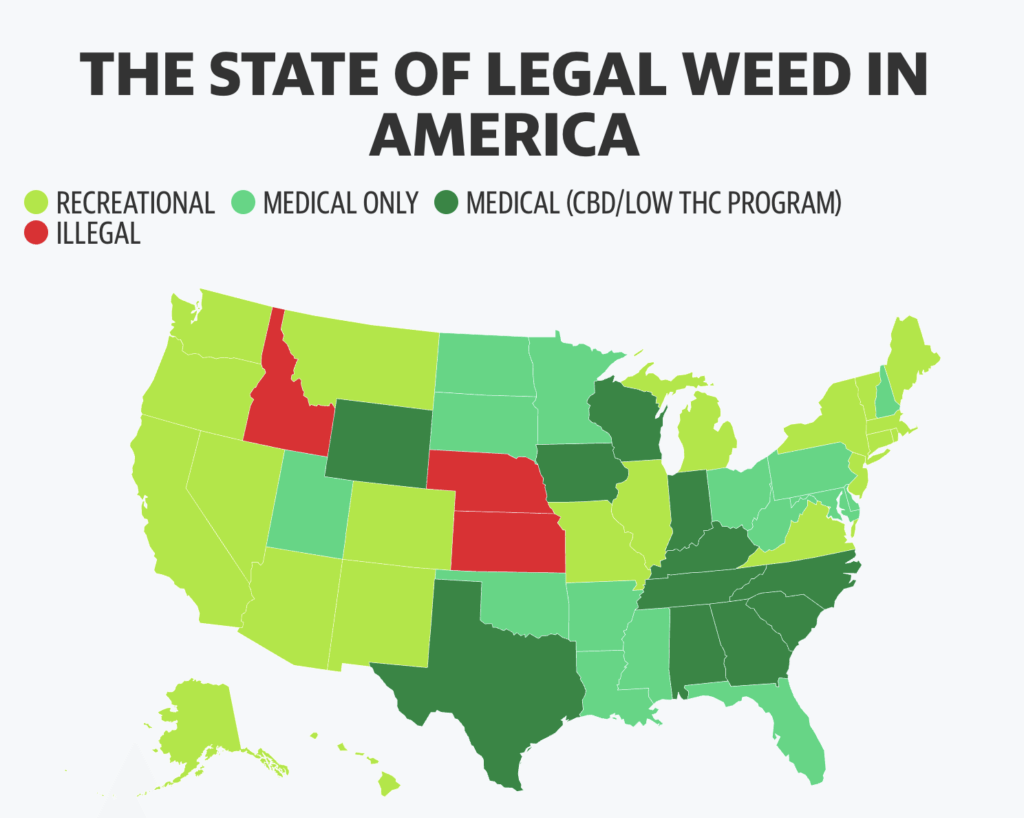
SOURCE: NATIONAL COUNCIL OF STATE LEGISLATURES
Among the states that have legalized weed to any degree, “none of these states have ever repealed or even rolled back their laws, and public support for these policies has never been higher,” Paul Armentano, deputy director of Norml, a non-profit lobby for cannabis legalization, told Yahoo Finance. “That is because these policies are largely working as politicians and voters intended, and they are preferable to prohibition.”
A strong majority of Americans support the legalization of cannabis. An October 2022 survey from Pew Research found that 59% of adults support legalizing marijuana for both medical and recreational use while 30% support it solely for medical use.
There is clear bipartisan support for legalization: A January 2023 poll conducted by the Coalition for Cannabis Policy, Education and Regulation found that 68% of likely Republican voters support federal cannabis reform.
“It is time for lawmakers, and federal lawmakers in particular, to set aside their ‘canna-bigotry’ and comport the law in a manner that is consistent the available science, majority public opinion, and the plant’s rapidly changing cultural status,” Armentano said.
Armentano added that it is important for cannabis policy to “legalize, regulate, and educate,” which helps reduce the risks associated with cannabis abuse and an unregulated market.
 Register today: 2023 Cannabis Banking Symposium
Join us June 27-28, 2023, for our signature cannabis banking event. Network with state and federal regulators, credit union leaders, cannabis experts, and industry stakeholders in a two-day, collaborative deep-dive into the cannabis banking landscape environment.
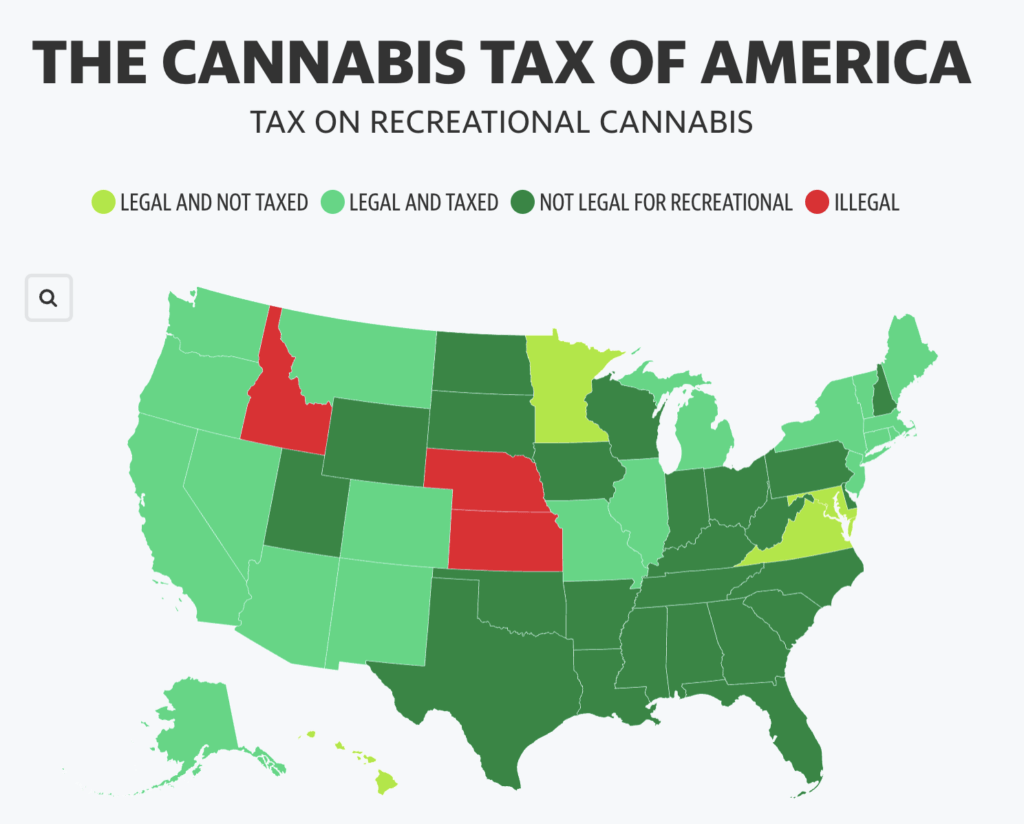
SOURCE: URBAN INSTITUTE • Hawaii, Maryland, and Virginia recently legalized recreational cannabis but taxation hasn’t begun yet.
The cannabis tax
National and global cannabis demand is increasing. It is projected that the U.S. cannabis market could see sales reaching $57 billion to $72 billion by 2030, according to a report from New Frontier Data.
States that have legalized marijuana have used the opportunity to generate revenue.
So far, 19 states levy a “cannabis tax” for the sale of recreational weed. Between July 2021 and June 2022, 11 states collected up to $774 million in state cannabis taxes, the highest being Washington and Colorado on a per capita basis.
“The main lesson we’ve learned so far from state cannabis taxes is that tax design matters,” Adam Hoffer, director of excise tax policy at the Tax Foundation, told Yahoo Finance. “The revenue potential from cannabis taxes is significant. A simple, low-rate, and low-cost tax system has the potential to raise significant amounts of revenue, while simultaneously decreasing social harms from cannabis by bringing illicit market transactions into a legal market framework.”
Hoffer explained that many states have opted for an “ad valorem tax” or a “sales tax based on the transaction price.” This tax relies on the value of the product and typically changes every year, most commonly used for properties. It fluctuates based on market prices.
With a larger cannabis supply chain, if the price falls, tax collection will fall too. Hoffer explained that taxes “based on product weight and potency would have far less volatility.”
There are currently five states — Alaska, Colorado, Maine, Nevada, and New Jersey — that use a weight-based cannabis tax. Aside from New Jersey, which taxes the different parts of the cannabis plant based on potency, the other four states tax the grower directly, according to the Urban Institute.
Still, federal cannabis policy views the drug as illicit, and therefore, the varying taxation in states has resulted in losses for cannabis businesses. Last year, the largest publicly-traded cannabis companies in total lost $550 million.
State of Cannabis: Understanding the Regulatory and Enforcement Framework in The US and Canada
We present a three-part series outlining the legal environment, the business, and the financial relationships of the cannabis industry. The three workshops delve into the AML/CFT requirements of the cannabis industry. In Workshop 1, we examine the legal landscape. Later, in workshops 2 and 3, we develop the best in class financial crime compliance program as we prepare for audits and examinations from regulators and financial institutions.
March 30, 2022 | 12:00pm –2:00pm ET
Click here to register and learn more.

NASCUS is hosting a 2022 Cannabis Symposium June 14-15, devoted specifically to the cannabis landscape. This event was handcrafted to provide financial institutions with the latest updates, best practices, and insights surrounding the cannabis industry.
Engage with these and other leading-edge experts
- State Cannabis Legalization: Today and Tomorrow panelists Zane Gilmer TDB Partner, Stinson LLP; Katrina Skinner, General Counsel, Chief Banking Officer, Simplyfia; and David C. Bass Partner, KNCH LLP
- Cannabis and Insurance expert Scott Eckburg, CEO CC Insurance
- Cannabis Banking: Lessons Learned and Board Governance panelists Todd Gunderson, CEO, CU1 and Karla Haglund, CEO, Live Life Federal Credit Union
- Hemp Banking Update expert Zane Gilmer, Partner, Stinson LLP
and more…
Event attendees can visit the event Hub to download presentations from their favorite sessions. Click on the button below to join the Hub. Once on the “sessions” page, click and scroll to the bottom of your preferred session to download.

With special guest, NCUA Board Member, the Honorable Rodney E. Hood.
The US legal cannabis industry is predicted to top $30 billion in 2022. As a result, the demand for banking services will continue to intensify. Credit unions need to understand the complicated policy questions related to the cannabis industry and every examiner needs to have a working understanding of the state-licensed cannabis industry to understand a credit union’s true risk profile in states where marijuana has been legalized.
Throughout the entire symposium, understand the critical role vendors can play in enhancing a program and how to determine whether third-party assistance or self-contained compliance is the best path forward. And of course, the hot spots of compliance and audit will be explored for financial institutions and examiners.
- State Cannabis Legalization: Today and Tomorrow
- Cannabis, Insurance, and Data Analytics
- Hemp Banking Updates
- Cannabis Banking: Lessons Learned and Board Governance
- Compliance Considerations
Conference Admission Price:
- $700 members
- $850 non-members
Location: Gaylord Rockies Resort & Convention Center
6700 North Gaylord Rockies Boulevard, Aurora, CO 80019
phone: (720) 452-6900
Hotel block reservations: Click here to access the event hotel block booking website
- Hotel Reservation cut off: May 23, 2022
- Check-in on Monday, June 13
- Depart on Wednesday, June 15
Room Rate: $229 per night
 Agenda
Tuesday, June 14, 2022
7:30 am – 8:00 am Breakfast and Registration
8:00 am – 8:15 am Opening Remarks
Mark Valente, Commissioner of Financial Services, Colorado Department of Regulatory Agencies; Division of Financial Services
Mike Williams, President/CEO, Colorado Credit Union
The Honorable Rodney Hood, NCUA Board Member
8:15 am – 9:15 am State Cannabis Legalization: Today and Tomorrow
Panel Discussion:
Zane Gilmer TDB Partner, Stinson LLP,
Katrina Skinner, General Counsel, Chief Banking Officer, Simplyfia
David C. Bass Partner, KNCH LLP
- The discussion will survey the latest developments in state legalization initiatives. Panelists will share their perspectives of the legal, political, and philosophical paths ahead.
9:15 am – 10:15 am Cannabis Banking: Lessons Learned and Board Governance
Todd Gunderson, CEO, CU1
Tim Rademaker, CEO, Trellis LLC
- Financial institutions that serve MRBs/CRBs will share their perspectives: lessons learned, board governance, pitfalls, & what banking cannabis means to them.
10:15 am – 10:30 am Comfort Break
10:30 am – 11:30 pm Cannabis and Data Analytics
Adam Crabtree, NCS Analytics
- In this changing and dynamic market, data analytics is key to understanding the cannabis industry.
11:30 am – 12:30 pm Cannabis Payments
Tyler Beuerlein, Strategic Business Development Officer, Safe Harbor Financial
12:30 pm – 1:30 pm Lunch
1:30 pm – 2:30 pm Hemp Banking Updates
Zane Gilmer, Partner, Stinson LLP
- If you are currently banking or contemplating banking hemp-related businesses, attendees must understand the unique nuances of the hemp industry and current regulatory updates everyone should know.
2:30 pm – 2:45 pm Comfort Break
2:45 pm – 3:30 pm Vendor Spotlight Green Check Verified
Mike Kennedy, Founder
- Cannabis Banking Compliance Software
3:30 pm – 4:30 pm Cannabis Banking and NCUA’s Current Take on Legalization
The Honorable Rodney Hood, NCUA Board Member
4:30 pm – 4:45 pm The Day’s Wrap-up
Wednesday, June 15, 2022
7:30 am – 8:15 am Breakfast and Registration
8:15 am – 8:30 am Opening Remarks
8:30 am – 9:45 am State and Federal Agency Views on Cannabis Banking
Mark Valente, Commissioner of Financial Services, Colorado Department of Regulatory Agencies; Division of Financial Services
Rebecca Laurie, Stakeholder and Innovations Strategist, Colorado Division of Financial Services
9:45 am – 10:30 am Vendor Spotlight Shield Compliance
Jenna Meyer, Director of Client Success
- Cannabis Compliance Software
10:30 am – 10:45 am Comfort Break
10:45 am – 11:30 am Cannabis and Insurance
Scott Eckburg, CEO Colorado Commercial Insurance
- Whether bond insurance for the financial institution or the myriad of business insurance products the financial institution would expect to find in the MRBs/CRBs, understanding the cannabis business model necessitates understanding its insurance coverage.
11:30 am – 12:30 pm Compliance Considerations
Panel Discussion:
Carole McCormick, Chief Compliance Officer NorthBay Credit Union and President of Higher Growth
Deirdra O’Gorman, CEO, DX Consulting and Empyreal Logistics
Katrina Skinner, General Counsel, Chief Banking Officer, Simplyfia
- This session will review the compliance program considerations for banking MRBs/CRBs. With industry changes, it is important to keep up with the latest trends and issues.
12:30 pm – 1:30 pm Lunch
1:30 pm – 2:15 pm Vendor Spotlight DocFox
Angela Limoncelli, Director of Marketing
- Cannabis Compliance Software
(Nov. 12, 2021) A bipartisan group of 24 governors and other top officials called on the Congress this week to include the SAFE Banking Act – legislation supported by the state system to provide clarity to financial institutions seeking to serve legitimate cannabis businesses – as an amendment to the military funding bill now pending in Congress.
The governors, territorial leaders and the mayor of the District of Columbia – 20 Democrats and four Republicans – said the SAFE Banking Act has “more bipartisan support than ever before.”
The legislation has passed the House but has not been taken up in the Senate. It would provide a safe harbor for credit unions and banks serving cannabis businesses in states where it is legal. More than 35 states have legalized cannabis for medical or adult use. However, federal law prohibits credit unions and banks from safely banking cannabis businesses, including those that provide them with goods and services.
The state and territorial leaders argued that the bill should be added to the National Defense Authorization Act (NDAA), must-pass legislation by year’s end to essentially keep the military funded. The House has added the provision to its version of the NDAA; the Senate has not yet acted. The state leaders wrote that the issue was one of public safety.
“Medical and recreational cannabis sales in the U.S. were estimated to total $17.5 billion last year, but because of antiquated federal banking regulations, almost all cannabis transactions are cash-based,” the leaders wrote. “Not only are cash-only businesses targets for crime, cannabis businesses are further disadvantaged compared to other legal businesses by being unable to open bank accounts or obtain loans at reasonable rates. The cannabis industry is legal in some form in the majority of U.S. states and it is too large of a market to be prohibited from banking opportunities.”
LINK:
(June 11, 2021) Marijuana and hemp are the subjects of a three-day virtual conference, sponsored by NASCUS, which wraps up today after delving into a wide variety of subjects about offering financial services in the fast-developing industry.
More than two dozen speakers are featured at the event (including NCUA Board Member Rodney Hood), which kicked off Wednesday, and looked at recent regulatory updates, how business is evolving in the space, details of cannabis and hemp banking programs at credit unions, and business payments.
The event was led by Deirdra O’Gorman, founding and principal of DX Consulting, a Bank Secrecy Act/anti-money laundering (BSA/AML) consulting firm for cannabis banking.
Specific sessions looked at cash logistics and onsite compliance in cannabis business solutions, building sustainable cannabis business in a regulated environment, lending, NCUA guidance (with Tim Segerson, deputy director of the agency’s office of examination and insurance), hemp rules from the U.S. Department of Agriculture, and a regulator’s perspective on exam programs (featuring NASCUS Vice Chairman Janet Powell, chief of regulation and supervision – credit unions, Oregon Department of Consumer and Business Services).
Videos of key sessions from the event are posted on the NASCUS website, available to registered attendees of the program.
LINK:
NASCUS Marijuana & Hemp eSchool
(April 23, 2021) The House passed NASCUS-backed legislation this week (again) aimed at providing a safe harbor for financial institutions seeking to serve legitimate cannabis-related businesses in states where the activity is legal. The Secure and Fair Enforcement Banking Act (SAFE Banking Act) of 2021 (H.R. 1996), adopted on a 321-101 vote, is similar to legislation that made its way through the House in the last Congress, but ultimately did not come up for a vote in the Senate. Senate Majority Leader Chuck Schumer (D-N.Y.) has indicated the Senate would consider the bill as part of broader legislation addressing marijuana use … Implementation of the new current expected credit losses (CECL) accounting standard – particularly technical issues related to purchased financial assets with credit deterioration (PCDs) and troubled debt restructurings (TDRs)– will be the subject of a three-hour virtual event scheduled for May 20, the Financial Accounting Standards Board (FASB) said this week. The virtual roundtable on CECL will be webcast live from 9 a.m. to noon ET. FASB said the roundtable – which it also termed a “listening session” – is aimed at helping FASB members and staff gather additional feedback on implementation for the CECL standard … Businesses and tax-exempt organizations with less than 500 employees — including credit unions — can receive a tax credit toward Medicare taxes they pay for providing paid time off for each employee receiving an anti-COVID-19 vaccination and for any time needed to recover from the injection, the Treasury and the IRS said this week. The announcement came after comments earlier in the day by President Joe Biden (D) outlining the program in a televised address. The Treasury and tax agency said that, as an example of use of the program, if an eligible employer offers employees a paid day off to be vaccinated the employer can receive a tax credit equal to the wages paid to its workers for that day (up to certain limits).
LINKS:
FASB to Host Virtual Credit Losses Roundtable on May 20, 2021