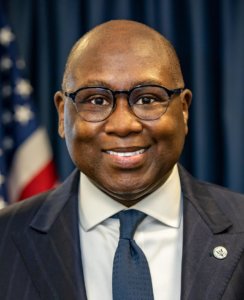
 August 15, 2023 — As NCUA board member Rodney Hood’s term comes to a close this month, and with a Democrat expected to take his place, eyes turn to the Biden Administration for news of who that individual might be, though no successor has been named.
Hood served as NCUA Chairman under Trump in 2019 and then as an NCUA board member in 2021 when Todd Harper took over the Chairman position after nomination from President Biden. He also served on the board previously under President George W. Bush from 2005-2009.
Hood acknowledged the end of his term on the NCUA board back in July, remarking on his motivations for joining the board originally and his desire to further the credit union goal of “people helping people.”
“I hope that I have lived up to that commitment by demonstrating a fidelity to the tenets of safety and soundness while also striving to provide access to financial inclusion for the nearly 135 million members of our country’s credit union system,” said Hood. “In the coming weeks, I will begin another season in my life as my term on the NCUA board concludes in August. I would like to thank Lenwood Brooks and Hallie Williams Hailey in Chattanooga for all their hard work and support in my role as Chairman and board member.”
However, despite these remarks, Hood will remain on the NCUA board for the foreseeable future, as the Biden Administration has yet to name a successor. Furthermore, even if one were to be named tomorrow, it could take months for said successor to be confirmed by the Senate.
Hood, for example, was nominated in January 2019, but was not confirmed until March 2019 and was not sworn in until April 2019.
In light of this, Hood has expressed his willingness and intention to remain on the NCUA board in the coming months until his replacement is sworn in. This move is not out of the ordinary, though it is impossible to say how long Hood could unofficially “extend” his term through. Democrat Debbie Matz, for example, served for over a year after her term expired in 2016.
While this may seem inconsequential, considering Hood has already served for several years with the NCUA, it could have ramifications for key NCUA decisions in the upcoming months. Hood ensures a Republican majority on the board, as fellow board member Kyle Hauptman is also a Republican whereas Board Chairman Todd Harper is a Democrat.
Since the beginning of Harper’s term in 2021, he has worked to push through several proposals which have been blocked by the Republican majority. Meaning that Harper will either need to delay certain issues or risk an undesired outcome.
For instance, the NCUA recently requested information relating to climate change risk back in June. This move was led by Harper, and rejected by Hauptman, and while Hood supported the request for information, he made it clear he would not support any rulemaking or further action on it.
Though if Harper does delay decision-making while waiting for Biden to appoint another Democrat, he might have to wait a while, as the White House remains quiet on the topic.
Courtesy of Emily Claus, CUSO Magazine
(Feb. 4, 2022) FDIC Board Chairman Jelena McWilliams is scheduled to step down today (Friday, Feb. 4), following through on the announcement she made late last month.
In her resignation letter submitted to the White House on New Year’s Eve, McWilliams gave no indication why she was resigning, three-and-a-half years into her five-year term (she was nominated by President Donald Trump [R] in December 2017 and confirmed by the Senate in late May 2018).
Since then, the White House has been silent about who will succeed McWilliams, either as a permanent chairman of the agency’s board or as an acting chairman to take over after she leaves today. The only member of the agency’s board who was appointed (and confirmed by the Senate) specifically to serve on the panel is Board Member (and former chairman) Martin Gruenberg, a Democratic appointee. He is serving in a “holdover” capacity since his term expired in December 2018. Unless he resigns, he may remain on the board until a successor is confirmed by the Senate.
Meanwhile, McWilliams received a note of acknowledgement from her regulatory colleagues at NCUA with a joint statement signed by all three board members.
NCUA Chairman Todd M. Harper said he had “seen firsthand the expert knowledge, considerable skill, and strategic insights she provides in issues and making decisions.” Vice Chairman Kyle Hauptman said McWilliams is “an inspiring example of the American dream, an immigrant from a statist regime who then achieved here at the highest levels.” Board Member Hood said she “played a pivotal role in creating an effective regulatory environment for the U.S. banking system.”
LINK:
NCUA’s Harper, Hauptman, and Hood Commend Chairman McWilliams for Her Service to the FDIC
(July 23, 2021) Federally insured credit unions with $500 million or more in assets could avoid risk-based capital (RBC) requirements and opt-in to a new measure of capital adequacy if they meet a minimum net worth standard and other qualifying criteria, under a proposal issued by the NCUA Board Thursday.
Called the Complex Credit Union Leverage Ratio (CCULR, and dubbed “cooler” by members of the board), the proposal would allow the $500 million and more credit unions to opt in to the new capital standard if they also hold a minimum net worth ratio of 9% as of Jan. 1 of next year (which will be gradually increased to 10% two years later).
Other qualifying criteria include: off-balance sheet exposures held by the credit union must be 25% or less of total assets; trading assets and trading liabilities must be 5% or less of total assets; and goodwill and other intangibles must be 2% or less of total assets.
“A complex credit union that opts into the CCULR framework would not be required to calculate a risk-based capital (RBC) ratio under the Oct. 29, 2015, risk-based capital final rule” as amended in October, 2018, the proposal’s summary states. “A qualifying complex credit union that opts into the CCULR framework and that maintains the minimum net worth ratio would be considered to be well capitalized.”
Issued on a unanimous vote by the board, the proposal would make other changes to the RBC rule, according to the summary, including addressing asset securitizations issued by credit unions, clarifying the treatment of off-balance sheet exposures, deducting certain mortgage servicing assets from a complex credit union’s risk-based capital numerator, updating several derivative-related definitions, and clarifying the definition of a consumer loan.
As both NCUA staff and board members noted during the meeting, the proposal is similar to the community bank leverage ratio (CBLR) adopted by the federal banking agencies for banks and which became effective in 2020. That rule removes requirements for calculating and reporting risk-based capital ratios for most banks with less than $10 billion in assets that hold more than 9% in risk-based capital, and that meet certain risk-based qualifying criteria. Banks meeting the criteria can “opt-in” to use the CBLR.
The NCUA proposal was issued with a 60-day comment period, which means it would end sometime in either late September or early October. That doesn’t give NCUA much time to consider whatever comments it receives before finalizing a rule that will, in effect, directly affect the risk-based capital (RBC) rule set to take effect on Jan. 1.
During discussion, NCUA Board Chairman Todd Harper called the proposal a prudent course of action. “This proposal is an appropriate measure that provides complex credit unions with a streamlined approach to managing their capital levels while also strengthening the system’s resiliency to economic shocks,” he said.
He said year-end 2020 call report data indicate that nearly 75% of complex credit unions would meet the 9% net worth requirement under the proposal. He also asserted that the proposal would increase the capital buffer of insured complex credit unions, by $22 billion (to an estimated $104.6 billion) , if all of the credit unions “opted in” to the rule. (The increase in capital is compared to the total amount if the RBC rule were in effect, Harper noted.)
Board Vice Chairman Kyle Hauptman said the chief benefit of the proposal is that it allows some credit unions to bypass the risk-based capital approach. “For me, the point of this simpler leverage ratio is that it protects both credit unions and the (National Credit Union) Share Insurance Fund from the inevitable problems of risk weighting,” he said.
Although Board Member Rodney Hood said he would “begrudgingly” vote for the proposal (which he did), he took the opportunity before the vote to call for an end to the RBC rule. He said he wants the board to either table the RBC rule or rescind it, noting that it would be eight years old when it fully takes effect. “RBC should be a tool and not a rule,” he said.
LINK:
Notice of Proposed Rulemaking, Parts 702 and 703, Complex Credit Union Leverage Ratio
(April 23, 2021) While no new regulations were proposed or finalized, the NCUA Board did indicate at its meeting Thursday that final rules on two NASCUS-supported proposals – on capitalization of interest and derivatives — are nearing the point of being considered soon, according to comments during this week’s meeting.
In open session of the NCUA Board, Chairman Todd Harper said staff is “working through” issues on proposed rules for capitalization of interest and on derivatives. Harper said he was hopeful to see actions on the proposals “in the near future.”
The issue of action on proposed or pending regulations was brought up by Board Member Rodney Hood. Thursday’s meeting included only board briefings, on cybersecurity and an interim final rule addressing the impact of savings growth due to the coronavirus crisis on credit union capital.
Hood, in his comments, suggested the board work in the future “in a bipartisan manner” to develop board meeting agendas for “robust rulemaking opportunities.” Hood indicated that there are proposed rules awaiting action (and proposals waiting to be unveiled) that he and the other board members want to see move forward.
The capitalization of interest rule was proposed in November by the NCUA Board; it would remove the prohibition in agency rules against the capitalization of interest in connection with loan workouts and modifications, particularly as they struggled with the financial impact of the coronavirus crisis.
NASCUS, in its February comment letter, supported the proposal and called for its expeditious completion. NASCUS also recommended the agency reconsider the blanket prohibition against additional advances, to cover credit union fees and provide them with “the full range of options for managing and structuring loan work outs as other depository institutions.”
The derivatives rule was proposed in October; it would make the agency’s regulation less prescriptive and more “principles-based,” expanding federal credit unions’ authority to purchase and use derivatives as part of their interest-rate risk (IRR) management. NASCUS likewise supported the proposal in its December comment letter, calling for two changes: eliminate the redundant supervisory notice requirements where applicable, and incorporate exempt derivatives transactions directly into part 741.219 of NCUA rules – the section that covers federally insured state-chartered credit unions (FISCUS) and investment requirements.
NASCUS also noted that the proposal continues recognition by NCUA of the primacy of state law in determining investment authority for FISCUs.
Both items were issued for comment without objection by any members of the board.
NASCUS comment: Proposed Rule — Derivatives (RIN 3133–AF29)
(March 5, 2021) Watching closely to determine what additional support may be needed for smaller credit unions and minority depository institutions in the months to come as they face the continuing coronavirus crisis will be a priority for NCUA, NCUA Board Member Rodney Hood said this week.
At the same time, he and board Vice Chairman Kyle Hauptman agreed that the agency needs to loosen up chartering requirements so that more federal credit unions can be created.
In recorded remarks to the Credit Union National Association (CUNA) Governmental Affairs Conference, NCUA Board Member (and former Chairman) Rodney Hood said many financial institutions were left more vulnerable than they would otherwise have been due to the financial impact of the pandemic. “So closures of financial institutions, with the attendant systemic risks, are always a possibility,” he said.
Hood said, should closures occur, regulators need to be “prepared to respond appropriately to ensure the safety and soundness of the larger system,” and that it would always be his preference to save institutions rather than merging them.
In other comments, Hood said that moving forward with a new rule to expand lending authorities for credit union service organizations (CUSOs), which is now out for comment, is a priority for him. “This rule also would allow credit unions to invest in non-credit union owned fintech companies, something that I think is critical in today’s marketplace,” he said.
The NCUA board member also voiced support for “significantly” streamlining and simplifying the process of chartering new credit unions. NCUA Board Vice Chairman Kyle Hauptman, during his recorded comments at the conference, echoed Hood’s call.
“There has got to be an easier path for de novo credit unions,” Hauptman said. “I’m from Maine, and I was pleased to hear about a new credit union chartered in my home state just last year— until I learned it took nine years to accomplish. Nine. Things may move a bit slowly in Maine, sure, but not that slowly. Self-reliant, accountable people who want to work cooperatively with others to charter a new credit union that they will own, deserve a clear path to make that a reality.”
Hauptman said he intends to talk to persons who have recently started a credit union and those who want to start one. He said his goal is to work with NCUA staff on a new, easier path for creating new credit unions.
LINK:
NCUA Board Member Rodney E. Hood Remarks before CUNA’s 2021 Governmental Affairs Conference
NCUA Vice Chairman Kyle S. Hauptman Remarks before CUNA’s 2021 Governmental Affairs Conference
(March 5, 2021) NCUA’s Rodney Hood was named the agency’s representative on the board of NeighborWorks America, a public-private organization that promotes affordable housing and community development, NCUA Chairman Todd Harper said this week. The group’s board consists of representatives of financial regulatory agencies and the U.S. Department of Housing and Urban Development (HUD) and includes (in addition to Hood): Martin Gruenberg, member of the FDIC Board, serving as NeighborWorks’ board chair; Michelle W. Bowman, member of the Federal Reserve Board of Governors, serving as vice chair; Grovetta Gardineer, senior deputy comptroller for bank supervision policy at the (OCC) … Federal civilian agencies were advised this week to install a patch for Microsoft Exchange for on-premises products – or disconnect those products until they do update with the patch. The “emergency directive” issued by the federal Cybersecurity and Infrastructure Security Agency (CISA) said the directive was issued in response to observed active exploitation of these products using previously unknown vulnerabilities. The directive also requires agencies to collect forensic images (if they are currently able to do so), and requires agencies to search for known indicators of compromise after patching; if indicators are found, they agencies are advised, they should contact CISA to begin incident response activities … The State of Washington, Dept. of Financial Institutions, is inviting applications for the position of program manager, chief of specialty examinations; see the NASCUS “state job opportunities” page (link below) for more details … NASCUS now has its own Facebook page, an effort undertaken by NASCUS Senior Director of Communications and Marketing Amanda Tuckey to expand the association’s reach. “We’re welcoming everyone to follow our page for daily NASCUS/industry news,” Tuckey said.
LINKS:
Chairman Harper Appoints Hood to NeighborWorks America Board of Directors
CISA issues emergency directive requiring federal agencies to patch critical vulnerability
NASCUS state job opportunities (WA program manager, chief of specialty exams)
NASCUS Facebook page (https://www.facebook.com/NASCUS)
(Jan. 29, 2021) On behalf of the state system, NASCUS President and CEO Lucy Ito congratulated new Chairman Harper, noting his experience with credit unions.
“State regulators and credit unions recognize the breadth and depth of his knowledge of the consumer financial services market and his dedication to a robust dual chartering framework that ultimately benefits members of both state and federal credit unions,” Ito said in a press statement. “Working together, we hope to achieve our shared objectives of a safe, sound and strong credit union system that can innovate and grow in the interests of our members.”
The NASCUS leader also extended thanks to former Chairman Hood for working with the state system over the past two years. “We are especially grateful for his support of the 2019 Document of Cooperation between NCUA and NASCUS which provides a durable roadmap for federal-state partnership,” she said.
Finally, Ito said the state system looks forward to working with Vice Chairman Hauptman, who also serves as the NCUA Board liaison to NASCUS, “particularly as both NASCUS and the agency foster collaboration and alignment between state and federal regulators and the whole NCUA Board.”
(Jan. 29, 2021) Todd M. Harper is now the NCUA Board chairman, succeeding Rodney Hood in the position, as the result of designation by President Joe Biden early this week. Harper is the 12th person to be chairman of the federal credit union regulator board.
“The credit union system now sits at the intersection of several crossroads, and the agency faces many decisions ahead related to the economic fallout of the COVID-19 pandemic and the need to advance economic equality and justice,” Harper said in a statement issued the day his designation was announced. “As NCUA Board Chairman, I will continue to focus on four policy priorities: capital and liquidity, consumer financial protection, cybersecurity, and diversity, equity and economic inclusion. Each of these priorities are vital in responding to current economic and marketplace realities.”
Prior to joining the NCUA Board, Harper served as director of the agency’s Office of Public and Congressional Affairs and chief policy advisor to former Chairmen Debbie Matz and Rick Metsger. He is the first member of the NCUA staff to become an NCUA Board member and chairman. Before joining the agency, he worked for the U.S. House of Representatives as staff director for the subcommittee on capital markets, insurance, and government-sponsored enterprises and as legislative director and senior legislative assistant to former Rep. Paul Kanjorski (D-Pa.).
Harper was confirmed by the Senate as a member of the NCUA Board in April 2019. His term expires in just about two months (in April), but he can continue to serve in a holdover capacity until a successor is confirmed.
But Harper is the lone Democrat on the board, serving alongside Republican appointees Hood and Vice Chairman Kyle Hauptman. Because he is the only Democrat, it’s likely that the White House will keep him in the seat until at least another position opens on the board. That may be a while, however: the term of Hood (who remains on the board as a member) ends in August 2023, and Hauptman’s in August 2025.
Hood and Hauptman also released a statement this week congratulating Harper, with Hauptman saying he looked forward to working with the new chairman “to provide a regulatory framework that helps credit unions meet the evolving needs of members,” and Hood saying he would work in partnership with both board colleagues to address the impact of COVID-19 on credit unions, and other things, “in a bipartisan manner.”
(Dec. 23, 2020) A new title has been bestowed on the newest member of the three-member board for the NCUA, who is now “vice chairman,” according to a release from the agency late last week.
Kyle S. Hauptman, who was confirmed by the Senate to a seat on agency’s board Dec. 2 – and who joined his first two meetings of the board last week (on Dec. 17 and 18) – was, late in the day Friday, tapped as vice chairman of the panel. The title — while indeed an honor — is largely honorific: other than sitting in for the board chairman in that individual’s absence, and taking a role in some appeals for Freedom of Information Act (FOIA) request decisions (under part 792.28 of agency regulations), there are few specific duties, responsibilities or benefits attached to role, other than those assigned by NCUA Board Chairman Rodney Hood.
The new vice chairman, in a press statement, said that in his role he looks forward to “working with credit unions, my fellow Board Members, and Congress on solutions that provide regulatory relief for the credit union community and expand the use of technology to reach underserved communities.”
This week, Hauptman named veteran credit union service organization (CUSO) and state league executive Sarah Canepa Bang as his senior adviser. The agency, in a release Monday, said Bang has broad experience in the credit union industry that includes serving as executive vice president of industry relations and president and chief strategy officer at CO-OP Financial Services. Previously, she was (among other things) chief executive officer at Financial Service Centers Cooperative, Inc., and executive vice president of the Oregon Credit Union League and Affiliates.
In other agency personnel developments this week, NCUA officially announced the retirement of J. Owen Cole, associate director of the policy and markets division in the NCUA’s Office of Examination and Insurance at the end of this month. NCUA said Cole served in various roles during his 27-year tenure, including senior investment officer, director of the division of risk management, associate regional director of operations, deputy executive director, and acting chief of staff. Most recently he had also served as president of the NCUA Central Liquidity Facility, which addresses potential credit union system liquidity risks.
LINKS:
NCUA Board Designates Hauptman as Vice Chairman
Sarah Canepa Bang Appointed Senior Advisor to Vice Chairman Hauptman
Owen Cole, Associate Director for Policy and Markets, Announces Retirement
(Dec. 4, 2020) A new member will be sitting at the next meeting of the NCUA Board when it gathers in about two weeks, thanks to action taken by the Senate this week.

Kyle Hauptman
Kyle S. Hauptman was confirmed by the Senate Wednesday on a bipartisan vote of 56-39, clearing the way for his swearing in and subsequent participation in a vote slated Dec. 17 on the agency’s 2021-2022 budget.
Nominated June 18 to the NCUA Board by President Donald Trump, Hauptman has most recently served as a staff director for the economic policy subcommittee of the Senate Banking Committee and as an economic policy advisor to Sen. Tom Cotton (R-Ark.). He worked on the 2016 Trump presidential transition team and served as a policy advisor on financial services for 2012 Republican presidential nominee Mitt Romney (now a U.S. senator representing Utah).
Confirmed to a term that continues into August 2025, Hauptman will take the seat recently vacated by J. Mark McWatters, whose term on the board expired in August 2019. McWatters had been serving in holdover capacity until his resignation Nov. 20.
That resignation followed by one day McWatters’ noting during an open board meeting that he would not approve of the agency’s proposed budget without certain changes.
NASCUS President and CEO Lucy Ito congratulated Hauptman on behalf of the state credit union system. “We look forward to working with him over the coming years,” Ito said. “There are a number of key issues of importance to state credit unions, including maintaining an equitable overhead transfer rate from the NCUSIF, continued consideration of subordinated debt for use by all federally insured credit unions, and on-going dialogue and collaboration between state and federal regulators. We are eager to meet with the newest NCUA Board member to discuss these and other issues as together we work toward a strong, and safe, credit union system.”
Hauptman’s confirmation fills out the membership of the agency’s board, as he joins Chairman Rodney Hood and Member Todd Harper. Both Hood and Hauptman are Republican appointees; Harper is a Democrat appointee. Hauptman becomes the third member to join the board in less than two years: both Hood and Harper joined the board in the spring of 2019 (although Hood is serving a second stint on the panel, having served on the board from 2005-09).
During a board briefing Wednesday, both Hood and Harper publicly congratulated Hauptman on his confirmation. Harper, further, noted that all three board members’ names now begin with the letter “H,” replacing the “Ms” on the board (when Chairman Debbie Matz, and Board Members Rick Metsger and J. Mark McWatters all served on the board together).
Interestingly, the last time all three board members’ last names began with the same letter (the “Ms”), all three, eventually, served as board chairmen. Harper could be in line to become the next board chairman (as a Democratic appointee) after Joe Biden is inaugurated as president Jan. 20.
(Nov. 25, 2020) Change is coming to the NCUA Board in the next 10 days or so, following change that already occurred late last week with the resignation of one of the board members. Here’s a quick rundown of what happened late last week, what’s scheduled to happen next week, and a look at what may be ahead for leadership of the agency.
- Last week, Senate Majority Leader Mitch McConnell (R-Ky.) announced (via the Senate’s executive calendar, which lists when executive branch nominees will begin to be considered by the Senate) that the nomination of Kyle S. Hauptman to be a member of the NCUA Board would be considered as early as Monday of next week (Nov. 30). Hauptman was nominated by outgoing President Donald Trump (R ) last summer to take the seat of J. Mark McWatters, whose term expired in August 2019; McWatters has been serving in a holdover capacity until his successor (Hauptman) was confirmed by the Senate. McWatters is a former chairman of the NCUA Board (succeeded by current Chairman Rodney Hood last year), who was named to that position by Trump.
- On Thursday, during the regular monthly meeting of the NCUA Board, both Board Members McWatters and Todd Harper expressed some dissatisfaction with the proposed NCUA budget for 2021, which is scheduled to be the subject of a Dec. 2 briefing by the agency (and which NASCUS has requested to provide comments for). McWatters also announced that he would not support the 2021 staff budget as drafted “as long as I’m on this board.” The NCUA Board is scheduled to consider the 2021 budget at its next monthly meeting, set for Dec. 17.
- Late Friday, McWatters released a copy of a letter he said he had sent to Trump that day informing the president that he was submitting his resignation. “As the Senate is scheduled to confirm my successor in the next few days, I hereby resign my position as of today,” McWatters wrote.
- Monday, Hood publicly released a statement noting McWatters’ resignation, observing that “his years on the NCUA Board are a credit to his decades-long career in law and policymaking. I wish Mark all the best in his future endeavors.” (NCUA Board Member Todd Harper – who also voiced concerns about the budget – released a statement on social media reading (in part) “Mark leaves the Board with a commendable record of achievement, and I wish him well in his future endeavors.”)
The end result of all of this: When the NCUA Board meets Dec. 17 to consider the 2021 budget – including the overhead transfer rate (OTR) for the NCUSIF portion of the agency spending plan – there could be one new face on the board, and perhaps two votes in favor of the agency’s budget for next year.
Looking ahead, with the transition of President-elect Joseph R. Biden (D) now officially underway in advance of the Jan. 20 transfer of power from Trump, there is likely to be more change. The new president will be in a position to designate a new chairman of the NCUA Board (that position is not confirmed by the Senate if the individual has already been confirmed as a board member). As the only Democrat-appointee on the board, Harper is in line to become the next NCUA Board chairman if the president decides to take action.
The most recent example of the president tapping a member of his own party to be chairman: McWatters was named acting chairman of the agency board by Trump on Jan. 26, 2017 – six days after taking the oath of office as president. McWatters replaced Rick Metsger who remained on the board (ultimately to be succeeded by Hood). The “acting” part of McWatters’ title was removed by Trump in June of that year.
Harper’s term on the board ends in April; however, he may serve on the board until a successor is confirmed by the Senate. Hood’s term ends in August 2023; Hauptman, if confirmed, would inherit a term that runs to August 2025.
(Nov. 13, 2020)Despite the financial impact of the coronavirus crisis, federally insured credit unions performed well and remain well capitalized – although there are still challenges ahead, NCUA Board Chairman Hood told Senate and House committees this week.
Hood also made a legislative request: that the authority in the Coronavirus Aid, Relief, and Economic Security (CARES) Act given to NCUA to respond to the pandemic – particularly that providing expanded flexibility and borrowing authority to the agency’s Central Liquidity Facility (CLF) – should be extended to the length of the pandemic. The authority under the CARES Act is now set to expire at year’s end.
In reporting on the state of credit unions, Hood said they were well capitalized at the start of the pandemic, with high levels of net worth and ample liquidity. He noted that federally insured credit unions (FICUs) increased their net worth by $11.6 billion, or 6.8%, over the year ending June 2020, to $182.9 billion. He said asset growth led to a decline In the aggregate net worth ratio – net worth as a percentage of assets – from 11.27% to 10.46%. “Still, the credit union system remains well capitalized through June 2020,” Hood said.
But he also reported that the effects of the economic downturn will affect credit union performance through year’s end and into 2021. “System-wide delinquency rates, which remained low through the second quarter, could begin to rise as forbearance programs end, particularly given the current high level of unemployment. Interest rates across the maturity spectrum have fallen to historically low levels,” he said. “A prolonged period of low interest rates also poses risks, particularly to credit unions that rely primarily on investment income.”
NCUA is actively monitoring economic conditions and assessing these and other risks to credit unions and their members, he said.
In seeking extended authority for the CLF, Hood noted a number of changes the CARES Act made for the CLF when the law was enacted last March (including higher borrowing authority, relaxed membership for corporate CUs, more clarity about what borrowed funds can be used for). He indicated credit unions have responded well to the changes, with new memberships adding $989.8 million in additional capital stock (since April), borrowing authority increased by $21.7 billion to $32.2 billion, and 80% of all federally insured credit unions (4,145 in total) now having access to the facility.
Securing the extension of the authorities, Hood said, would “provide regulatory certainty to credit unions. Having a reinforced CLF will also ensure the credit union system can continue to support its members and communities should the need for emergency liquidity arise.”
NASCUS commented in favor of changes to the CLF in a comment letter on an interim final rule the association filed in June, implementing provisions of the CARES Act.