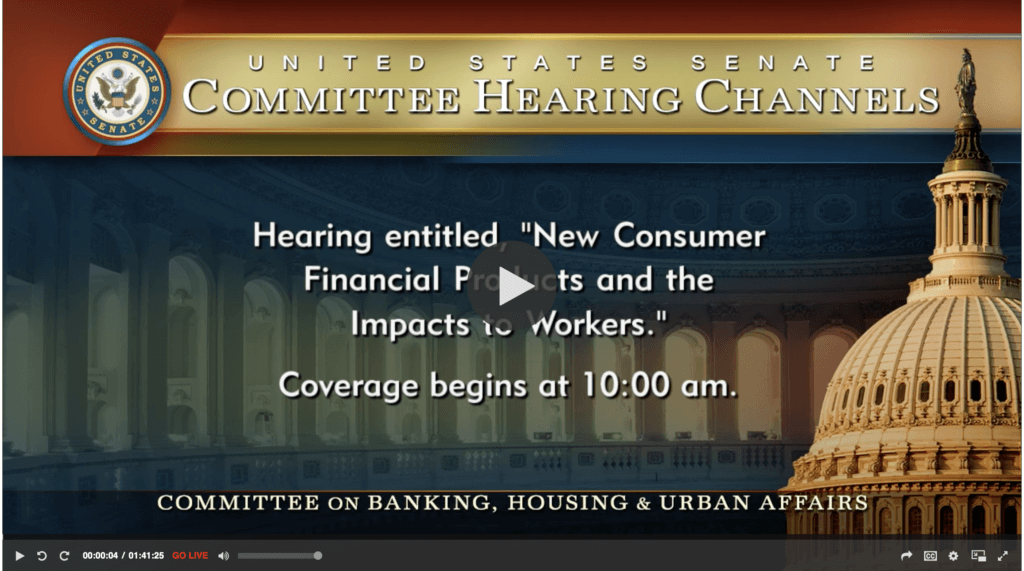
Click on the image above to access a recording of the hearing.
THE COMMITTEE ON BANKING, HOUSING, AND URBAN AFFAIRS will meet in OPEN SESSION, HYBRID FORMAT to conduct a hearing on “New Consumer Financial Products and the Impacts to Workers.” The witnesses will be: Ms. Rachel Gittleman, Financial Services Outreach Manager, Consumer Federation of America; Ms. Penny Lee, CEO, Financial Technology Association; Professor Todd J. Zywicki, George Mason University Foundation Professor of Law at George Mason University Antonin Scalia School of Law; and Mr. David H. Seligman, Executive Director, Towards Justice.
The main findings from the August 2022 Survey are:
Inflation
- Median one- and three-year-ahead inflation expectations continued their steep declines in August: the one-year measure fell to 5.7% from 6.2% in July, while the three-year measure fell to 2.8% from 3.2%. The survey’s measure of disagreement across respondents (the difference between the 75th and 25th percentile of inflation expectations) increased to a new series high at the one-year horizon but decreased at the three-year horizon.
- Median five-year-ahead inflation expectations, which have been elicited in the monthly SCE core survey on an ad-hoc basis since the beginning of this year and were first published in July 2022, also declined to 2.0% from 2.3%. Disagreement across respondents in their five-year-ahead inflation expectations also declined in August.
- Median inflation uncertainty—or the uncertainty expressed regarding future inflation outcomes—decreased at the short-term horizon and was unchanged at the medium-term horizon.
- Median home price expectations declined sharply by 1.4 percentage points to 2.1%, its lowest reading since July 2020, and falling below pre-pandemic levels. The decline was broad based across demographic groups and geographic regions. Home price expectations have now fallen by nearly two-thirds since the April 2022 reading of 6.0%.
- Expectations about year-ahead price changes fell by 1.4 percentage points for gas (to 0.1%), 0.8 percentage point for food (to 5.8%), and 0.3 percentage point for rent (to 9.6%). The median expected change in the cost of medical care rose by 0.1 percentage point (to 9.3%) and was unchanged for college education at 8.4%.
Labor Market
- Median one-year-ahead expected earnings growth remained unchanged at 3.0% in August for the eighth consecutive month.
- Mean unemployment expectations—or the mean probability that the U.S. unemployment rate will be higher one year from now—decreased by 0.2 percentage point to 40.0%.
- The mean perceived probability of losing one’s job in the next 12 months decreased by 0.7 percentage point to 11.1%. Similarly, the mean probability of leaving one’s job voluntarily in the next 12 months decreased by 0.9 percentage point to 18.5%, its lowest reading since March 2021.
- The mean perceived probability of finding a job (if one’s current job was lost) increased to 57.2% from 55.9% in July. The increase was most pronounced for those with a high-school education or less.
Household Finance
- The median expected growth in household income increased by 0.1 percentage point to 3.5% in August, a new series high.
- Median household spending growth expectations increased by 1.0 percentage point to 7.8%. The increase was driven by those with a high-school degree or less.
- Perceptions of credit access compared to a year ago deteriorated, with the share of households reporting it is harder to obtain credit than one year ago increasing to a new series high. Similarly, expectations for future credit availability also deteriorated, with the share of respondents expecting it will be harder to obtain credit in the year ahead increasing to a new series high.
- The average perceived probability of missing a minimum debt payment over the next three months increased by 1.4 percentage points to 12.2%, its highest reading since May 2020. This increase was broad based across demographic groups.
- The median expectation regarding a year-ahead change in taxes (at current income level) decreased by 0.3 percentage point to 4.5%.
- Median year-ahead expected growth in government debt decreased by 0.2 percentage point to 10.4%, its lowest reading since November 2020.
- The mean perceived probability that the average interest rate on saving accounts will be higher in 12 months was unchanged in August.
- Perceptions about households’ current financial situations compared to a year ago improved with fewer households reporting a worse situation compared to a year. Year-ahead expectations about households’ financial situations also improved, with fewer households expecting to be worse off a year from now.
- The mean perceived probability that U.S. stock prices will be higher 12 months from now increased by 2.1 percentage points to 36.4%.
About the Survey of Consumer Expectations (SCE)
The SCE contains information about how consumers expect overall inflation and prices for food, gas, housing, and education to behave. It also provides insight into Americans’ views about job prospects and earnings growth and their expectations about future spending and access to credit. The SCE also provides measures of uncertainty regarding consumers’ outlooks. Expectations are also available by age, geography, income, education, and numeracy.
The SCE is a nationally representative, internet-based survey of a rotating panel of approximately 1,300 household heads. Respondents participate in the panel for up to 12 months, with a roughly equal number rotating in and out of the panel each month. Unlike comparable surveys based on repeated cross-sections with a different set of respondents in each wave, this panel allows us to observe the changes in expectations and behavior of the same individuals over time. For further information on the SCE, please refer to an overview of the survey methodology here, the interactive chart guide, and the survey questionnaire.
NCUA Releases Second Quarter Credit Union System Performance Data
 Sept. 7, 2022 — According to the latest financial performance data released today by the National Credit Union Administration, total loans outstanding in federally insured credit unions increased $194 billion, or 16.2 percent, over the year ending in the second quarter of 2022, to $1.39 trillion. This represents the largest year over year growth in loans outstanding in at least two decades. Credit union loan balances also rose in all major categories, compared with the second quarter of 2021.
During the same period, total assets climbed by $159 billion, or 8.1 percent, to $2.14 trillion. Insured shares and deposits also grew $110 billion, or 7.0 percent, to $1.69 trillion, from one year earlier.
“These latest quarterly industry performance results point to a growing and overall healthy credit union system that’s facilitating the ability of families to achieve their financial goals,” said NCUA Chairman Todd M. Harper. “But, at the same time, we have also seen declines in the system’s net income and returns on average assets, rapidly rising interest rates and continued inflationary pressures. And, we have identified growing liquidity concerns within the system. Therefore, credit unions of all types and sizes must remain diligent in managing safety and soundness as we continue to navigate the challenging economic environment ahead of us.”
The NCUA’s Quarterly Credit Union Data Summary provides an overview of the financial performance of federally insured credit unions based on information reported to the agency in the second quarter of 2022. As of June 30, 2022, there were 4,853 federally insured credit unions with 132.6 million members.
Additional highlights from the NCUA’s Credit Union Data Summary(opens new window) for the second quarter of 2022 include:
- Net income for federally insured credit unions in the first half of 2022 totaled $18.0 billion at an annual rate, down $3.3 billion, or 15.4 percent, from the first half of 2021.
- Interest income rose $5.7 billion, or 9.8 percent, over the year to $63.6 billion. Non-interest income fell $3.1 billion, or 11.7 percent, to $23.6 billion, largely due to a drop in other income.
- The credit union system’s provision for loan and lease losses or credit loss expense increased $2.1 billion, or 154.8 percent, to $3.4 billion at an annual rate in the first half of 2022.
- The delinquency rate at federally insured credit unions was 48 basis points in the second quarter of 2022, up 2 basis points compared with the second quarter of 2021.
- Credit union shares and deposits rose by $139.7 billion, or 8.1 percent, over the year to $1.85 trillion in the second quarter of 2022. Regular shares increased $62.3 billion, or 9.9 percent, to $689.0 billion. Other deposits increased $37.1 billion, or 5.0 percent, to $782.5 billion, led by money market accounts, which grew $52.2 billion, or 13.9 percent, over the year.
- The credit union system’s net worth increased by $21.6 billion, or 10.8 percent, over the year to $222.7 billion.
- The aggregate net worth ratio — net worth as a percentage of assets — stood at 10.42 percent in the second quarter of 2022, up from 10.16 percent one year earlier.
The NCUA makes credit union system performance data available in the Credit Union Analysis section of NCUA.gov. The analysis section includes quarterly data summaries as well as detailed financial information, a graphics package illustrating financial trends in federally insured credit unions, and a spreadsheet listing all federally insured credit unions as of June 30, 2022, including key metrics.
 Aug. 31, 2022 — Bank of America and BMO Harris are leaning into real estate aid with programs designed to close the racial property ownership gap.
Bank of America launched two programs Tuesday — one to aid small-business owners and another aimed at future homeowners.
The Small Business Down Payment Grant Program extends credit to small-business borrowers within historically disadvantaged communities and offers them financial support to purchase commercial real estate. Women and nonwhite business owners applying for Small Business Administration (SBA) commercial real estate loans for opportunity zones in Atlanta, Chicago, Charlotte, Dallas and Los Angeles can access the grants, which can be used to cover up to half of the down payment, capped at $25,000.
The bank plans to expand the program geographically next year.
“Today, many business owners of diverse backgrounds lack the access to capital and technical assistance needed to qualify for commercial loans, which can help secure transferable assets that build equity across generations,” said Jill Calabrese Bain, managing director of small business, specialty banking and lending at Bank of America.
Just 3% of Black households own nonresidential commercial real estate, Brookings reported in July. That compares with 8% of White households. Further, for the households that do, there’s a major disparity in the value: The average Black household owns $3,600 in it; the average White household, $34,000.
Applicants for the program announced Tuesday must pay at least 5% of the down payment and must be able to prove at least 51% business ownership by women or nonwhite people.
Bank of America’s Community Affordable Loan Solution, meanwhile, offers a zero-down payment, zero-closing-cost mortgage solution to first-time buyers purchasing homes in certain Black and Latinx neighborhoods in Charlotte, Dallas, Detroit, Los Angeles and Miami.
The program uses credit guidelines based on factors such as timely rent, phone and car insurance payments. Prospective buyers needn’t have mortgage insurance or a minimum credit score but must complete a homebuyer certification course through a Bank of America and Housing and Urban Development Department-approved housing counseling partner before submitting an application.
The program builds onto Bank of America’s $15 billion community homeownership commitment, which launched in 2019 and aims to provide affordable mortgages, grants and education to help some 60,000 low-to-moderate income individuals and families buy their own homes by 2025.