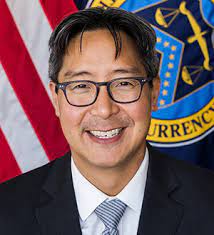
 This week, Acting Comptroller of the Currency Michael Hsu gave remarks to the DC Blockchain Summit titled “Crypto: A Call to Reset and Recalibrate.”
By speaking at the Blockchain Summit, Mr. Hsu may have gone into the so-called belly of the beast to give his self-proclaimed crypto-skeptic message. Notwithstanding his skepticism, Mr. Hsu noted that he does see cryptocurrency’s potential, but will continue along the OCC’s “careful and cautious approach to crypto in order to ensure that the national banking system is safe, sound, and fair.”
Mr. Hsu noted that the recent collapse of the TerraUSD stablecoin and the selloff seen in other crypto assets showed risks in the asset class, and he said it also showed that much of the growth in the crypto space is “indicative of the crypto economy’s dependency on hype.”
Mr. Hsu shared three “high-level observations from the perspective of a bank regulator.”
First, he said that recent events “have revealed deep vulnerabilities in the crypto system.” He noted three in particular:
- Cryptocurrency markets are highly fragmented and cryptocurrency exchanges are prone to hacks
- Contagion risks for cryptocurrency markets are just as real as other financial markets
- Custody and ownership rights are under-developed for the size, scope, and ambitions of the industry
Second, he pointed out that the OCC’s “careful and cautious” approach has shown value in the recent market volatility, as “there has been no contagion from cryptocurrencies to traditional banking and finance.”
Third, he observed that “hype is not harmless,” and elaborated by saying that the hype of crypto and digital assets and the associated vulnerabilities “make the crypto space very dangerous for investors of modest means.”
Mr. Hsu summarized his remarks by noting that the recent market volatility involving stablecoins (and cryptocurrencies more broadly) provides an opportunity “to reset and to recalibrate the problems the industry is trying to solve.”
Courtesy of Cadwalader, Wickersham & Taft LLP
(Jan. 14, 2022) Entities using a “multitude” of fictitious names and websites – including as a credit union — are purporting to offer banking services in the state of Florida, according to a report circulated in an alert this week by the OCC.
Specifically, the OCC alert names two entities – one calling itself a bank, the other a credit union. The Florida Office of Financial Regulation (FLOFR), the federal agency said, reported that both groups have been using foreign-hosted websites designed to obtain information to likely perpetrate fraud, including identity theft.
The oddball thing about the phony credit union is that it uses the initials “N.A.” (for national association) in its name – the moniker assigned to bank charters from the OCC.
“None of these entities are authorized to conduct banking business in the United States, and websites appear to spoof a legitimate financial institution,” the OCC stated.
The OCC identified the phony institutions as:
- Ledge Community Credit Union, N.A., purports to conduct banking business from addresses throughout Florida, including Fleming Island and Jacksonville which correspond to a legitimate Florida-chartered financial institution. Another known name used by the group includes Flygate Financial (www.flygatefinancial.com).
- Fedro Asset Bank, N.A., purports to conduct banking business from addresses in Jacksonville, Orlando, Gainesville, and Tampa.
LINK:
(Dec. 17, 2021) The “normal operating level” (NOL) of the NCUSIF – the level at which NCUA considers whether it needs to inject more reserves into the fund to cover looming losses, primarily through premiums – was set at 1.33% by the agency board Thursday. The decision was made after the agency dropped two of eight factors it uses to set the NOL as “no longer necessary” (the modeled potential decline in value of the NCUSIF’s claims on the corporate asset management estates; and to account for a potential projected equity ratio decline through the end of the following year without an economic downturn) … Robert (“Rob”) Schmidt is the new director of the Alaska Division of Banking and Securities; he succeeds James McConnell who left in October … The OCC finalized rescission of its 2020 rule implementing the Community Reinvestment Act (CRA), reverting agency rules to those adopted in 1995 and followed by its fellow federal banking regulators. The 2020 CRA rule was rescinded, the OCC said, to “facilitate the ongoing interagency work to modernize the CRA regulatory framework and promote consistency for all insured depository institutions.”
LINK:
Share Insurance Fund 2022 Normal Operating Level
(Dec. 10, 2021) A new candidate for a permanent appointment as comptroller of the currency will have to be found by the Biden Administration after the most-recent nominee, Saule T. Omarova, bowed out of consideration.
In a letter, Omarova said she appreciated President Joe Biden’s (D) nomination of her to lead the Office of the Comptroller of the Currency (OCC), but wrote that “at this point in the process, however, it is no longer tenable for me to continue as a Presidential nominee.”
Omarova, a Cornell University law professor and veteran of the Treasury Department under President George W. Bush (R ), had proven to be a controversial nominee to lead the federal bank regulator. Industry opposition was intense (based on some of her past writings that included suggesting the Federal Reserve consider offering some banking services), and her nomination ran into particular trouble during a hearing last month before the Senate Banking Committee, where she faced intense questioning from Republican senators, described as rude and condescending by some.
Biden accepted the withdrawal but took notice of the opposition Omarova faced. “Unfortunately, from the very beginning of her nomination, Saule was subjected to inappropriate personal attacks that were far beyond the pale,” Biden said in a statement.
For the time being (and until a new nominee is found), the OCC will continue to be led by Acting Comptroller Michael Hsu, who this week named a new chief of staff (Lauren Oppenheimer).
LINK:
(Nov. 24, 2021) A final rule requiring banks to notify their federal regulators of certain cyber incidents with potentially systemic effects was approved jointly late last week; it takes effect April 1, with compliance required by May 1. NCUA has not yet adopted a similar rule for credit unions.
Adopted by the Federal Reserve, FDIC, and OCC, the final rule requires a banking organization to notify its primary federal regulator of any “computer-security incident” that rises to the level of a “notification incident” as soon as possible and no later than 36 hours after the banking organization determines that a cyber incident has occurred, according to a notice for the Federal Register.
The final rule defines a “notification incident” as a computer-security incident that has materially disrupted or degraded, or is reasonably likely to materially disrupt or degrade, a banking organization’s:
- ability to carry out banking operations, activities, or processes, or deliver banking products and services to a material portion of its customer base, in the ordinary course of business;
- business line (or lines), including associated operations, services, functions, and support, that upon failure would result in a material loss of revenue, profit, or franchise value; or
- operations, including associated services, functions and support, as applicable, the failure or discontinuance of which would pose a threat to the financial stability of the United States.
The final rule also requires a bank service provider to notify each affected banking organization customer as soon as possible when the bank service provider determines that it has experienced a computer-security incident that has caused, or is reasonably likely to cause, a material service disruption or degradation for four or more hours, the notice states.
LINK:
Agencies approve final rule requiring computer-security incident notification
(Nov. 19, 2021) Flexibility for board meetings originally extended to FCUs during the height of the coronavirus crisis will be extended in the new year, NCUA said this week. In Letter to Federal Credit Unions (LTCU) 21-FCU-06, the agency said a federal credit union (FCU), as allowed for in March of last year, may adopt at any time by a two-thirds vote of its board of directors a bylaw amendment allowing the board to meet virtually. The provision was approved by the agency in response to person-to-person limits on meetings during the coronavirus crisis … The use of stablecoins deserves a look – and issuance should be broader than just that by banks and credit unions – Federal Reserve Board Gov. Christopher Waller said this week. Referring to a report issued Nov. 1 by the President’s Working Group on Financial Markets that advocated only federally insured financial institutions could issue the digital payments, Waller said “there may be others that better promote innovation and competition while still protecting consumers and addressing risks to financial stability.” He said he disagrees that stablecoin issuance can or should only be conducted by federally insured banks credit unions “simply because of the nature of the liability … The controversy over OCC Nominee Saule T. Omarova (who faced a confirmation hearing Thursday) was illustrated by competing headlines issued in advance by the top Democrat and Republican members of the Senate Banking Committee. The headline of the press release issued by Chairman Sherrod Brown (D-Ohio) stated “Saule Omarova is Eminently Qualified to Lead the OCC.” The headline of the release issued by Ranking Member Pat Toomey (R-Pa.) stated: “I’ve Never Seen a Nominee with More Radical Ideas.” The banking industry has also expressed skepticism about the nominee. Omarova told the panel her priorities would be helping small- to medium-sized banks invest locally.
LINKS:
Federal Credit Union Meeting Flexibility in 2022 Due to the COVID-19 Pandemic
Witness statement: Dr. Saule T. Omarova (Comptroller of the Currency Designate)
(Nov. 12, 2021) NCUA late last week placed the tiny Pomona Postal FCU of Pomona, Calif., into conservatorship, saying the credit union’s most recent call report shows it had 717 members and $4.2 million in assets. The 57-year-old credit union had about a 51% loan-to-share ratio, according to NCUA data … Bob Gallman, president and CEO of the Louisiana Credit Union League since 2017, has announced his retirement, effective next March; he has notched more than 45 years in the credit union system … Guidance for dealing with climate change risk management “supervisory expectations” will be released this year, the acting comptroller of the currency said this week. “We expect to issue framework guidance by the end of this year, to be followed next year with detailed guidance for each risk area,” Acting Comptroller Michael J. Hsu said. “The detailed guidance will build on a range-of-practices review that will launch this week, industry and climate groups’ input, and lessons from other jurisdictions” … Providing “relevant and timely information” specifically for examiners and financial institution practitioners is the aim of a revamped notification system announced this week by the FFIEC (which, since April, has been chaired by NCUA Chairman Todd Harper). According to the Exam Council, its “FFIEC Announcements” email notifications will be distributed to the council’s email subscribers notifying them of updates to its website and “Infobases.” Each issuance, the council said, will be designated with the word “Announcement” in the header, followed by a sequential numbering order of a four-digit year and a two-digit issuance number. See the link for more or to sign up.
LINKS:
NCUA Places Pomona Postal Federal Credit Union Into Conservatorship
Acting Comptroller Discusses Climate Change Risk
FFIEC Implements New “Announcements” Communication Tool
(Nov. 5, 2021) Payment stablecoins and their arrangements should be subject to a federal regulatory framework on a consistent and comprehensive basis through an act of Congress – including by requiring that stablecoins may only be issued by federally insured credit unions and banks, according to a report issued this by a presidential working group focusing on the digital currencies.
Issued by the Treasury Department’s “President’s Working Group on Financial Markets,” along with the FDIC and the OCC, the report also said that such federal legislation would complement existing authorities held by federal regulators meant to ensure market integrity, investor protection and prevention of illicit finance.
“Stablecoins that are well-designed and subject to appropriate oversight have the potential to support beneficial payments options,” said Treasury Secretary Janet L. Yellen in a statement. “But the absence of appropriate oversight presents risks to users and the broader system.”
The report’s conclusions are being interpreted by some that stablecoin issuers would have to secure either a bank or credit union charter before participating with the payment method. In any event, a key recommendation is that legislation be enacted that only allows stablecoins to be issued by federally insured financial institutions.
Key concerns that should be addressed in legislation, according to the report, include:
- Risks to stablecoin users and protection against stablecoin runs, which legislation should address by requiring stablecoin issuers to be insured depository institutions, “which are subject to appropriate supervision and regulation, at the depository institution and the holding company level.”
- Payment system risk, which legislation should address by requiring custodial wallet providers to be subject to appropriate federal oversight. “Congress should also provide the federal supervisor of a stablecoin issuer with the authority to require any entity that performs activities that are critical to the functioning of the stablecoin arrangement to meet appropriate risk-management standards,” the report stated.
- Systemic risk and concentration of economic power, which should be addressed by legislation that requires stablecoin issuers to comply with activities restrictions that limit affiliation with commercial entities. “Supervisors should have authority to implement standards to promote interoperability among stablecoins,” the report asserts. “In addition, Congress may wish to consider other standards for custodial wallet providers, such as limits on affiliation with commercial entities or on use of users’ transaction data.”
In the meantime, the report states, the FDIC and OCC are committed to taking action to address risks falling within their jurisdictions, “including efforts to ensure that stablecoins and related activities comply with existing legal obligations, as well as to continued coordination and collaboration on issues of common interest.”
The report states that while Congressional action is “urgently needed” to address the risks inherent in payment stablecoins, “in the absence of such action, the agencies recommend that the Financial Stability Oversight Council (FSOC) consider steps available to it to address the risks outlined in this report.”
The report also notes that work on digital assets and other payment innovations related to cryptographic and distributed ledger technology is ongoing throughout the Biden Administration. “The administration and the financial regulatory agencies will continue to collaborate closely on ways to foster responsible financial innovation, promote consistent regulatory approaches, and identify and address potential risks that arise from such innovation,” the report stated.
LINK:
President’s Working Group on Financial Markets Releases Report and Recommendations on Stablecoins
(Sept. 24, 2021) Saule T. Omarova, a Cornell University law professor, is President Joe Biden’s (D) pick as nominee to a five-year term for Comptroller of the Currency, the White House announced Thursday. A former special advisor for regulatory policy in the Treasury Department’s office of domestic finance (from 2006-07), Omarova has spent most of her career as an academic and lawyer studying and practicing financial regulatory law, according to a biography published by the White House … NCUA did not always pursue enforcement actions aggressively enough with regard to failed credit unions with concentrations in taxicab medallions, or conduct post-mortem reviews of failed credit unions as required, the Government Accountability Office (GAO) said in a report issued Thursday. The report, the congressional watchdog said, was aimed at analyzing the causes of failure and observed opportunities for NCUA to enhance its oversight. The report takes particular focus on the failure in 2018 of three credit unions with loans concentrated in taxi medallions with declining values. GAO said it recommended that the agency enhance its tracking of enforcement data, act earlier on indications of future problems, and complete post-mortem reviews in a timely manner … Credit unions and banks serving legal, cannabis-related businesses would receive a “safe harbor” and other protections under legislation that was added this week to the House version of must-pass FY22 National Defense Authorization Act (NDAA), which annually funds the nation’s military, among other things. The House passed the bill – Secure and Fair Enforcement (SAFE) Banking Act — as a standalone measure earlier this year, but it has not advanced in the Senate. Including it in the NDAA helps the SAFE Banking Act’s chances for final enactment, but is still subject to change in the Senate.
LINKS:
President Biden Announces Key Nominations for Financial Regulation and Investor Protection
NCUA: Additional Actions Needed to Strengthen Oversight
(July 23, 2021) New regulations on anti-redlining rules will be rescinded, and federal banking agencies vowed to work together to develop a new proposal, the agencies announced this week.
On Tuesday, the OCC announced that it would propose rescinding its Community Reinvestment Act (CRA) rule adopted in 2020. Acting Comptroller Michael J. Hsu said a review he started shortly after taking office in early May led to his decision to make the proposal. However, he indicated strengthening and modernizing the CRA rules – which implement 1970s legislation designed to thwart redlining in lending by banks – was necessary to ensure fairness during “persistent and rising inequality and changes in banking.”
The June 2020 rule was finalized by the OCC alone; neither the Federal Reserve Board nor the FDIC was party to that action, and the final OCC rule received a lackluster response from the banking industry. Meanwhile, the Fed issued its own advance notice of proposed rulemaking (ANPR) on modernizing CRA rules in September 2020, with a 120-day comment period. The notice was issued on a 5-0 vote by the Fed board.
This week, following OCC’s action, the OCC, Fed and FDIC issued a joint statement that they want to work together to jointly strengthen CRA rules. “Joint agency action will best achieve a consistent, modernized framework across all banks to help meet the credit needs of the communities in which they do business, including low- and moderate-income neighborhoods,” the agencies stated.
LINKS:
Interagency statement on Community Reinvestment Act joint agency action
OCC Statement on Rescinding its 2020 Community Reinvestment Act Rule
(July 9, 2021) Community First Fund Federal Credit Union, of Lancaster, Penn., was chartered this week by NCUA, the second credit union chartered so far this year by the federal regulator. The new institution is sponsored by the nonprofit Community First Fund to serve the approximately 550,000-person community of Lancaster County; operations are expected to begin by year’s end. The credit union plans to offer credit cards and first mortgages … The position of chief operating officer (COO) is “retired” at the OCC under a reorganization plan announced this week by the agency; however, Blake Paulson, the veteran occupant of that position (and former acting comptroller) will stay with the agency but in a new role. The agency’s bank supervision units (the bank supervision policy, midsize and community bank supervision, large bank supervision, and supervision risk and analysis) and the office of management will now report directly to Acting Comptroller Michael J. Hsu. Since 2019, those divisions reported to the agency’s COO … NASCUS participated in this week’s annual conference of the International Credit Union Regulators’ Network (ICURN), held virtually Wednesday and Thursday. NASCUS President and CEO Lucy Ito serves on the ICURN Board of Directors. In conjunction with the event, ICURN announced a new virtual training program for credit union supervisors, running from Sept. 20-24. The virtual course is based on the group’s in-person training program, ICURN said.
(June 25, 2021) The Supreme Court ruled this week that the director of the Federal Housing Finance Authority (FHFA) may be fired by the president, overturning the agency’s structure which held that the director could only be removed “for cause” – and the same day, that’s what the president did. The White House said that President Joe Biden (D) had fired FHFA Director Mark Calabria (in office since 2019) and replaced him (as acting director) with Sandra Thompson, who has served as deputy director of the agency’s division of housing mission and goals since 2013. She worked before that for more than 23 years at the FDIC … The loan interest rate ceiling for federal credit unions will remain at 18% through March 10, 2023, under action taken Thursday by unanimous vote of the NCUA Board – the 23rd time the board has approved the ceiling since it was initially set in 1987 … Farewell to Jay Murray who has retired as CEO of Vizo Financial Corporate CU effective June 1 after nearly 30 years with the corporate — and congrats to David Brehmer who had been serving as president is now president and CEO of VFCCU … The House on Thursday joined the Senate (both with bipartisan – if narrowly so – votes) to repeal the OCC’s “true lender” rule. President Biden has indicated he will sign it into law. The rule, the first financial regulator rule from the Trump era to be overturned by Congress, aimed to determine when a bank is a “true lender” within the context of a partnership between it and a third party. It had been criticized by consumer groups and others, saying it leaves customers vulnerable to predatory “rent-a-bank” schemes, in which an agreement is made between a bank and a third party to advance the loan – but then the bank takes over the loan once the transaction is completed.