(Oct. 1, 2021) More time – 30 days – is allowed for comments on NCUA’s request for information (RFI) about the impact of activities connected to digital assets and related technologies, according to a notice published this week in the Federal Register.
The original comments-due date was Monday (Sept. 27).
The request for information (RFI), was first issued in July by the NCUA Board. It highlights the agency’s interest in the impact of distributed ledger technology (DLT, such as blockchain) and decentralized finance (DeFi).
The RFI poses more than two dozen questions over five subject areas: the use of DLT and DeFi applications within the credit union system; development of such projects with third-party relationships or credit union service organizations (CUSOs); risk and compliance management; supervision, including whether and how regulation should be revised to address such activities; and share insurance and resolution – including, among other things, how to distinguish between uninsured digital assets and insured shares.
LINK:
Comment period for digital assets RFI closes Oct. 27
(Sept. 24, 2021) Saule T. Omarova, a Cornell University law professor, is President Joe Biden’s (D) pick as nominee to a five-year term for Comptroller of the Currency, the White House announced Thursday. A former special advisor for regulatory policy in the Treasury Department’s office of domestic finance (from 2006-07), Omarova has spent most of her career as an academic and lawyer studying and practicing financial regulatory law, according to a biography published by the White House … NCUA did not always pursue enforcement actions aggressively enough with regard to failed credit unions with concentrations in taxicab medallions, or conduct post-mortem reviews of failed credit unions as required, the Government Accountability Office (GAO) said in a report issued Thursday. The report, the congressional watchdog said, was aimed at analyzing the causes of failure and observed opportunities for NCUA to enhance its oversight. The report takes particular focus on the failure in 2018 of three credit unions with loans concentrated in taxi medallions with declining values. GAO said it recommended that the agency enhance its tracking of enforcement data, act earlier on indications of future problems, and complete post-mortem reviews in a timely manner … Credit unions and banks serving legal, cannabis-related businesses would receive a “safe harbor” and other protections under legislation that was added this week to the House version of must-pass FY22 National Defense Authorization Act (NDAA), which annually funds the nation’s military, among other things. The House passed the bill – Secure and Fair Enforcement (SAFE) Banking Act — as a standalone measure earlier this year, but it has not advanced in the Senate. Including it in the NDAA helps the SAFE Banking Act’s chances for final enactment, but is still subject to change in the Senate.
LINKS:
President Biden Announces Key Nominations for Financial Regulation and Investor Protection
NCUA: Additional Actions Needed to Strengthen Oversight
(Sept. 24, 2021) In yet more action at its Thursday meeting, the NCUA Board approved a state member business lending rule in Oregon for exemption from NCUA’s revised member business lending rule. However, NASCUS noted that the approval highlights concerns for the state system about the 2016 rule that the approval was based on, and the need for future dialogue with the agency about that federal rule.
Under NCUA rules, state-chartered credit unions do not face NCUA examination of compliance with the agency’s member business (commercial lending) rule if the state rule is “no less restrictive” than the NCUA regulation. Oregon had presented its state business rule for consideration and approval by the NCUA Board that the rule complied with the federal regulation.
NASCUS’ Lucy Ito praised Oregon regulators for taking the time and effort to develop a rule that complied with the federal requirements. She also said the state system acknowledges the NCUA Board’s approval of the Oregon rule.
However, Ito said NASCUS has continuing concerns with the NCUA regulation adopted five years ago.
“From the modern inception of NCUA’s MBL (now commercial lending) rule, Part 723 has provided a path for states to implement a divergent, yet sound, rule governing commercial lending,” Ito said. “In the intervening years between 1998 and 2016, several states took advantage of that power—to the betterment of the entire credit union system. And those states did so without detrimental effect on the National Credit Union Share Insurance Fund. Indeed, in finalizing the 2016 rule, NCUA cited no shortcomings or enhanced risk in states that had adopted state-specific MBL rules.”
She noted that, under the previous rule, states both with and without state-specific rules led the way in removing the MBL personal guarantee requirement as a regulatory mandate, permitting loan-to-value (LTV) flexibility, and introducing the concept of viewing MBL through the prism of commercial lending terminology. She asserted that the federal agency emulated states on all these fronts several years after states had evolved these changes.
“In a rule meant to be principles-based, NCUA chose an unnecessarily prescriptive approach to managing the dual-chartering strength of the credit union system,” Ito said. “Rather than focusing on whether a state-specific rule increased risk to the NCUSIF in an unacceptable manner, the ‘no less restrictive’ limitation on state rules instead foreclosed, for practical purposes, the historical avenue by which the regulatory framework for commercial lending was advanced. This was and remains unfortunate,” she said.
The NASCUS leader added that, at a time when the agency is appropriately considering innovative approaches to accommodate digital assets and fintechs, “revisiting innovation in the regulation and supervision of commercial lending would be congruent with NCUA’s laudable future focused posture.”
She said the association looks forward to conferring with NCUA on reconsidering the MBL rule and other regulations “to assure the future vibrancy and health of the credit union system by fostering regulatory diversity and competition between charters and regulators while maintaining safety and soundness.”
LINK:
Oregon Member Business Lending Rule
(Sept. 24, 2021) NASCUS President and CEO Lucy Ito agreed with the NCUA Board for proposing the secondary capital changes to the subordinated debt rule scheduled to take effect at the first of next year. “The state system appreciates the board’s proposal to essentially make subordinated debt more accessible to LICUs,” Ito said. “That will serve to strengthen the use of subordinated debt and reduce burden on LICUs—two goals the state system has been seeking for years.”
Regarding the action on the three rules over the next three months – and particularly expansion of CUSO authorities, Ito noted that NASCUS supports the agency obtaining exam authority over technology service providers (TSPs) that provide services to federally insured credit unions — provided that any such authority requires NCUA to rely on state examinations of such service providers where such authority exists at the state level. Further, she noted, NASCUS supports efforts to strengthen state regulatory exam and supervision of third parties providing services to state-chartered credit unions.
(Sept. 24, 2021) A proposed change to the new subordinated debt rule to accommodate credit union access to federal investment programs – but making no other changes to the rule taking effect Jan. 1 – was approved unanimously for a 30-day comment period by the NCUA Board Thursday.
In other action, the board agreed – on a split vote, with Chairman Todd Harper dissenting – to act on three outstanding proposed rules over the course of the next three, monthly board meetings dealing with credit union service organization (CUSO) authorities, field of membership (FOM) shared service facility requirements, and mortgage servicing rights (see following item).
The subordinated debt proposal, according to NCUA staff, would amend the definition of “grandfathered secondary capital” to include any secondary capital issued to the U.S. government or one of its subdivisions under an application approved before Jan. 1, “irrespective of the date of issuance” (that is, when funds are issued), primarily to benefit low-income credit unions (LICUs).
According to NCUA, the benefit would accrue to the LICUs that are either participating in the Treasury Department’s Emergency Capital Investment Program (ECIP) — or other programs administered by the federal government – “that can be used to fund secondary capital, if they do not receive the funds for such programs by Dec. 31, 2021.”
This proposal also provides that the expiration of regulatory capital treatment for the issuances is the later of 20 years from the date of issuance or Jan. 1, 2042, according to NCUA.
The ECIP (created by this year’s Consolidated Appropriations Act) directs Treasury to make investments in “eligible institutions” to financially support small businesses and consumers in low-income and underserved communities. Those institutions include federally insured credit unions that are minority depository institutions (MDIs) or community development financial institutions (CDFIs) that are in sound financial condition. The investments are made in the form of subordinated debt.
However, although LICUs are also eligible to apply to NCUA for secondary capital treatment for the investments, under current rules those institutions approved by NCUA for the program and not funded by year’s end would have to reapply for regulatory capital treatment under the subordinated debt rule.
The proposal would permit funding of secondary capital approved under the current rule, beyond 2021, without the need to reapply under the subordinated debt rule – thus giving those credit unions a measure of regulatory relief.
According to NCUA, as of Sept. 17, 44 LICUs have received approval to issue secondary capital under the ECIP for an aggregate amount of approximately $1.9 billion.
LINK:
Proposed Rule, 702 and 703, Subordinated Debt
(Sept. 24, 2021) Earlier in the meeting, the NCUA Board voted – 2-1, with Harper the “no” vote – to act on three outstanding proposed rules over the span of the final three months of the year. Under the board’s vote, an expanded list of permissible activities and services of CUSOs would be considered for final action at the board’s Oct. 21 meeting
Action on two other outstanding proposals – on FOM shared service facility requirements, and mortgage servicing – were also scheduled for action at upcoming board meetings (Nov. 18 and Dec. 16, respectively). All three rules have been awaiting final action since this spring, following the close of their comment periods.
The CUSO proposal would allow the origination by a service organization of any type of loan that a federal credit union may originate, and grant the NCUA Board additional flexibility to approve permissible CUSO activities and services. In the comment request, the agency also sought comments on broadening federal credit unions’ authority to invest in CUSOs.
The proposal was issued by the NCUA Board Jan. 14, also on a vote of 2-1, with then-Board Member Harper dissenting (he became chairman later that month). Harper, making his objection, noted the NCUA’s lack of direct supervisory authority over CUSOs and indicated the proposal raised potential consumer protection concerns.
He essentially repeated those objections at Thursday’s meeting, calling the proposal the “wrong rule at the wrong time.” He asserted that the rule is not related to COVID-19 pandemic relief, and more likely to cause harm to small credit unions rather than help them. “It will grow an already unregulated space within the credit union system with little accountability to consumers and credit unions,” Harper said.
He also reiterated a call (which he has made before Congress) for NCUA to have oversight authority of CUSOs and other third-party vendors.
Regarding the FOM shared service facility requirements and mortgage servicing proposals, the NCUA chairman voiced continued opposition to both, but also aired some optimism about “a path forward” for each.
Under the FOM shared service facility requirements, any federal credit union shared branch, ATM, or electronic facility would meet the definition of “service facility” for membership requirements in multiple-common-bond FCU that participates in a shared branching network, thus expanding membership reach of federal credit unions. Under the mortgage servicing proposal, the agency’s investment regulation would be amended to permit FCUs to purchase mortgage servicing rights from other federally insured credit unions subject to certain conditions.
Those two proposals were issued for comment in December, on a vote of 2-1 for both with Harper dissenting on both.
Thursday’s action on the three proposals was advanced jointly by Vice Chairman Kyle Hauptman and Board Member Rodney Hood. They presented a joint memo to the board for approval that set the meeting dates, specifically meant to force action on the three outstanding proposals. “The items put forth by this Board Action Memorandum shall be brought before the Board as final rules in the timeframe set by this action. Nothing in this action should be construed to alter NCUA’s obligations under the Government in the Sunshine Act,” their memo stated.
LINK:
Board action memorandum: Action on NCUA Board Agenda Items for 2021
(Sept. 24, 2021) Savings expanded at a slightly quicker pace at state-chartered credit unions than at federal credit unions in the first half of the year, while lending at federals moved ahead slightly faster, according to additional numbers compiled by NASCUS for state and federally chartered credit unions.
Using mid-year call report data provided by NCUA (for federally insured credit unions) and by American Share Insurance (ASI, for privately insured credit unions), NASCUS found that savings at all state-chartered credit unions advanced by $66.3 billion in the first six months of 2021, up 8.18% to a total of $877.2 billion. At FCUs, according to the mid-year data, savings advanced by $62.2 billion, up 7.82% to $857.1 billion.
It was a flip-flop for loans, however, with states just behind the federals. According to the data, all SCUs added $15.2 billion in loans by June 30, 2021 – up 2.57% to $606.8 billion. FCUs ran their loan totals to $599 billion at mid-year – an increase of 2.69% (or $15.7 billion).
Still, in both cases, SCUs hold slight edge in market share of both loans and savings, with 50.3% and 50.6%, respectively
(Sept. 24, 2021) In other action Thursday, the NCUA Board:
- Approved “midsession budget review” action that will use a $15 million 2021 budget surplus (realized through savings on curtailed travel during the coronavirus pandemic) to add seven new positions to the agency’s employment roster, among other things. Those positions will be added to the agency’s cybersecurity program (three new positions), the NCUA Board secretary (one position), and the agency’s office of ethics counsel (three positions), taking up $11 million of the surplus. The balance will be “reprogrammed,” with $2.4 million going to address cybersecurity support, employee relocations, and “human capital analytical support” (for analysis of compensation plans and diversity/equity/ inclusion programs and practices), and approximately $1.6 million to cover employee leave payouts.
- Considered a staff projection that, by year’s end, a “residual budget balance” (or surplus) of about $24.6 million will be left, which the agency said “can be used to offset future budget needs by the agency.”
- Heard a quarterly report on the National Credit Union Share Insurance Fund (NCUSIF), which noted an equity ratio for the fund, as of June 30, at 1.23% — three basis points above the minimum allowed by law before a “restoration plan” (including assessment of a premium) can be established by the board, but well below the fund’s current “normal operating level” (NOL) of 1.38%. Along those lines, Board Member Hood said he wants the board to consider resetting the NOL to 1.3% at either the October or November board meetings (staff project the equity ratio to rise to 1.28% at the end of December 2021).
Regarding the budget review, NASCUS’ Lucy Ito urged NCUA to apply any surplus in 2021 to offset the overhead transfer rate (OTR) for 2022. “Additionally, surplus in the share insurance fund’s admin budget, which largely represents savings in state examiner training, should either be reserved for future training needs or also used to offset the OTR even more,” Ito said.
LINKS:
Board Briefing, Share Insurance Fund Quarterly Report
Oregon Member Business Lending Rule
(Sept. 17, 2021) Input from federal credit unions (FCUs) on NCUA’s pre-examination, reporting, and post-examination requirements will be collected through a survey pilot set to launch early next week and administered by the agency’s ombudsman, the agency said in a letter this week. this week.
In the Letter to Federal Credit Unions (LTFCU), NCUA said the survey will allow FCUs to provide timely feedback to the agency while helping to standardize the feedback process. The program is being conducted with FCUs that volunteer to participate; the letter does not apply to federally insured, state-chartered credit unions (FISCUs).
During the pilot, set to run from Sept. 20 through March 31 of next year, FCU CEOs or managers will receive a link to the post-examination survey from the NCUA’s Ombudsman at the conclusion of a regular examination, the agency said. FCUs will have 15 days to submit responses. There will be no survey at the conclusion of a follow-up examination or supervision contact, and credit unions are not required to respond to the survey, it said.
“The Ombudsman will administer the collection of survey responses to maintain separation of the survey responses from NCUA staff conducting examination work,” the letter states. “The Ombudsman is responsible for reviewing survey responses, consolidating data from responses, and reporting the results to NCUA leadership. Survey responses will be collected through SurveyMonkey and will generally not be used to evaluate the results of individual examinations.”
The letter says the survey will include five questions focused on pre-examination, reporting, and post-examination requirements; plus an open-ended question that will ask for credit union feedback on the types of questions the agency should consider in a future permanent survey. Three versions of the survey will rotate among credit unions with completed examinations.
The NCUA said the survey should only be submitted once and can be completed by any senior-level employee or official designated by the credit union manager or CEO. It instructs credit unions not to include personally identifiable information in the survey response.
It also said examination disagreements or reports of waste, fraud, or abuse should not be reported through the survey response but that credit unions should refer to the examination report cover letter to learn how to report such concerns.
LINK:
NCUA LTFCU: Post-Examination Survey Pilot (21-FCU-05)
(Sept. 17, 2021) $100,000 is being made available for minority depository institution (MDI) mentoring grants to eligible credit unions, NCUA announced this week. The regulator said federally insured credit unions with both the MDI and low-income designations are eligible to apply for the grants between Oct. 11 to Oct. 29. The grants are to support mentoring relationships that allow larger, experienced credit unions the opportunity to provide guidance to other MDIs.
“The expiration of unemployment benefits and foreclosure and eviction moratoriums mean that low-income households and communities of color will face financial stress in the coming months,” NCUA Chairman Todd Harper said in a statement. “The NCUA’s mentoring grants program helps MDI credit unions provide greater opportunities for members to build financial security, make investments in communities, and help to close the wealth gap. I strongly encourage eligible MDIs to apply to this program.”
LINK:
NCUA MDI Mentoring Grant Round Reopens Oct. 11
(Sept. 10, 2021) More than 100 low-income credit unions (LICUs) were awarded grants totaling $1.5 million to expand their outreach to underserved communities and improve digital services and security, the federal credit union regulator said last week.
The grants awarded to the 105 credit unions, NCUA said, were offered through the agency’s Community Development Revolving Loan Fund (CDRLF).
According to NCUA, the grants ranged from $1,500 to $50,000 to credit unions in 35 states and the District of Columbia. The agency said 16 credit unions were first-time grant recipients, and 33 were minority depository institutions. Awards were made in two categories: Underserved outreach (for 22 grants totaling $1,006,190), and digital services and cyber security (for 83 grants totaling $529,517).
The agency said it received 280 grant applications seeking more than $4.6 million.
LINK:
NCUA Awards Grants to Assist Low-Income Credit Unions
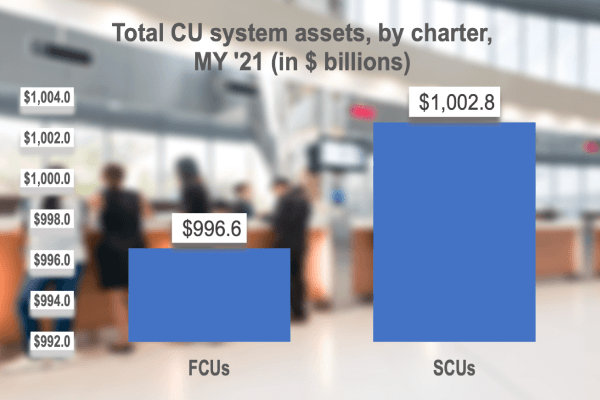 State credit unions now hold more than $1 trillion in assets, representing more than half of all assets held across the credit union system, the latest figures from NCUA show.
Mid-year 2021 numbers released this week by the agency (and numbers compiled by NASCUS for privately insured credit unions from American Share Insurance (ASI)) show that the state system holds $1.003 trillion in combined assets (both federally insured, state chartered CUs (FISCUs) and privately insured credit unions (PICUs)). Federal credit unions hold just under the trillion-dollar mark, at $997 billion.
That brings the combined total of assets for all credit unions to just under $2 trillion ($1.99 trillion). As of mid-year, SCUs held 50.2% of total assets, with FCUs at 49.8%.
The numbers also show state credit unions expanded their asset totals slightly faster than federals during the first half of the year, at a rate of 7.35% (compared to 7.02% for FCUs). In memberships, however, the FCUs added more at a faster rate, adding 1.8 million (up 2.77% from year-end). SCUs added just under 1.1 million members (for a 1.79% growth rate). Total memberships at credit unions are now more than 127 million, according to the compiled statistics.
“The trillion-asset mark is a milestone for the state credit union system,” NASCUS President and CEO Lucy Ito said. “It was only in the last decade that the credit union system as a whole reached $1 trillion in assets. This latest achievement is an indication of how consumers have turned to the credit union system – and particularly state credit unions – during these latest days of economic challenges, and a search by savers and borrowers for security and service.”
The NCUA mid-year numbers also show that credit unions saw their net income rise by more than 77% in the first half of 2021, compared to year-end 2020, expanding to $21.3 billion over the six-month period.
Yet, even though credit unions saw growth in assets, memberships and net income, the overall net worth ratio for the credit union industry in the first half of the year actually declined, the NCUA numbers show. At mid-year, the credit union net worth ratio (which is the primary indicator of credit union safety and soundness) fell to 10.17%, down 150 basis points from year-end (when it stood at 10.32%).
However, the net interest margin at credit unions (which is gauged by comparing the net interest income a credit union earns on loans to the interest it pays savers, a key indicator of profitability) remained steady during the first half of the year, at 2.57% of average assets (the same as at the end of the first quarter). That’s the first quarter in the last five that the ratio has not declined. However, the ratio for the second quarter is also tied for the lowest point it has been in the last five years (comparing second quarter figures only).
LINK:
Credit Unions’ Net Income, Insured Shares and Deposits Rise in Second Quarter