(Nov. 12, 2021) A summary of NCUA’s new rule on federal credit union service organizations (CUSOs) – adopted Oct. 21 by the NCUA Board on a 2-1 vote – has been published by NASCUS; it is available to members only.
The final rule gives CUSOs owned by FCUs the power to originate any type of loan an FCU may originate – and give the NCUA Board more flexibility in approving permissible CUSO activities and services. It becomes effective Nov. 26. Board Chairman Todd Harper voted against finalizing the rule.
By allowing FCU-owned CUSOs to originate any type of loan an FCU can, the list of permissible loans by FCU CUSOs is expanded from only business loans, consumer mortgage loans, student loans, and credit cards. The list of new loans includes automobile and small-dollar (payday) loans – the two types NCUA has said would likely draw the newest involvement by CUSOs.
In its comment filed on the proposal last spring, NASCUS noted as a key concern with the proposal that possible, additional reporting requirements for state credit unions could be a result of a finalized rule. NASCUS noted that the proposal could influence state credit unions considering collaborating with FCU investors in the formation and ownership of a CUSO – a condition that prompted the association to comment.
In some states, NASCUS pointed out, CUSOs owned by state credit unions already hold expanded lending power. The association noted, however, that the NCUA proposal could end up requiring additional reporting requirements that don’t today exist for SCUs. “NASCUS opposes extension of any additional reporting requirements to SCU CUSOs resulting from an expansion of FCU powers,” the association wrote.
Following the rule’s adoption last month, NASCUS President and CEO Lucy Ito said the association views the final rule as a “natural evolution” in a robust dual charter system. However, she noted the additional reporting requirements and added that the state system will review the final rule closely and work with NCUA to resolve any unintended, negative impacts on state credit union CUSOs.
LINK:
NASCUS Final Rule Summary: FCU CUSOs (Parts 712) (members only)
(Nov. 12, 2021) NCUA late last week placed the tiny Pomona Postal FCU of Pomona, Calif., into conservatorship, saying the credit union’s most recent call report shows it had 717 members and $4.2 million in assets. The 57-year-old credit union had about a 51% loan-to-share ratio, according to NCUA data … Bob Gallman, president and CEO of the Louisiana Credit Union League since 2017, has announced his retirement, effective next March; he has notched more than 45 years in the credit union system … Guidance for dealing with climate change risk management “supervisory expectations” will be released this year, the acting comptroller of the currency said this week. “We expect to issue framework guidance by the end of this year, to be followed next year with detailed guidance for each risk area,” Acting Comptroller Michael J. Hsu said. “The detailed guidance will build on a range-of-practices review that will launch this week, industry and climate groups’ input, and lessons from other jurisdictions” … Providing “relevant and timely information” specifically for examiners and financial institution practitioners is the aim of a revamped notification system announced this week by the FFIEC (which, since April, has been chaired by NCUA Chairman Todd Harper). According to the Exam Council, its “FFIEC Announcements” email notifications will be distributed to the council’s email subscribers notifying them of updates to its website and “Infobases.” Each issuance, the council said, will be designated with the word “Announcement” in the header, followed by a sequential numbering order of a four-digit year and a two-digit issuance number. See the link for more or to sign up.
LINKS:
NCUA Places Pomona Postal Federal Credit Union Into Conservatorship
Acting Comptroller Discusses Climate Change Risk
FFIEC Implements New “Announcements” Communication Tool

Participants in a first day’s panel at the NCUA DEI Summit this week were (from left) NASCUS’ Lucy Ito, CUNA’s Jim Nussle, and NAFCU’s B. Dan Berger.
(Nov. 5, 2021) NASCUS President and CEO Lucy Ito played a central role in week’s Diversity, Equity and Inclusion (DEI) Summit presented by NCUA, appearing on two panels at the three-day, virtual conference held Tuesday through Thursday.
The conference focus, according to NCUA, was on advancing DEI in the credit union system by sharing best practices, addressing challenges to advancing DEI and learning about how NCUA can support the industry in its efforts.
Ito shared the first panel with CEOs of other Washington groups representing credit unions, Jim Nussle of the Credit Union Natl. Assn. (CUNA), and B. Dan Berger of the Natl. Assn. of Federally Insured Credit Unions (NAFCU). The group discussed the credit union role in the DEI journey. The second panel featuring Ito discussed “How to Increase Gender Diversity in the C-Suite,” and included CEOs from credit unions: Mary McDuffie (Navy Federal CU president and CEO), Shruti Miyashiro (Orange County’s CU CEO), and Tracey Jackson (ResourceOne CU CFO).
In both sessions, Ito discussed the impact of DEI on herself and on the credit union system, and efforts by NASCUS and the state system at large to advance DEI along the lines of the conference’s goals.
“My thanks to NCUA, particularly Chairman Harper, Vice Chairman Hauptman and Board Member Hood, for inviting me to participate in this event – and for their personal commitments to this vital effort for the credit union industry at large,” Ito said.
(Nov. 5, 2021) Credit unions are encouraged to participate in the free program that helps members address their federal income taxes; credit unions have until Nov. 15 to contact the IRS about their interest in participating, NCUA said this week.
In its letter to credit unions (LTCU) 21-CU-12, the agency said the IRS Volunteer Income Tax Assistance (VITA) program provides education for consumers on refundable credits, including the Earned Income Tax Credit (EITC) and the Child Tax Credit (CTC). The agency noted that the refundable federal tax credits can provide thousands of dollars to working individuals and families with low to moderate incomes.
The letter outlines the benefits of participating in the VITA program (which NCUA described as potential for attracting new members, asset- and wealth-building opportunities for members and greater financial education and financial stability for members, among other things), and lists the ways credit unions may participate, and methods for doing so.
NASCUS has posted a summary of the letter (available to members only).
LINK:
NASCUS Summary, NCUA LTCU 21-CU-12 (members only)
(Oct. 29, 2021) Coordination with state and other federal regulators on regulation of decentralized finance (DeFi) and other emerging uses of digital assets is crucial to avoid conflicting rules and confusion, NASCUS wrote in a comment letter to NCUA– one of two posted by the association to the agency this week.
However, the association noted, the regulated and trusted incumbent credit union and banking systems offer the best and safest path forward for the growing consumer use of digital assets and the other innovations brought forth by DeFi.
The letter was in response to the NCUA Board’s July-issued “request for information,” which highlighted the agency’s interest in the impact of distributed ledger technology (DLT, such as blockchain) and DeFi. The original comment due date was extended late last month by 30 days, closing out Oct. 27.
The RFI posed more than two dozen questions over five subject areas: the use of DLT and DeFi applications within the credit union system; development of such projects with third-party relationships or credit union service organizations (CUSOs); risk and compliance management; supervision, including whether and how regulation should be revised to address such activities; and share insurance and resolution – including, among other things, how to distinguish between uninsured digital assets and insured shares.
The state system said it applauded the agency for developing its understanding of DeFi, emerging technologies, and how “credit union stakeholders have engaged with digital assets and emerging DeFi ecosystem.”
However, NASCUS also “strongly recommended” that the agency coordinate with both state and other federal regulators with jurisdiction over products, services and participants engaged in DeFi. “Lack of coordination between regulatory systems can lead to conflicting rules and supervisory expectations that would further complicate and hinder credit union participation in the DeFi ecosystem,” NASCUS stated.
As an example, NASCUS noted that there is a “dizzying array of evolving digital currency with critically distinct features,” pointing to (among others) unregulated decentralized convertible virtual currency (CVC), stablecoins, and central bank digital currencies (CBDCs). “Each of these types of currencies carry different consumer protection, money laundering, and volatility risks,” NASCUS wrote. “Close coordination between regulators will help ensure a common understanding of which products carry which risks.”
Further, NASCUS wrote, NCUA should focus “narrowly on material financial safety and soundness risks with respect to federally insured state credit unions (FISCUs) and defer to state law regarding permissibility of FISCU activities in this space. So doing will ensure the most vibrant innovation for credit union engagement in DeFi by leveraging the power of the dual chartering system.”
In other comments, NASCUS wrote:
- The DeFi ecosystem is diverse, and regulation should distinguish between those credit unions using digital assets, creating digital assets, providing services to members’ use of digital assets, and credit unions’ own use of DeFi technology. “A one-size-fits-all approach to regulating, or supervising, credit union engagement with DeFi will stifle innovation and leave stakeholders at a competitive disadvantage,” NASCUS stated.
- Providing an on-ramp to DeFi stakeholders will require the agency to consider enhanced flexibility in existing rules and powers for credit unions. For example, NASCUS wrote, facilitating credit unions’ ability to explore “banking as a service” (BaaS, offered in partnership with financial technology (fintech) firms) “may require evolving views on associational field of membership or authority to provide pass-thru services to a business member’s customers.” Further engagement with fintechs, NASCUS wrote, “may require expanding permissible services for natural person and corporate CUSOs and permitting credit unions to hold equity investments in non-CUSO fintechs and other entities.” The preemptive application of its rules on FISCUs’ state-authorized powers should be minimized by NCUA, NASCUS argued, to allow the dual chartering system to maximize its potential for innovation among the states.
Comment from National Association of State Credit Union Supervisors
(Oct. 29, 2021) A Texas credit union that expects to start operations by year’s end is the third to be chartered in 2021 by NCUA, the agency said this week.
The agency said Capital Federal Credit Union (FCU) in Lubbock would provide services to a multiple common-bond field of membership that will include employees of Capital Mortgage Services of Texas, members of the League of United Latin American Citizens — Lubbock, Texas Council #263, and an underserved portion of Lubbock County consisting of 39 census tracts.
NCUA said the credit union will also seek the low-income credit union (LICU) designation by focusing on serving the Latin American population in the underserved area.
Although the new credit union will not initially offer checking accounts and debit card access (which it plans to do later, NCUA said), it will offer such services as savings accounts, vehicle and personal loans, online banking and mobile banking.
Earlier this year, the agency chartered Maun FCU in Kendall Park, N.J., as an Islamic-faith-based, no-interest credit union; and Community First Fund FCU in Lancaster, Pa., a community development financial institution (CDFI) aimed at serving the approximately 550,000-person community of Lancaster County.
LINK:
NCUA Charters Capital Federal Credit Union
(Oct. 22, 2021) Eligible low-income credit unions (LICUs) may accept 30-year subordinated debt investments from a Treasury program meant to encourage the institutions to augment efforts to support small businesses and consumers, NCUA announced Thursday.
In a letter to credit unions (LTCU 21-CU-11) Thursday, the agency said the LICUs may accept the subordinated debt investments from the Treasury Department’s Emergency Capital Investment Program (ECIP). In addition, the agency said, the credit union may treat the investment as secondary capital in accordance with NCUA regulations. That is, provided that the LICU has an agency-approved secondary capital plan by year’s end.
According to NCUA Board Chairman Harper, the policy will allow ECIP-participating credit unions to fulfill that statutory mission and advance economic equity and justice. “Going forward, the NCUA will pursue additional action to permit ECIP funding to count as regulatory capital for the entire time it is held,” he said.
The agency’s subordinated debt rule, adopted in January, includes a 20-year limitation on the regulatory capital treatment of “Grandfathered Secondary Capital,” NCUA said. That is defined as any secondary capital issued under a secondary capital plan that was approved by the NCUA before Jan. 1, 2022. The agency indicated it plans, in the future, to clarify that ECIP participating credit unions may count ECIP funding as regulatory capital for the entire time it is held.
NCUA said the latest LTCU is the second step in a three-step process for ensuring credit unions can use ECIP. The first step was a proposed rule issued earlier this year to allow eligible credit unions to accept ECIP funding in 2022 without having to fill out a new subordinated debt application after the effective date of the new rule. The third step, according to the agency, will be more NCUA action – “sometime in 2022” — to permit ECIP funding to count as regulatory capital for the entire time it is held.
LINK:
NCUA LTCU 21-CU-11: Emergency Capital Investment Program Participation
(Oct. 22, 2021) An “S” for “market sensitivity” is now part of the NCUA exam rating system, thanks to a unanimous vote by the agency board at its Thursday meeting – and long-term advocacy by NASCUS – bringing the agency in line with a policy already adopted by more than half of all state regulators.
The rule also redefines the “L” component (liquidity risk) of the rating system.
The new rating – which effectively renames the rating system “CAMELS” – will take effect April 1, 2022.
Adding the “S” component, according to NCUA, will allow the agency and federally insured credit unions to better distinguish between liquidity risk (“L”) and sensitivity to market risk (“S”). Also, the amendment will enhance consistency between the regulation and supervision of credit unions and other financial institutions.
The CAMELS proposal was issued in January and approved for public comment on a unanimous NCUA Board vote. As proposed, the rule would bring NCUA’s rating system up to date with a change that banking regulators incorporated decades ago and satisfy a recommendation the agency’s inspector general has been recommending for about the past five years.
More than five years ago, NASCUS wrote to NCUA urging the change and adding the “S” component. “NASCUS and state supervisory agencies encourage NCUA to consider earlier adoption of ‘CAMELS,’” NASCUS’ Lucy Ito wrote in the June 2016 letter to the board. “We again note that the separation of the ‘S’ component does not require a credit union to develop additional management system enhancements where market risk is already appropriately identified, measured, monitored and managed as part of the ‘L’ component.”
She also noted that in states that have adopted CAMELS (now totaling 25 – up from 16 when Ito penned the letter in 2016), that regulators and credit unions have reported positive outcomes with nearly no additional regulatory burden.
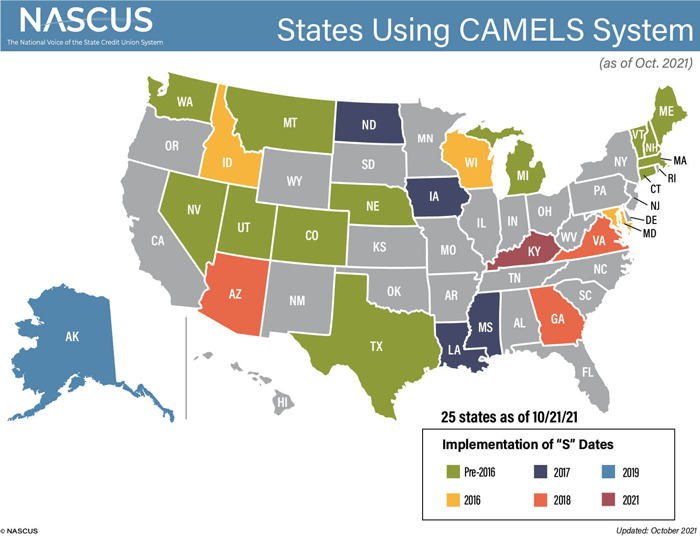
In its comment letter filed last spring, NASCUS said there is no need to “reinvent the wheel and develop a credit union CAMELS Rating System that diverges from the established CAMELS system currently in use in bank supervision and in the states that have adopted CAMELS for credit union supervision.”
In the final rule commentary issued Thursday, NCUA stated that the updated rating system is based on (and consistent with) the Uniform Financial Institutions Rating System (UFIRS) system used by NCUA and the banking regulators. However, the commentary noted, NCUA has made certain minor, non-substantive modifications to the rating descriptions to clarify and better reflect supervision of credit unions. “Notwithstanding this slight divergence from UFIRs, the Board has determined that the NCUA’s revised rating system is consistent with the other financial supervisors,” NCUA said.
Agency staff also told the board that, in their view, the new rule will have little, if any, impact on the 20 state regulators (and their credit unions) that do not yet have the S component in their exam ratings.
LINKS:
Final Rule: CAMELS Rating System
NASCUS comment: Notice of Proposed Rulemaking Regarding CAMELS Rating System
(Oct. 22, 2021) NASCUS President and CEO Lucy Ito congratulated the NCUA Board for finalizing an “S” component (for market sensitivity) to the CAMEL rating system (making it now “CAMELS”) at its Thursday meeting (and adjusting the “L” component, accordingly, for liquidity). She also thanked Board Member Hood for responding to NASCUS’ recommendation to introduce the change, which he did early this year – something NASCUS has advocated for years.
“To date, 25 states have implemented CAMELS and two additional states are scheduled to do so by Jan. 1,” Ito said. “Without exception, all states that have already adopted CAMELS report a very smooth and seamless transition for credit unions including smaller asset sizes as all credit unions are already monitoring market risk under the L component. Indeed, under CAMEL, credit unions can be ‘dinged’ unfairly. If their liquidity and sensitivity to market risk are rated differently, the lower rating will prevail for the L component. The addition of the ‘S’ component will not only be fairer, it will also position both credit unions and examiners to more effectively monitor and evaluate interest rate risk as the U.S. enters an uncertain interest rate environment.”
(Oct. 22, 2021) Speaking of cybersecurity: Use of cloud-based email services are proving to be targets for cybercriminals, and credit unions need to take steps to thwart any exploitation and take preventative steps, NCUA said this week.
In Risk Alert 21-RISK-01, the agency said phishing emails designed to steal account credentials through cloud-based email services have proven to be among the most effective types of business email compromise (BEC) scams. The agency said that action occurs by cybercriminals using phishing kits to target victims on cloud-based services, analyze accounts, impersonate email communications, fraudulently demand (and receive) payments, compromise address books, send more phishing emails — and more.
The risk alert listed 12 methods credit unions may take to prevent BEC fraud; the top three are: Enable multi-factor authentication for all email accounts; disable basic or legacy account authentication that does not support multi-factor authentication; use caution when posting information on social media and company websites, especially job duties and descriptions, hierarchal information, and out-of-office details.
The risk alert also notes wire transfer fraud incidents are also increasing, as more transactions through virtual environments have tilted that way. The alert lists a number of operational, transactional, and physical and logical controls for limiting wire fraud risk and incidents.
LINK:
(Oct. 22, 2021) The state system supports the NCUA proposed rule establishing a “complex credit union leverage ratio” (CCULR), as well as a quick implementation of a final regulation, but also has key considerations for the agency before it finalizes the rule, NASCUS wrote in its comment letter this week.
More specifically, NASCUS wrote that subordinated debt should be permitted in calculating net worth for CCULR thresholds; that complex credit unions of all sizes can appropriately manage the optionality of both entering and exiting the CCULR; and changes are needed to the current (and proposed) risk-based capital (RBC) and subordinated debt rules in order to avoid a “chilling effect” on the low-income credit union (LICU) secondary capital system.
The NASCUS letter was in response to a call for comments issued by NCUA in July for its proposal to make a simplified measure of capital adequacy available to federally insured credit unions defined as “complex” – meaning those with more than $500 million in assets. According to NCUA, the CCULR framework is comparable to the community bank leverage ratio (CBLR) that went into effect in January 2020 for banks under the 2018 financial regulatory relief law. That rule allows banks to hold a certain, uniform level of capital (now at 9% of assets) as long as they meet certain conditions, including in lending and investments.
Under the NCUA proposed rule, a complex credit union that opts into the CCULR framework and maintains the minimum net worth ratio would be considered well capitalized. For the CCULR, that would begin with 9% as of Jan. 1, 2022, and rise gradually to 10% by Jan. 1, 2024. The credit union would not be required to calculate a risk-based capital ratio under the Oct. 29, 2015, risk-based capital final rule, which also takes effect Jan. 1, 2022. Other qualifying criteria for the proposed framework include: off-balance-sheet exposures equal to 25% or less of total assets; trading assets and trading liabilities that are 5% or less of total assets; and goodwill and other intangible assets that are 2% or less of total assets.
NASCUS wrote developing the CCULR would reduce regulatory burden for those complex credit unions opting-in and would allow them to redirect scarce resources toward other operational priorities, without compromising capital standards or endangering the credit union share insurance fund (SIF).
“By ensuring that the CCULR is available as an option to all complex credit unions, the NCUA can maximize synergy with the RBC rule, maintain flexibility, and achieve greater consistency with sound public policy and the Federal Credit Union Act,” NASCUS wrote. “Thus, the CCULR can achieve its purposes of providing optionality and regulatory relief to complex credit unions by allowing for more effective and efficient deployment capital in service of the members.”
NASCUS also urged the agency to make some additional considerations before finalizing the rule, which – as proposed – would take effect at the beginning of next year, the same date that the RBC rule is scheduled to take effect.
NASCUS recommended that that agency incorporate subordinated debt into the calculation of the CCULR net worth ratio. “Excluding subordinated debt from the CCULR would be an unfortunate step back from nearly a decade’s worth of work to modernize the credit union capital framework,” NASCUS wrote. “Allowing complex credit unions to access capital in addition to retained earnings to meet regulatory benchmarks is sound public policy.”
Further, NASCUS urged the agency provide credit unions with authority to opt in and out of the CCULR with the same flexibility that community banks have udder the CBLR (the proposal allows credit unions to open in at the end of a reporting quarter, and they can only opt out if they provide NCUA with at least 30 days prior notice; banks can do both at any time under their rule). NCUA, in its proposal, said the advance notice was required because credit unions do not have experience, yet, with calculating risk-based capital under the RBC, which takes effect at the beginning of next year.
“While it is true that complex credit unions have not been required to calculate the risk-based capital ratio pursuant to the 2015 final RBC rule, the fact is that the rule has been in place for several years and we believe many complex credit unions have familiarized themselves with the calculations in anticipation of previous, and now pending, effective date(s),” NASCUS asserted.
Finally, the state system urged NCUA to address ongoing concerns about whether the final Subordinated Debt rule is properly calibrated with respect to low-income designated credit unions (LICUs).
“LICUs are a critically important component of the credit union system providing services to predominantly low-income members,” NASCUS wrote. “While an overwhelming majority of LICUs are not subject to the RBC rule, they are subject to the 2020 Subordinated Debt rule. Given the genesis of the Subordinated Debt rule as a corollary to the RBC rule, it is appropriate that refinements to the subordinated debt framework be considered contemporaneously with changes to the RBC rule.”
(Oct. 22, 2021) Actions credit unions, banks and nonbanks alike should consider taking to ensure safe-and-sound practices during the transition away from the LIBOR reference rate were outlined in joint guidance this week by NCUA, the federal bank regulators, state credit union and bank regulators and the CFPB.
NCUA covered the joint statement in letter to credit unions (LTCU) 21-CU-10, Interagency Statement on LIBOR Transition. In the letter, NCUA noted that the regulators are emphasizing the expectation that credit unions and other supervised institutions with exposure to LIBOR (the London Interbank Offered Rate) will continue to progress toward an orderly transition away from LIBOR toward an alternative reference rate.
“The NCUA encourages all federally insured credit unions to transition away from using U.S. dollar LIBOR as a reference rate as soon as possible, but no later than Dec. 31, 2021, and to ensure existing contracts have robust fallback language that includes a clearly defined alternative reference rate,” the NCUA letter states.
LIBOR will be discontinued for new contracts after Dec. 31; existing contracts using LIBOR after that date must transition to an alternative by June 30, 2023.
CFPB said it joined the letter to highlight the consumer risks posed by the discontinuation of LIBOR, and urged credit unions, banks and nonbanks alike to continue their efforts to transition to alternative reference rates to mitigate consumer protection.
“The financial services industry uses LIBOR as a reference interest rate for many consumer financial products including mortgage loans, reverse mortgages, home equity lines of credit, credit cards, and student loans,” CFPB said in a press release. “The approaching discontinuation of most LIBOR tenors in June 2023 presents financial, legal, operational, and consumer protection risks. Additionally, consumers may not know when the transition from LIBOR will occur or how institutions will calculate their interest rates if they do not issue required disclosures to consumers.”
The regulators’ joint statement, among other things, urges financial institutions to ensure that no new contracts utilizing a LIBOR index reference rate are entered into after Dec. 31 – the day LIBOR becomes defunct. NCUA and the other regulators outlined supervisory considerations for financial institutions in transitioning away from LIBOR. Among them: clarification on the meaning of new LIBOR contracts, which stated that contracts entered into on or before Dec. 31 should either use a reference rate other than LIBOR or have fallback language that provides for use of a “strong and clearly defined alternative reference rate after LIBOR’s discontinuation.”
The statement also outlines considerations when assessing the appropriateness of alternative reference rates, expectations for fallback language and more.
Also this week, the OCC released an updated self-assessment tool to aid banks in their LIBOR transition. According to the agency, the tool is aimed at evaluating bank preparedness to deal with the end of the rate, particularly by helping banks evaluate their management processes for identifying and mitigating LIBOR transition risks.
LINKS:
NCUA LTCU 21-CU-10: Interagency Statement on LIBOR Transition
Joint Statement on Managing the LIBOR Transition
CFPB Joins Other Financial Regulatory Agencies in Issuing Statement on Discontinuation of LIBOR