(July 2, 2021) Plans for future Bank Secrecy Act (BSA) rule changes to incorporate just-issued national priorities for combatting money laundering and financing of terrorism were outlined this week in an interagency statement from NCUA and other federal financial regulators. NCUA also issued a “letter to credit unions” (21-CU-05) on the topic.
The priorities, issued by Treasury’s Financial Crimes Enforcement Network (FinCEN), describe “the most significant AML/CFT (anti-money laundering and countering the financing of terrorism) threats currently facing the United States,” according to the agency. The priorities outlined by FinCEN include corruption, cybercrime, domestic and international terrorist financing, fraud, transnational criminal organizations, drug trafficking organizations, human trafficking and human smuggling, and proliferation financing.
FinCEN said the priorities are meant to assist covered institutions in their AML/CFT efforts and enable them to prioritize the use of their compliance resources. It said the priorities highlight key threat trends as well as informational resources that can help institutions in managing their risks.
NCUA (as stated in its letter to credit unions) and bank regulators said that while not required to do so, the agencies plan to propose changes to their own BSA rules addressing the priorities. Banks and credit unions (as well as nonbanks, the target of a separate FinCEN statement) are not required to make any changes in their risk-based BSA compliance programs, and examiners will not review institutions for incorporation of the AML/CFT priorities into those programs, until the effective date of a final rule, the agencies and FinCEN said.
In its letter, NCUA said credit unions “may wish to start considering how they will incorporate the AML/CFT Priorities into their risk- based BSA compliance programs.” The banking agencies advised the same for their supervised entities, noting that incorporation could include assessing the “potential related risks associated with the products and services they offer, the customers they serve, and the geographic areas in which they operate.”
No target date for a proposed rule was offered by any of the regulators. However, FinCEN pointed out that the AML Act requires that the agency promulgate rules to implement the priorities within 180 days of their publication.
LINKS:
(June 25, 2021) The Supreme Court ruled this week that the director of the Federal Housing Finance Authority (FHFA) may be fired by the president, overturning the agency’s structure which held that the director could only be removed “for cause” – and the same day, that’s what the president did. The White House said that President Joe Biden (D) had fired FHFA Director Mark Calabria (in office since 2019) and replaced him (as acting director) with Sandra Thompson, who has served as deputy director of the agency’s division of housing mission and goals since 2013. She worked before that for more than 23 years at the FDIC … The loan interest rate ceiling for federal credit unions will remain at 18% through March 10, 2023, under action taken Thursday by unanimous vote of the NCUA Board – the 23rd time the board has approved the ceiling since it was initially set in 1987 … Farewell to Jay Murray who has retired as CEO of Vizo Financial Corporate CU effective June 1 after nearly 30 years with the corporate — and congrats to David Brehmer who had been serving as president is now president and CEO of VFCCU … The House on Thursday joined the Senate (both with bipartisan – if narrowly so – votes) to repeal the OCC’s “true lender” rule. President Biden has indicated he will sign it into law. The rule, the first financial regulator rule from the Trump era to be overturned by Congress, aimed to determine when a bank is a “true lender” within the context of a partnership between it and a third party. It had been criticized by consumer groups and others, saying it leaves customers vulnerable to predatory “rent-a-bank” schemes, in which an agreement is made between a bank and a third party to advance the loan – but then the bank takes over the loan once the transaction is completed.
(June 25, 2021) NASCUS President and CEO Lucy Ito said the state system embraces both new rules, which the association had supported. On interest capitalization, Ito said the new rule will provide greater flexibility for the credit union system to work with economically distressed members. “This rule will expand the options for loan repayments by members working to regain their economic footing as the financial impact of the coronavirus crisis begins to recede,” she said.
On the CECL standard rule, Ito thanked the board for heeding the state system’s suggestions on recognizing fiscal years and clarifying eligibility for small, state-chartered credit unions subject to GAAP.
She also took note of comments by NCUA Board Vice Chairman Kyle Hauptman about CECL and its applicability to credit unions as financial cooperatives. “Vice Chairman Hauptman keenly observed the cooperative structure of credit unions differentiates them from other financial intermediaries,” Ito said.
However, she added that “NASCUS believes CECL should apply to credit unions given their business functions as depositories and lenders. We look forward to working with NCUA on tools and resources to assist credit unions in complying with CECL in a cost-effective and time-effective manner.”
(June 25, 2021) Allowing otherwise healthy credit unions to continue to focus on serving their members through rules providing regulatory relief from prompt corrective action has once again won the support of the state system, NASCUS said in a comment letter filed late last week.
NASCUS filed the comment on NCUA’s temporary regulatory relief rule in response to COVID-19-prompt corrective action, which took effect April 19. The rule allowed NCUA to waive the earning retention requirement for any federally insured credit union classified as adequately capitalized. It also allowed certain qualifying undercapitalized FICUs to submit simplified net worth restoration plans (NWRPs). The rule extended action taken in spring 2020 as the financial impact of the pandemic became apparent.
“The extraordinary effects of the COVID-19 pandemic and subsequent government efforts to mitigate the resulting economic dislocation strained the regulatory capital of some otherwise healthy credit unions,” NASCUS wrote. “The changes made by the IFR provide targeted regulatory relief without unduly increasing risk to the share insurance fund.”
LINK:
NASCUS Comments on Temporary Regulatory Relief Rule in Response to COVID-19-Prompt Corrective Action
(June 25, 2021) Final rules on capitalization of interest by federally insured credit unions, and on mitigating the day-one effect of the current expected credit loss (CECL) accounting standard on capital levels at credit unions, were approved – both unanimously – by the NCUA Board at its Thursday meeting.
Both rules are supported by NASCUS.
The interest capitalization rule is slated to take effect 30 days after publication in the Federal Register; however, NCUA staff indicated that credit unions could begin using its provisions now. The CECL rule takes effect immediately.
The interest capitalization rule removes the prohibition on capitalizing interest in connection with loan workouts and modifications. Adopted as proposed (without change), the agency said the final rule establishes documentation requirements to “help ensure that the addition of unpaid interest to the principal balance of a mortgage loan does not hinder the borrower’s ability to become current on the loan.”
The final rule makes several technical changes to the regulations to improve their clarity and update certain references
NCUA Office of Examination and Insurance Director Myra Toeppe indicated that, although the official effective date of the rule is 30 days after publication, credit unions are encouraged to use its provisions as soon as possible without facing enhanced scrutiny from examiners.
NASCUS had urged NCUA, when filing its comment letter in February, to act expeditiously in finalizing the rule, arguing that doing so would give credit unions greater flexibility to work with economically distressed members and provides “consumer protection guardrails that protect against the unlikely chance that a credit union engages in unfair lending practices.”
Regarding state laws on interest capitalization, NCUA’s final rule notes that the agency is not inclined to provide a blanket preemption of any or all state laws that may relate to capitalization of interest. “FCUs may need to evaluate the application of relevant state laws on a case-by-case basis and may contact the NCUA for its opinion in the event a particular state law raises a preemption issue,” the agency wrote.
On the rule dealing with the impact of the CECL accounting standard (which takes effect for most credit unions in January 2023), a phase-in period of three years is established for adverse effects on credit unions’ regulatory capital. Credit unions with less than $10 million in assets would be exempted from using the standard to figure loan loss reserves.
The final rule has two changes from the proposal, as advanced by NASCUS. First, the rule makes a technical change (for clarity) removing references to specific calendar dates in the transition period for the phase in. The rule now consistently refers to fiscal years.
The second change clarifies that state-chartered FICUs with less than $10 million in assets and that are required by state law to comply with generally accepted accounting practices (GAAP) are eligible for the transition phase-in.
NASCUS, in its comments last year, supported the rule and NCUA’s efforts to mitigate the impact of the accounting standard. However, NASCUS also noted that the accounting standard remains of concern. “NASCUS, many state credit union regulators, and many state credit union system stakeholders remain concerned that the CECL methodology will be counter-productive when implemented for the credit union system,” NASCUS wrote.
LINKS:
Final Rule, Part 741, Appendix B, Capitalization of Interest.
Final Rule, Part 702, Current Expected Credit Loss Methodology
(June 25, 2021) In another development during Thursday’s NCUA Board meeting, two members discussed the future of an advisory council from among the credit union system for NCUA – something NASCUS has long supported and called for again in the wake of this week’s meeting.
Board Member Rodney Hood spoke in favor of an advisory group (noting that other federal financial regulators have such councils); NCUA Board Chairman Todd Harper reminded that he supported such a group for NCUA – and other forms of “community outreach” – during Senate confirmation hearings in 2019. However, no decisions were made by the board on any advisory group for NCUA.
NASCUS’ Lucy Ito suggested the agency should consider action soon.
“NASCUS fully agrees with Chairman Harper and Board Member Hood on the value of a credit union advisory body at NCUA,” Ito said. She noted that in April 2017, NASCUS enacted a public policy advocating for the creation of an “NCUA Federally Insured Credit Union Advisory Council.”
“As administrator of the NCUSIF, NCUA should form an advisory council of federally insured credit unions to provide NCUA with advice and guidance on issues related to share insurance regulation and supervision,” Ito said. “Such an advisory council should consist of equal numbers of state chartered and federally chartered credit unions and should convene at least twice annually with the NCUA Board in public meetings.”
(June 18, 2021) Two final rules – on mitigating the impact of the new CECL accounting standard, and allowing credit unions to capitalize interest, which NASCUS urged be finalized “expeditiously” earlier this year – are on the agenda for the NCUA Board when it meets next week.
The proposal on capitalizing interest was issued in November by the NCUA Board and would remove a prohibition on interest capitalization. Then, the board suggested, that continuing to prohibit the authorization of additional advances to finance unpaid interest may be overly burdensome. Removing the prohibition, the board asserted, would “assist a federally insured credit union’s good-faith efforts to engage in loan workouts with borrowers facing difficulty because of the economic disruption that the COVID- 19 event has caused.”
In its comment letter filed in February, NASCUS agreed, writing that finalizing the proposal would provide credit unions’ greater flexibility to work with economically distressed members (including those affected by the coronavirus crisis). “That enhanced flexibility benefits distressed credit union borrowers by expanding the options for repayment programs as the member regains their economic footing,” NASCUS wrote.
The state system also urged the board to act expeditiously in finalizing the proposal. “We have no doubt credit unions will exercise the ability to capitalize interest to the benefit of members in need and are confident in the ability of state examiners to provide supervisory oversight of loan workouts and modifications,” NASCUS wrote.
Also on the board’s agenda for next week’s meeting: finalizing a rule mitigating the day-one effect of the current expected credit loss (CECL) accounting standard on capital levels at credit unions. The new standard takes effect for most credit unions in January 2023.
Under the proposal, a phase-in period of three years would be established for the day-one adverse effects on credit unions’ regulatory capital under the CECL accounting standard. However, smaller credit unions (those with $10 million or less in assets) would be exempted from having to use the standard to figure loan loss reserves.
NASCUS, in its comment letter filed last October, supported the proposal, but also offered some suggested changes, including that credit unions that reach $10 million in assets after Jan. 1, 2023 should be afforded the opportunity of a three-year phase in of the day-one effect. Credit unions larger than that, NASCUS wrote, should have the option of recognizing the full day-one effect of CECL immediately. NASCUS also urged NCUA to consider how CECL will be incorporated into stress-testing requirements after implementation.
The meeting is set for 10 a.m. on Thursday; audio of the session will be streamed live, via the Internet.
LINKS:
NCUA Board Agenda for the June 24, 2021 Meeting
NASCUS Comments on Transition to the Current Expected Credit Loss Methodology
(June 18, 2021) Other new and proposed rules that should be coming up for action soon by the NCUA Board were also outlined in the spring 2021 regulatory agenda published recently by the agency (via the White House Office of Management and Budget (OMB)). Those include:
- A proposed rule to integrate an NCUA equivalent (the Complex Credit Union Leverage Ratio, CCULR) to the community bank leverage ratio (CBLR) into NCUA’s capital standards, perhaps as soon as next month. The CCULR is modeled on the bank ratio adopted by federal banking agencies in 2019, which removes requirements for calculating and reporting risk-based capital ratios for most banks with less than $10 billion in assets, more than 9% in risk-based capital, and that meet certain risk-based qualifying criteria. Banks meeting the criteria can “opt-in” to use the CBLR. NASCUS, in a comment letter last month, said the state system supported further development of the CCULR, noting that it would allow both the 2015 risk-based capital and subordinated debt rules to take effect.
- A final rule (as soon as September) updating the CAMEL exam rating system, including adding an “S” (for “sensitivity to market risk”). NASCUS filed comments on the proposal in early May, urging the agency to move “expeditiously” on adding the S component, which, NASCUS wrote, would better align NCUA with state credit union and federal banking regulators that have already made the move.
- A final rule (perhaps by the end of this summer) expanding CUSO lending activities. In its comment letter in March, NASCUS noted possible, additional reporting requirements for state credit unions if the proposal were made final. In some states, NASCUS pointed out, CUSOs owned by state credit unions already hold expanded lending power. The association noted, however, that the NCUA proposal could end up requiring additional reporting requirements that don’t today exist for SCUs. “NASCUS opposes extension of any additional reporting requirements to SCU CUSOs resulting from an expansion of FCU powers,” the association wrote.
- Revision of regulation prohibiting a federally insured credit union (FICU) from making golden parachute and indemnification payments to an institution-affiliated party under certain circumstances. According to the rule list, the proposed rule would improve the organization and clarity of the regulation and would include a section on merger-related financial arrangements. It also would amend the regulation to assist FICUs in the identification and processing of golden parachute payments. The proposal is scheduled by October or later.
LINK:
OMB Agency Rule List – Spring 2021 (NCUA)
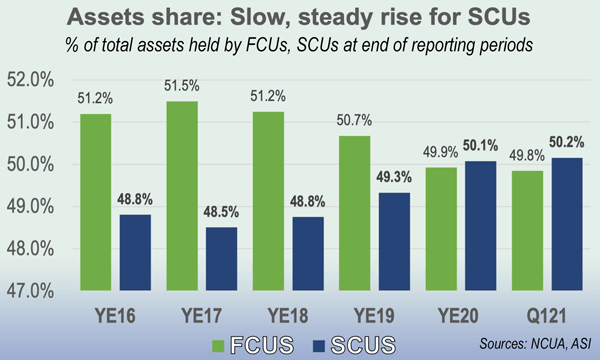 (June 11, 2021) Credit union assets mushroomed to a total of just under $2 trillion in the first quarter of the year – and state-chartered credit unions kept pace with the growth, maintaining a slight edge over federals in the share of total assets held as of March 31, according to numbers released by NCUA, and compiled by NASCUS, late last week.
According to first-quarter credit union statistics culled from first quarter call reports, the nation’s 2,007 state credit unions (federally and privately insured) held 50.2% of total assets, with the 3,167 federals holding the balance. Growth of assets in the first quarter slightly favored state credit unions, which advanced their holdings by 5.85%; FCUs grew by 5.52%. Membership at the state credit unions advanced by just over 500,000 (0.83%); FCUs saw memberships grow by 900,000 (1.39%). Total membership for credit unions was 125.8 million (FCUs have the edge here, with 51.7% of all members).
As in past quarters, most of the growth in assets was centered on the largest of credit unions: those with at least $1 billion (395 credit unions). Those CUs held more than $1.4 trillion in assets and 72% of all assets in credit unions. Membership grew by 10% and net worth increased by 13.7%, according to NCUA. (The 293 credit unions with more than $500 million but under $1 billion in assets held about 10% of total assets and also saw increases in their lending, memberships and net worth).
Those results are in stark contrast with smaller credit unions (those under $500 million in assets): according to NCUA, loans, membership and net worth among those credit unions – which make up 92% of all credit unions, but hold only about 17% of all assets — declined in the first quarter, following a trend of the last several years.
NASCUS President and CEO Lucy Ito affirmed that the inflow of savings from stimulus payments and other sources was a key factor in driving up assets at credit unions that saw growth. But she also praised the management of state credit unions for ensuring their members have a haven for their savings, and that the members understand the safety and value a credit union offers.
“The numbers make it clear that credit union members recognize that their state-chartered institutions are strong, safe and resilient institutions that watch out for their members’ interests,” she said.
But she also acknowledged the struggle that smaller credit unions face in today’s environment. “State supervisory authorities are committed to doing whatever they can, in concert with safety and soundness, to give smaller credit unions their best chance to thrive,” Ito said. “Small credit unions play a key role in the lives of their members, and the state system wants that role to continue.”
Other first quarter results for federally insured credit unions (state and federal) reported by NCUA showed:
- The return on average assets for federally insured credit unions was 104 basis points in the first quarter of 2021, up from 52 basis points in the first quarter of 2020.
- Net income totaled $19.7 billion at an annual rate, up $11.3 billion (134.9%) from the same period a year ago.
- The net interest margin was $48.7 billion, 2.57% of average assets.
- Delinquency and net charge-off rates were both down, compared to a year ago: the former was 46 basis points (down 17 points from last year); the latter (as the net charge-off ratio) was 35 bp (down from 58 bp in the first quarter of 2020).
LINK:
Rising Net Income, Elevated Insured Share Growth Reported in First Quarter of 2021
(June 11, 2021) Actions taken by the federal credit union regulator in April – extending temporary provisions giving credit unions some regulatory relief from savings surges during the coronavirus crisis – were reinforced by the agency late last week in a letter to federally insured credit unions.
NASCUS has prepared a summary of the letter, which is available now (members only).
In its Letter to Credit Unions (21-CU-04), the NCUA Board reminded credit unions that the actions it took in April — reducing the earnings retention requirement for credit unions classified as adequately capitalized, and permitting an undercapitalized credit union to submit a streamlined net worth restoration plan if it becomes undercapitalized predominantly because of share growth during the coronavirus crisis – are in effect until the end of March 2022.
The action taken in April was essentially an extension of a decision made in June 2020, which the agency said was taken in “anticipation that some federally insured credit unions may experience a temporary reduction in earnings and regulatory capital ratios due to their COVID-19 response efforts.” Those temporary modifications expired Dec. 31, 2020.
However, NCUA decided earlier this year to reintroduce the temporary changes, due to the continued impact of the COVID-19 pandemic, the agency said.
LINKS:
NCUA Letter to Credit Unions 21-CU-04, Renewal of Prompt Corrective Action Relief
NASCUS SUMMARY: LTCU 21-CU-04, renewal of PCA relief (members only)
(June 4, 2021) Credit unions should ensure their policies, procedures, and training materials promote compliance with federal equal credit opportunity laws, and Regulation B administered by the CFPB, in line with a 2020 U.S. Supreme Court ruling, NCUA said this week.
In a Regulatory Alert (21-RA-07), NCUA noted that the March 16, 2021 interpretive ruling published by CFPB clarified the prohibition against sex discrimination in the Equal Credit Opportunity Act (ECOA). The alert stated that the act and the rule encompass discrimination based on sexual orientation and gender identity discrimination. “The interpretive rule also covers discrimination based on actual or perceived nonconformity with sex- or gender-based stereotypes, and discrimination based on an applicant’s associations,” the alert states.
It notes that the law and rule cover discrimination against individuals, not merely groups. The alert also states that sex discrimination “includes discrimination motivated by actual or perceived nonconformity with sex- or gender-based stereotypes, such as discrimination based on a lender’s perception that a customer’s attire does not accord with the customer’s perceived gender.”
The rule is consistent, the agency said, with the 2020 high court ruling in Bostock v. Clayton County, Ga. That ruling held that the prohibition against sex discrimination in Title VII of the Civil Rights Act of 1964 encompasses sexual orientation discrimination and gender identity discrimination.
“Some state laws already prohibit discrimination in credit transactions based on sexual orientation or gender identity,” the alert notes. “Credit unions should ensure their policies, procedures, and training materials promote compliance with ECOA and Regulation B consistent with the interpretive rule. Credit unions should also review automated scoring, decisioning, and pricing models for variables that could be proxies for these prohibited bases.”
NASCUS will develop a (members only) summary of the alert.
LINK:
NCUA Reg Alert: Equal Credit Opportunity Act (Regulation B)
(June 4, 2021) An increase in appropriations in 2022 for NCUA’s Community Development Revolving Loan Fund (CDRLF) was requested this week by agency Board Chairman Todd Harper in NCUA’s annual report to Congress on the fund’s 2020 activities.
Harper, however, sought no specific amount of dollar increases. However, in the report, he noted that the CDRLF was able to fund just about half of the $7.6 million in total requests for technical assistance grants and loans from low-income-designated credit unions last year,
To bolster his request, the NCUA chairman in the report noted that NCUA last year devoted nearly all of the fund’s efforts to help credit unions and their members meet the significant challenges posed by the COVID-19 pandemic. “Because demand regularly exceeds the amount of available funds for these grants, and because low-income credit unions are more likely to serve communities disproportionately impacted by COVID-19, I urge Congress to increase appropriations for CDRLF grants in 2022,” Harper stated. “With more funding, the agency could increase the number of credit unions receiving grants and increase the size of the grants it makes, deepening the program’s impact in underserved communities.”
Congress created the CDRLF to stimulate economic development in low-income communities served by credit unions; all appropriations go to eligible credit unions. The fund is administered by the NCUA.
LINK:
NCUA: CDRLF Funds Have Positive Impact on Communities, Credit Unions