Dec. 4, 2020) NCUA should reconsider how it allocates expenses to the federal insurance fund for credit unions to pay for agency operations, in order to safeguard balance, equity – and ensure that more funds are available to cover any losses that may occur due to the financial impact of the coronavirus crisis, NASCUS told the agency this week.
In a presentation before the NCUA Board, NASCUS’ Lucy Ito made two key recommendations for expense allocations made by NCUA to cover its “insurance related costs” paid for by the National Credit Union Share Insurance Fund (NCUSIF) through transfers to the agency’s operating budget. The transfers are made via the overhead transfer rate (OTR), which NCUA is proposing be 1 percentage point higher in 2021 from this year, or 62.3%. The OTR represents the rate at which NCUA transfers money from the insurance fund to its operating budget to cover insurance-related costs.
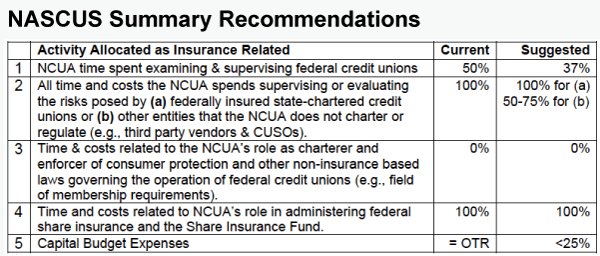
The two key recommendations Ito made were: reduce the amount of the funds transferred to cover costs for examining federal credit unions (FCUs) from 50% to 37% of those costs, and reduce the amount of funds transferred to cover costs of evaluating risks of entities that NCUA does not charter or regulate (such as third-party vendors and CUSOs) from 100% to a range of between 50% and 75%.
Ito, providing the state system’s view of the agency budget, focused in her remarks exclusively on the OTR and costs that are allocated to it by the agency. She was one of three to make presentations to the NCUA Board members attending the meeting, Chairman Rodney Hood and Member Todd Harper. The others making presentations represented the Credit Union Natl. Assn. (CUNA) and Natl. Assn. of Federally Insured Credit Unions (NAFCU).
In recommending changes to the expense allocations, Ito said every dollar the agency transfers from the fund to cover expenses of the agency in “insurance-related costs” is a dollar that is not available to pay for credit union losses that are likely to arise as a result of the financial impact of the pandemic.
“The 1% increase in the OTR for 2021 means there will be $3.3 million less to cover losses by the fund,” Ito said.
In other comments, Ito recommended the agency reconsider how it allocates expenses paid by the fund for capital budget costs of its operations. For example, Ito said, given increasing state agency assumption of computer and other capital costs, “it would seem that the insurance fund would carry a much smaller percentage of NCUA’s computer software and other capital charges than the agency allocates to its role as the FCU chartering authority.”
She also suggested that the agency work with state supervisory authorities to validate their time allocation assumptions that make up portions of the OTR calculations. “We noted in last year’s budget briefing we would very much welcome the opportunity to sit with NCUA and understand out how NCUA reconciles the budgetary OTR with actual time allocations,” she said, adding that the invitation remains open from the association.
LINK:
NASCUS presentation, NCUA 2021 budget briefing (Dec. 2, 2020)
(Nov. 20, 2020) In other action at its Thursday meeting, the NCUA Board:
- Reallocated $4.3 million in its budget for COVID-related “costs and opportunities.” The agency said the reallocation – from unspent 2020 travel budgets for the agency – were needed due to increased expenses from information technology costs that support offsite examinations and remote work by agency staff. The agency also said the reallocation would be used to pay for a “pull forward from the 2021 budget” of a previously planned renovation of NCUA headquarters while much of the workforce is offsite.
- Heard a report on credit unions’ use of the voluntary diversity self-assessment. Staff noted that the credit union response rate in submitting the self assessment has risen each year since it was unveiled in 2016, when 35 responded. In 2019, 118 FICUs responded (2.3% of all credit unions). The agency said it continues to urge more credit unions to commit to filling out self-assessment, pointing out that it has nothing to do with the credit union examination process.
LINKS:
NCUA 2020 Budget Update
State of Credit Union Diversity, Equity and Inclusion
(Nov. 20, 2020) NASCUS’ Lucy Ito expects to present the state credit union system view on the next NCUA budget – particularly its impact for the overhead transfer rate (OTR) – when the agency holds its annual budget briefing Dec. 2.
Late last week, the agency published its 2021-22 draft budget – totaling $342.5 million in 2021 and $364.2 million in 2022 – which will be the subject of the Dec. 2 briefing. The agency’s final budget is slated for approval during the NCUA Board’s Dec. 17 open meeting.
The agency primarily funds its operations through two sources: fees charged to federal credit unions (the FCU “operating fee”), and through funds transferred from the National Credit Union Share Insurance Fund (NCUSIF) to pay for “insurance-related costs” of the agency.
Budget documents posted on the agency’s website late last week show a total proposed 2021 budget of $342.5 million –down about $4.9 million, or 1.4%, from the approved budget of $347.4 million for 2020.
But that reduction would be more than made up in 2022, when the agency projects a 6.3% increase in its total budget, for a total of $364.2 million. That figure includes a $341.8 million operating budget (up $26.2 million); a $14.6 million capital budget (up $4.3 million); and $7.9 million NCUSIF administrative budget (down $218,000).
To fund its 2021 budget, the agency is estimating an OTR of 62.3% — one percentage point higher than in 2020 – with the remaining 37.7% of the budget to be paid largely by FCU operating fees. In its published budget, NCUA states that the primary driver of the increase in the estimated 2021 OTR is the rise in examination and supervision time for federally insured state-chartered credit unions.
“Calendar year 2021 marks the end of the first, five-year cycle associated with the Exam Flexibility Initiative that extended the NCUA exam time for eligible institutions,” the budget states. “The increase in budgeted time for FISCU examination and supervision for 2021 is due to program obligations associated with examination scheduling and scope requirements.”
NASCUS has voiced its concern over the years that the operations of the agency not be funded primarily by the insurance fund. In fact, in a comment letter to the agency earlier this month, NASCUS pointed out the “incontrovertible truth” that doing so means the insurance fund has less resources to face financial troubles for credit unions, unless an insurance fund premium is assessed, which is not outlined in the 2021 budget.
In fact, the 2021 budget proposal is already facing some headwinds: At the NCUA Board meeting Thursday, Board Member Mark McWatters said he does not support the proposal put forth by the staff. He said the budget proposal inappropriately omits some items, and funds other items that are not necessary for ensuring the safety and soundness of credit unions.
He did not outline the specific items in either case. However, last year, McWatters said he intended to pursue a “collegial, collaborative” path for adding consumer protection resources at the agency for the 2021 budget (such as additional staff). That, apparently, did not happen and is at least partly responsible for McWatters’ stated opposition.
The Dec. 2 budget briefing is scheduled to last one hour; it gets underway at 10 a.m. and will be live-streamed via the Internet.