(Dec. 17, 2021) NASCUS’ Ito acknowledged the agency’s efforts. “We commend the board for its thoughtful and unprecedented consideration of stakeholder feedback in finalizing the agency’s 2022 budget. On behalf of state credit union regulators and credit unions, NASCUS appreciates the downward adjustment of the 2022 proposed overhead transfer rate from 63.4% to 62.7%,” she said.
However, she asserted that the state system remains concerned about the underlying structural issues that dictate the calculation of the OTR and the federal credit union operating fee (see item below).
Finally, Ito said the state system also values the NCUA Board and staff commitment to providing more detailed explanations of new staff positions as well as clarifications in the budget justification related to state examiner equipment expenses and the payment of supervisory fees by state credit unions to their respective state regulators. “NASCUS and the state system look forward to continued open dialogue with our NCUA partners on how, together, we can assure both the safety and soundness of credit unions and the ongoing vitality of the dual charter credit union framework,” she said.
(Dec. 17, 2021) Meanwhile, the board also approved a $320.1 million operating budget that was $6 million less than that proposed. To reach that lower level, the agency also cut 46 full-time equivalent (FTE) positions that were proposed last month. For next year, the agency will carry 1,196 FTEs.
However: the board also decided to reduce the amount that federal credit unions (FCUs) pay to fund the remainder of the NCUA operating budget (the OTR will fund 62.7% of the agency operations, the FCU operating fee 37.3%). The agency is doing that by crediting to FCUs $15 million from “accumulated cash in excess of funding needs.” As a result, on average, in 2022 FCUs will pay approximately 24% less than they paid NCUA in 2021.
The agency said there the $15 million credit (from the agency’s operating fund), represents past-year, unspent operating fee cash collections “the NCUA does not currently require.” “It is important to note that the OTR is billed throughout the year for actual expenses, so there are not excess funds collected that can be ‘returned’ at the end of each year,” NCUA explained. However, as NASCUS has previously argued, a problem with the OTR and budgeting process is that, once the OTR is set, there is no reconciliation to affirm or correct the workload analysis assumptions that drive the OTR calculation, itself.
As another point in explaining the credit for the operating fee, the agency also said that, based on call report data through Sept. 30, average asset growth is calculated at 16.3%, an increase of approximately 200 basis points from the 14.3% projected asset growth included in the draft budget.
The decrease in the operating fee is 23.7% compared to 2021, NCUA said, adding that it is also “a 1,250 basis point reduction from the estimate provided in the staff (budget) draft.”
(Dec. 17, 2021) An increased overhead transfer rate (OTR) for 2022, a final operating budget of $320 million for next year, and three final rules – on the complex credit union leverage ratio (CCULR), subordinated debt and mortgage servicing assets — were all approved by the NCUA Board at a busy meeting this week.
All actions by the board (including new rules, see items) were approved unanimously.
In a U-turn, the board voted to reduce the staff-proposed OTR, but it is still higher than the last two years.
The board gave the nod to a 62.7% OTR to partially fund its 2022 budget of $320.1 million. The board’s action on the OTR, which represents the rate at which funds are transferred from the National Credit Union Share Insurance Fund (NCUSIF) to pay for “insurance related” expenses of the agency, is the third straight year that the rate has been raised (at 40 basis points higher than 2021, and 140 bp higher than 2020).
Although the OTR is higher again for 2022, the figure the board ultimately approved was lower than that proposed last month when the budget was unveiled. Originally, the agency recommended a 63.4% rate.
As recently as last week, during the agency’s briefing and public comment on its 2022 budget, NASCUS asserted that every dollar that is transferred from the insurance fund to fund NCUA expenses is one dollar not available to cover losses in the system, and subsequently a dollar that may need to be replenished in the NCUSIF by the charging of a premium.
NASCUS also urged the agency to do a more complete job in explaining how and why the OTR changes from year to year. “Credit unions should also be interested in what additional costs NCUA is now covering with NCUSIF dollars,” NASCUS President and CEO Lucy Ito said in prepared comments for last week’s briefing. In that regard, she was repeating the view of the state system that the agency needs to do better in communicating what goes into the OTR.
In response, NCUA indicated it is listening. “The NCUA will also look to provide better explanation for the drivers behind the year-over-year OTR changes in budget documents going forward, rather than just reporting on the level of the change,” agency staff said in background materials submitted for this week’s board meeting.
LINK:
NCUA’s 2022-2023 Budget: Board Action memorandum
(Dec. 10, 2021) Every dollar transferred from the federal credit union savings insurance fund to fund NCUA expenses is one dollar not available to cover losses in the system and subsequently a dollar that may need to be replenished in the NCUSIF by the charging of a premium, NASCUS President and CEO Lucy Ito told the agency this week.
And that’s why it is so important for both state and federally chartered credit unions to understand and closely monitor how the agency moves money from the insurance fund and into its operating budget via the overhead transfer rate (OTR), Ito said.
Acknowledging that any discussion of the OTR is lackluster (she said, at worst, such dialog can leave stakeholders “bleary-eyed” or lull credit unions into a “deep, deep coma”), credit unions need to know and comprehend: every National Credit Union Share Insurance Fund (NCUSIF) dollar that NCUA uses to cover its expenses is one dollar less in the NCUSIF’s equity level. “This is the fundamental reason why both state and federal credit unions should take serious interest in the OTR,” she asserted.
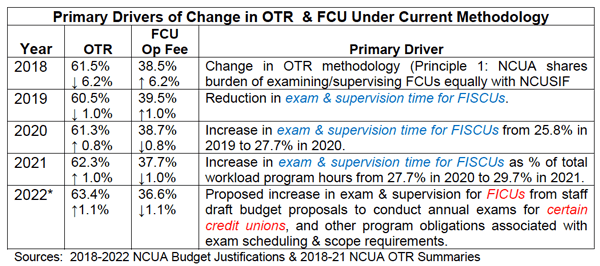
Ito made the comments this week during a public briefing and comment opportunity about the NCUA 2022 budget. The agency has proposed a 63.4% OTR for 2022, meaning that nearly two-thirds of the 2022 operating budget will be paid out of the share insurance fund (the remainder comes from federal credit union (FCU) operating fees). The operating spending plan – at $326 million — makes up 94.4% of the overall NCUA budget.
The 2022 OTR will be 110 basis points higher than the previous year’s and will be the third straight year that an increased transfer has been proposed by the agency (at 61.3% in 2020, 62.3% in 2021, and the proposed 63.4% for 2022).
Aside from taking funds from the insurance fund that could cover credit union losses, Ito said, there are two other reasons credit unions should monitor the OTR. First, NCUA’s use of NCUSIF dollars versus use of FCU operating fees to cover its expenses has the potential to imbalance the dual chartering system by disadvantaging the state system. “This is a threat to both state and federal credit unions,” she said, “because the dual charter framework is the credit union system’s most dynamic source of innovation and charter modernization.”
The third reason, she said, is the equity level of the insurance fund and the NCUA Board’s thought of raising the normal operating level (NOL) of the fund in anticipation of economic uncertainties related to the ongoing COVID-19 event. “Given the NCUA Board’s deliberations on changing the NOL to bolster NCUSIF equity, it behooves credit unions to monitor more than OTR as a mere formula used to transfer funds from the NCUSIF,” she said. “Credit unions should also be interested in what additional costs NCUA is now covering with NCUSIF dollars.”
Ito said her comments were made in the “pure spirit of state-federal regulator collaboration and in support of our shared objectives to foster a safe and sound and vibrant dual charter system that protects member-consumer best interests.”
In a nod to her impending retirement at year’s end, she thanked the board members for their “collegiality and commitment to forging a robust federal credit union system and a robust state credit union system” with state regulatory agencies during her seven-year run as NASCUS leader.
LINK:
President and CEO Lucy Ito Testifies on OTR During the 2022 NCUA Budget Briefing
(Dec. 10, 2021) The 2022 budget, and three final rules — on mortgage servicing rights, subordinated debt and the complex credit union leverage ratio — are among the items the NCUA Board will consider at its meeting next week.
In November, the board released publicly its proposed budget for the new year, which called for a 1.2% increase from the previous year’s. However, the components of the spending plan show significant changes from the previous year. For example, the agency’s capital budget (which funds such things as purchases of new equipment) is down 30.7% from the previous year (for a total of $13.1 million). The administrative budget for the National Credit Union Share Insurance Fund (NCUSIF) is down by 21.7% (to $6.2 million) from the previous year.
But the agency’s operating budget – which is funded mostly by funds from the National Credit Union Share Insurance Fund (NCUSIF) via the overhead transfer rate (OTR) of a proposed 63.4%, and accounts for 94.4% of the agency’s overall budget – is up 3.6%, according to the NCUA proposed budget for a total of $326 million. It includes 46 new full-time equivalent (FTE) staff positions for 2022 (including 32 regional and specialist credit union examiners). Employee pay and benefits makes up 79% of the operating budget.
(As noted in the item on NASCUS’ comments made during the NCUA budget briefing, the association has pointed out this year’s proposed OTR is the third straight year NCUA has raised the transfer rate.)
The mortgage servicing rights proposal, if finalized, would amend the agency’s investment regulation to permit federal credit unions to purchase mortgage servicing rights from other federally insured credit unions, subject to certain conditions. Describing the proposed rule as “half baked” when it was proposed and released for comment a year ago (and voting against it), NCUA Board Chairman Todd Harper said he could find a way to support a final rule if changes were made.
Also on Thursday’s agenda:
- Share Insurance Fund 2022 Normal Operating Level.
- Final Rule Complex Credit Union Leverage Ratio (parts 702 and 703)
- Subordinated Debt Final Rule (parts 702 and 741).
The NCUA Board meeting is scheduled to broadcast live via the Internet, and to get underway at 10 a.m. ET on Thursday.
LINK:
NCUA Board meeting agenda, Dec. 16
(Nov. 24, 2021) The state system is seeking to provide its views of the proposed NCUA 2022 budget at the agency’s public briefing in two weeks, particularly the proposed increased in the overhead transfer rate (OTR) – for the third straight year — in the spending plan.
If approved, NASCUS President and CEO Lucy Ito will provide the state system’s perspective at the briefing, scheduled for Dec. 8 at 2 p.m. (and to be live-streamed via the Internet).
The overhead transfer rate (OTR) provides a portion of the funding for NCUA’s “operating budget” of $326 million (which makes up 94.4% of the overall agency budget). For 2022, the OTR will be set at 63.4%, according to the budget papers posted by NCUA. The transfer means that nearly two-thirds of the 2022 operating budget ($206.7 million) will be paid out of the share insurance fund. The remainder of the operating budget comes from “operating fees” paid by federal credit unions.
The OTR represents money that is transferred from NCUSIF to the operating budget of the agency to cover “insurance-related” expenses of the agency. The remainder of the operating budget is covered by the operating fee paid by federal credit unions.
NASCUS President and CEO Lucy Ito pointed out that the proposed 2022 OTR will be the third straight year that an increased transfer rate has been proposed by the agency (at 61.3% in 2020, 62.3% in 2021, and the proposed 63.4% for 2022). She also noted that the number of federally insured, state-chartered credit unions has been declining. At year-end 2019, there were (according to NCUA quarterly call report data) 1,953 FISCUs. By the end of the next year (2020), the number had fallen to 1,914. At mid-year 2021, total FISCUs were 1,886.
Federal credit union (FCU) numbers are also in decline, she noted – but there are still many more of those charters than FISCUs: 3,383 at year-end 2019, 3,185 at year-end 2020, and 3,143 at mid-year 2021.
LINK:
NCUA Posts 2022-2023 Proposed Budget, Sets Dec. 8 Public Briefing
(Nov. 19, 2021) One of the key expenses proposed in the agency’s 2022 operating budget is the addition of 48 full-time equivalency (FTE) positions, according to NCUA budget documents released this week.
The additional positions include:
- 29 FTEs for regional staff and supervisory examiners;
- three FTEs among regional staff “to expand the cadre of specialist examiners;”
- five FTEs in the agency’s Office of Consumer and Financial Protection to “increase the number of fair lending examinations and reviews and to strengthen the agency’s efforts to promote financial inclusion and outreach;”
- adding seven FTEs in various NCUA headquarters offices;
- two FTEs in the agency’s Office of Credit Union Resources and Expansion (CURE);
- and making permanent eight FTEs now filled “within the total NCUA staffing plan.”
The net number of FTEs is reached by cutting five positions in the Office of Chief Financial Officer and Office of Examination and Insurance (E&I), and an additional one FTE in E&I by “reorganizing responsibilities in the office.”
Employee compensation, the agency proposes, will rise by $16.7 million (6.9% over 2021 budget).
During the NCUA Board meeting Thursday, Member Rodney Hood took aim at the 48 additional positions, saying the agency “doesn’t need nearly 50 additional staff positions at this time.” He added that “it’s going to be a busy couple of weeks” as the board members work on the budget before final approval.
Chairman Todd Harper committed to working with both Hood and Vice Chairman Kyle Hauptman in hashing out a final agency budget. The proposed budget released this week, he observed, was just a starting point.
Other key NCUA budget items include:
- An increase by $8.5 million for travel (for a total of $20.8 million);
- An $11.5 million decrease in “contracted services” (to $36.7 million);
- And $2 million less in rent, utilities and communications (for a total of $5.1 million)
LINK:
NCUA Staff Draft: 2022 – 2023 Budget Justification (see page 29)
(Nov. 19, 2021) A $345.3 million 2022 proposed budget, funded partially from an increased amount of funds transferred from the federal credit union savings insurance program, was posted this week by NCUA; a public briefing is set for Dec. 8, the agency said.
According to NCUA, its budget for next year is 1.2% higher than the previous year’s. However, components of the overall spending plan show significant changes from the previous year. For example, the agency’s capital budget (which funds such things as purchases of new equipment) is down 30.7% from the previous year (for a total of $13.1 million). The administrative budget for the National Credit Union Share Insurance Fund (NCUSIF) is down by 21.7% (to $6.2 million) from the previous year.
The overhead transfer rate (OTR), which provides funding for the NCUA’s “operating budget” of $326 million (and makes up 94.4% of the overall agency budget) will be set at 63.4%, according to the budget papers posted by NCUA. Essentially, that means the nearly two-thirds of the 2022 “operating budget” (or $206.7 million) will be paid out of the share insurance fund. The remainder of the operating budget comes from “operating fees” paid by federal credit unions.
The 2021 OTR, adopted in December last year, was 62.3%. NCUA acknowledges in its budget posting this week that the 2022 OTR will be 101 basis points higher than the previous year’s.
The OTR represents money that is transferred from NCUSIF to the operating budget of the agency to cover “insurance-related” expenses of the agency. The remainder of the operating budget is covered by the operating fee paid by federal credit unions.
NASCUS President and CEO Lucy Ito pointed out that the proposed 2022 OTR will be the second year in a row that the OTR has been increased by the agency. She also noted that, as the 2021 OTR was approved last December, that NCUA needed to reconsider how it allocates expenses.
LINK:
Agency Accepting Comments and Budget Briefing Presentation Requests
(Sept. 24, 2021) In other action Thursday, the NCUA Board:
- Approved “midsession budget review” action that will use a $15 million 2021 budget surplus (realized through savings on curtailed travel during the coronavirus pandemic) to add seven new positions to the agency’s employment roster, among other things. Those positions will be added to the agency’s cybersecurity program (three new positions), the NCUA Board secretary (one position), and the agency’s office of ethics counsel (three positions), taking up $11 million of the surplus. The balance will be “reprogrammed,” with $2.4 million going to address cybersecurity support, employee relocations, and “human capital analytical support” (for analysis of compensation plans and diversity/equity/ inclusion programs and practices), and approximately $1.6 million to cover employee leave payouts.
- Considered a staff projection that, by year’s end, a “residual budget balance” (or surplus) of about $24.6 million will be left, which the agency said “can be used to offset future budget needs by the agency.”
- Heard a quarterly report on the National Credit Union Share Insurance Fund (NCUSIF), which noted an equity ratio for the fund, as of June 30, at 1.23% — three basis points above the minimum allowed by law before a “restoration plan” (including assessment of a premium) can be established by the board, but well below the fund’s current “normal operating level” (NOL) of 1.38%. Along those lines, Board Member Hood said he wants the board to consider resetting the NOL to 1.3% at either the October or November board meetings (staff project the equity ratio to rise to 1.28% at the end of December 2021).
Regarding the budget review, NASCUS’ Lucy Ito urged NCUA to apply any surplus in 2021 to offset the overhead transfer rate (OTR) for 2022. “Additionally, surplus in the share insurance fund’s admin budget, which largely represents savings in state examiner training, should either be reserved for future training needs or also used to offset the OTR even more,” Ito said.
LINKS:
Board Briefing, Share Insurance Fund Quarterly Report
Oregon Member Business Lending Rule
(Sept. 17, 2021) A proposed rule on subordinated debt will be on the agenda of the NCUA Board when it meets next week, according to an agenda published Thursday by the agency.
According to the agenda posted on its website, the NCUA Board will consider a rule on the subordinated debt under parts 702 (capital adequacy) and 703 (investment and deposit activities) under its regulations.
Late last year, the agency adopted a subordinated debt final rule on allowing well-capitalized, federally insured credit unions to count the debt instrument as capital for risk-based net worth purposes. Under the final rule ultimately published in January of this year, the rule is slated to take effect Jan. 1, 2022. That date is the same that new risk-based capital rules for credit unions are to take effect.
The rule also grandfathered any secondary capital issued before the rule’s effective date of Jan. 1, and preserves that capital’s regulatory capital treatment for 20 years after the effective date. The “grandfathered secondary capital” generally, the agency said, remains subject to requirements in the agency’s current secondary capital rule.
Also on the agenda for the board’s meeting next week is:
- A quarterly report on the National Credit Union Share Insurance Fund;
- A review of the business loan rule for Oregon credit unions (to determine if the state rule covers all the provisions in the NCUA rule and is no less restrictive, thus exempting credit unions in the state from compliance);
- A 2021 mid-session budget review;
- And an item merely listed as “NCUA Board Agenda.” No other information is given.
The board meeting is scheduled to get underway at 10 a.m. ET, and will be streamed live via the Internet.
LINK:
NCUA Board Agenda for the Sept. 23, 2021 Meeting
(Dec. 18, 2020) With a rare second monthly meeting scheduled for today (Friday, Dec. 18), the full-complement NCUA Board will consider the 2021 budget for the agency, which includes an increase of 1 percentage point for the overhead transfer rate (OTR), the rate at which the agency transfers funds from the federal savings insurance fund to the operating budget of the agency to cover its “insurance-related costs.”
More coverage of the meeting, which ensues after NASCUS Report’s deadline, will be included in next week’s report.
The board is expected to approve the $342.5 million budget as proposed, although likely on a split vote. Board Member Todd Harper has voiced objection to the lack of funding for consumer protection compliance staff in the budget and has said he would not support the budget unless that funding was put into place. Board Chairman Rodney Hood has no such objections; newest Board Member Kyle Hauptman (a Republican appointee like Hood) is expected to follow Hood’s lead on the budget.
For its part, NASCUS has taken no position on the budget, except with respect to the increase in the OTR, which would be 62.3% in 2021 (up from 61.3% in 2020).
In testimony two weeks ago before the NCUA Board at its public briefing about the 2021 budget, NASCUS urged NCUA to consider making changes to how it allocates expenses through the OTR to insurance-related activities, in order to ensure balance, equity and that more funds are available to cover any losses that may occur due to the financial impact of the coronavirus crisis.
“The 1% increase in the OTR for 2021 means there will be $3.3 million less to cover losses by the fund,” NASCUS’s Lucy Ito told the board. She noted that NASCUS recognized its recommendations cannot be implemented for 2021, but that the state system hopes they would be considered for future budgets. “We want to work with NCUA,” she said.
Friday’s board session is scheduled to get underway at 10 a.m. ET, and is being live-streamed via the Internet.
LINK:
NCUA Board Agenda for the Dec. 18, 2020 meeting
(Dec. 11, 2020) Final approval of the 2021 NCUA budget, which includes a concerning increase in the overhead transfer rate (OTR), will be under consideration when the agency’s board meets for a second time next week, this time on Friday, likely with its full complement of three members.
The meeting is set for Friday, starting at 10 a.m. ET; it will be live streamed via the Internet.
In November, the agency unveiled a $342.5 million budget that is 1.4% smaller than the approved 2020 spending plan. However, for the following year, the agency projects spending could be increased by 6.3%, reaching $364.2 million.
The 2021 budget also includes an increase of 1 percentage point from 2020 in the OTR – the rate at which the agency transfers funds from the National Credit Union Share Insurance Fund (NCUSIF) to cover “insurance-related costs” applied to the agency’s operating budget – to 62.3%. The remainder of the budget is funded by operating fees paid by federal credit unions.
NASCUS, in testimony last week before the NCUA Board at its public briefing about the 2021 budget, urged the agency to consider making changes to how it allocates expenses to insurance-related activities, in order to ensure balance, equity and that more funds are available to cover any losses that may occur due to the financial impact of the coronavirus crisis.
“The 1% increase in the OTR for 2021 means there will be $3.3 million less to cover losses by the fund,” NASCUS’s Lucy Ito told the board. She noted that NASCUS recognized its recommendations cannot be implemented for 2021, but that the state system hopes they would be considered for future budgets. “We want to work with NCUA,” she said.
The agency’s budget, often an annual focal point of comment and criticism from within the credit union system, has been the source of some controversy this year as well. At the November NCUA Board meeting, both Board Member Todd Harper and then-Board Member J. Mark McWatters said they could not support the 2021 budget as proposed, questioning some expenses, the decrease in the total budget in the face of the financial impact of the coronavirus pandemic, and the lack of funding for consumer protection compliance examiner staff. “As long as I remain on the board, I will continue to carefully review the proposed budgets and identify those items that are not truly important to the operations and mission of the NCUA,” McWatters said.
A day later, McWatters submitted his resignation from the board, citing the impending confirmation of his replacement on the panel, Kyle S. Hauptman. The Senate voted Dec. 2, 56-39, to confirm Hauptman to the seat held by McWatters, who had been serving in a holdover capacity since his term expired in August 2019.
Hauptman is expected to be sworn in as a board member before next week’s meetings, and to join in board deliberations at that session (as well as the Thursday session considering various final and proposal regulations, among other things).