(Dec. 23, 2021) Brian Knight is the next president and CEO of NASCUS, the association announced this week, effective Jan. 1. He succeeds Lucy Ito, who retires as of Dec. 31, after leading the association since 2014.
 A 23-year staff member of the association, Knight’s most recent position is executive vice president and general counsel, a position he held since 2014. In 2007, he was named the association’s first internal general counsel; he joined the association in 1998 as director of regulatory affairs.
“NASCUS is a unique and vitally important thread in the fabric of the credit union system and the broader financial services sector,” Knight said. “I am honored and humbled to accept this position and build on the achievements of Lucy and those leaders that have come before me.”
Knight (right) said NASCUS helps to ensure that the credit union system is positioned to meet the challenges of the moment and of the future by supporting state regulatory agencies and working with dedicated credit union professionals to facilitate the cooperation and consultation essential for dynamic and viable credit union system.
“I know firsthand the commitment of our staff and members to our mission. I want to thank the NASCUS Regulator Board of Directors and Credit Union Advisory Council for this opportunity,” he added.
NASCUS Regulator Board of Directors Chair Rose Conner (who is administrator of the North Carolina Credit Union Division) said Knight is uniquely qualified to lead the organization. “The depth and breadth of his knowledge about the state and federal credit union systems, and his keen sense of emerging issues in the consumer financial services marketplace, has well-prepared him for this new role,” she said.
NASCUS Credit Union Advisory Council Chair Mike Williams (CEO of Colorado Credit Union in Denver) echoed Conner’s view. “I am confident that Brian’s leadership and vision are the combination we need to continue the organization’s success into 2022 and beyond,” he said.
Both Conner and Williams expressed their thanks to Ito for her leadership over the past seven years and wished her the best in her retirement.
Knight holds a B.A in history and political science from Hope College in Holland, Mich., and a J.D. from the Marshall Wythe School of Law of the College of William & Mary in Williamsburg, Va.
LINK:
NASCUS press release: Brian Knight Selected as NASCUS President and CEO
(June 11, 2021) Congratulations to Virginia’s Robert “Bob” Hughes retired as deputy director of the State Corporation Commission Bureau of Financial Institutions on May 28 after 41 years of service … Retiring NASCUS leader Lucy Ito is profiled in the American Banker (a trade publication) this week, focusing on NASCUS’ efforts to bring transparency and equity to the overhead transfer rate – which the article notes was a singular accomplishment during her nearly seven-year turn at the helm of the association. (To see the full text of the article, see the link below – subscription required) … Requiring financial institutions to report information on account flows for tax reporting purposes “would be a complex undertaking” with significant compliance burdens that may outweigh whatever benefits result, according to a letter sent from financial institution trade groups (including those representing credit unions) to a House subcommittee this week. The letter essentially cautions lawmakers about taking the step, which was proposed last week by President Joe Biden (D) in his 2022 budget. Under the proposal, all deposit, loan and investment accounts at financial institutions (including credit unions) for persons and businesses would be subject to a $600 “de minimus” gross inflow reporting threshold. The provision is designed to increase taxpayer compliance with income reporting … There is just a bit more than two weeks left for low-income designated credit unions to seek Community Development Revolving Loan Fund (CDRLF) grants, including minority depository (MDI) mentoring grants, NCUA said the week. The deadline is June 26 to apply for the approximately $1.5 million in CDRLF grants to the most-qualified applicants, subject to the availability of funds, the agency said. There are three categories of grants: underserved outreach (maximum award of $50,000); MDI mentoring (maximum award of $25,000); and digital services and cybersecurity (maximum award of $7,000).
LINKS:
American Banker — Lucy Ito’s legacy: Lowering a vexing regulatory cost for credit unions (subscription required)
NASCUS’ Lucy Ito discusses achievements and NASCUS, and the outlook for credit unions, during her interview with Mike Lawson, CUBroadcast.com (click on the arrow to view the complete video)
(June 4, 2021) Bringing attention to the overhead transfer rate (OTR) policies of NCUA, and securing authority for credit unions to issue subordinated debt, are two of the achievements NASCUS President and CEO Lucy Ito cited as attained during her tenure as leader of the state system organization during a video interview this week.
In May, Ito announced that she would retire from her position at the association, effective at the beginning of 2022.
Responding to questions from Mike Lawson of CUBroadcast (a web-based video interview program) Ito said that raising awareness of the OTR – the rate at which the agency transfers funds from National Credit Union Share Insurance Fund (NCUSIF) to cover insurance-related operating costs of the agency – ultimately resulted in the agency making changes to the formula for determining the rate.
In 2017, the NCUA Board voted to adopt a “simplified approach” to setting the rate, reflecting that “safety and soundness is not the sole domain of the insurer.” Reform of the OTR methodology had been a target for NASCUS and the state system for more than 20 years.
She also noted as an achievement the new subordinated debt rule, which was finalized by NCUA in December and is scheduled to take effect at the beginning of 2022. The rule would allow well-capitalized, federally insured credit unions to count subordinated debt as capital for risk-based net worth purposes. It was long sought by the state system, which has argued that such a rule would bring regulation of federally insured credit unions in line with regulations of some states that already allow their credit unions to issue secondary capital, including in the form of subordinated debt.
However, in her interview this week, Ito said the state system continues to look for changes in the rule. She noted the benefit of having a rule in place, and that “that’s something we can work with.”
In other comments during the 20-minute interview, Ito:
- Noted the common denominators of people who work in credit unions as being “service and duty.”
- Reflected on the commonalities of state regulators and leaders of credit unions, as both groups are service oriented and really feel a responsibility to protect and help others.”
- Suggested that the best way for the credit union community to succeed and maintain relevancy to consumers — in the face of mounting competition from such things as digital currencies and players such as PayPal – is collaboration among themselves and their related organizations (including associations). “Where there are shared problems, and shared objectives, let’s work together to address both,” she said.
(May 7, 2021) Lucy Ito, NASCUS President and CEO since 2014, will retire from the position at year’s end, she announced this week. The association is conducting a search for a new leader, to take office before Ito departs to allow for a smooth transition.
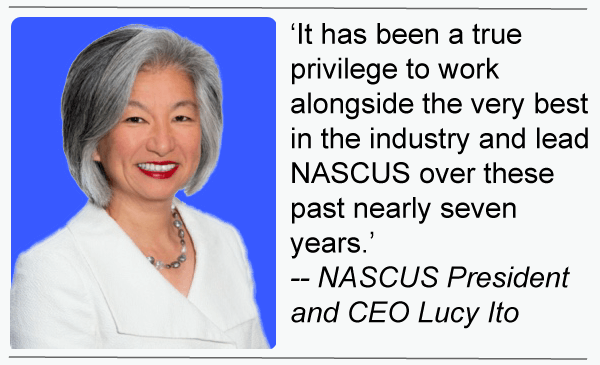
“Working with both state regulators and credit unions over my entire career has been tremendously fulfilling,” Ito said. “It has been a true privilege to work alongside the very best in the industry and lead NASCUS over these past nearly seven years.”
Ito thanked the NASCUS Regulator Board and the Credit Union Advisory Council for their support and guidance during her tenure at NASCUS, which began in November 2014. “The Regulator Board and Council have worked in true collaboration with myself and the staff; I am grateful for their leadership and friendship.”
But she also noted there is much to do before year’s end. “This transition of leadership at NASCUS will in no way interrupt or dampen our advocacy or our commitment on behalf of the state system,“ she said. “A number of proposed new rules and actions from NCUA, other federal agencies and other entities are in the works that will effect state credit unions. NASCUS will continue to be the voice of the state system throughout the year as these efforts proceed. We also will continue to pursue our own initiatives and events – including the 2021 State System Summit, our annual conference for the state credit union system this summer.”
The NASCUS leader joined the association after serving as executive vice president and chief operations officer at the California and Nevada Credit Unions Leagues. Prior to that, she served as a vice president of the World Council of Credit Unions (WOCCU) working on credit union development issues worldwide.
She currently serves on the International Credit Union Regulators’ Network (ICURN) Board of Directors and Steering Committee, the State Issues Committee of the American Association of Credit Union Leagues (AACUL), and the NCUA-SSA Joint Supervisory Working Group. She also participates in the African-American Credit Union Coalition’s (AACUL) Cross Cultural Exchange Program, a newly launched national pilot initiative.
NASCUS leadership has named a search committee to select a new leader for the association; D. Hilton and Associates, an executive recruiting firm with long ties to the credit union system, has been retained to identify suitable candidates.
(May 7, 2021) During her tenure as NASCUS president and CEO, Lucy Ito has been the leader for the state system on a number of issues and initiatives, including:
- Advocating for policies that foster balance and equity between state and federal credit unions, particularly NCUA’s overhead transfer rate (OTR) methodology.
- Creating an environment for state regulators and credit unions to work together to reach common sense solutions.
- Establishing a forum of collaboration for state regulators through events, such as the National Meeting for State Regulators, launched in 2016 and held each spring
- Constructing idea-sharing platforms such as The Exchange—a dialogue for state regulators and CEOs of large stand and federal credit unions (those with $10 billion or more in assets) to anticipate future challenges facing the entire credit union system.
- Partnering with NCUA, including re-committing, for the first time in more than a decade, to the Document of Cooperation between NASCUS and the agency, signed in 2019.
- Rebuilding credit union system involvement in the National Institute for State Credit Union Examination (NISCUE), NASCUS’ education foundation, and expanding scholarship opportunities for state examiners.
- Launching a cohesive and collaborative, member-focused engagement strategy and building nationwide trust in the NASCUS brand.