In October 2022, the Federal Housing Finance Agency announced new guidelines for the credit score models Freddie Mac and Fannie Mae can accept from mortgage lenders. While the changes may take time to be widely implemented, they could eventually have a substantial impact on groups that have historically been excluded from homeownership. These updated credit scoring models may allow more borrowers to qualify for mortgages. Here’s what happened and how it could potentially benefit homebuying hopefuls.
Replacing outdated credit score models
Freddie Mac and Fannie Mae are important to the home lending market because they buy mortgages from lenders, which frees up money for lenders to keep making home loans. But Fannie and Freddie can buy only conventional loans that meet certain standards, including for borrower credit scores.
The FHFA determines what credit scores Freddie and Fannie can accept, which in turn determines what scores mortgage lenders use when examining loan applicants. Because of this, mortgage lenders have long used FICO Scores 2, 4 and 5, which are considered outdated models. “The mortgage industry didn’t have a choice in the matter. They were essentially forced to use older FICO scores by the FHFA,” credit expert John Ulzheimer explained in an email. “All other types of lenders have long since moved on from those legacy scoring models.”
Advantages of FICO 10T and VantageScore 4.0
The FHFA announcement had two major components. The big news is that lenders can now use a much more up-to-date FICO score — the FICO 10T — to evaluate borrowers and can also use a score from FICO competitor VantageScore. In addition, the FHFA will no longer require credit reports from all three major credit bureaus, allowing lenders to provide two out of three.
The adoption of FICO 10T and VantageScore 4.0 is the headline, though, because both models use trended data, which Ulzheimer describes as like seeing a multidimensional view rather than a flat image. Trended data looks at two years’ worth of financial information rather than just a snapshot of the day the credit report was pulled.
Additionally, these models gather data from more sources, potentially including information like payments for rent, utilities or cell phone service. VantageScore may also be available to more borrowers because it requires a shorter credit history — as little as one month, compared with FICO’s six-month minimum. VantageScore estimates it has scores for 37 million Americans who don’t show up under FICO’s guidelines and that of those, over 13 million have credit scores that are above 620, which is a commonly used threshold for mortgage lending.
Ideally, using both FICO 10T and VantageScore 4.0 provides a rounder view of a potential borrower’s finances. But if a mortgage applicant doesn’t have both, lenders can use one or the other. This could benefit borrowers who have a VantageScore but aren’t on FICO’s radar.
Why rent reporting matters for mortgage applicants
Using updated credit scoring models certainly doesn’t sound exciting, but it could have significant implications for addressing the racial homeownership gap. The Urban Institute estimates that roughly 53 million Americans don’t have FICO scores under the older scoring models. Underrepresented minorities are disproportionately likely to have no FICO scores: 29.5% of Black households and 27.3% of Hispanic households, compared with 16.7% of white households, according to Urban Institute analysis of 2018 data from Freddie Mac. These groups are also less likely to be homeowners — with lack of credit score information likely playing a role. Pew Research Center analysis of 2019 census data found that 58% of Black-led households are renters, as are 52% of Hispanic- or Latino-led households. In contrast, 27.9% of non-Hispanic, white-led households are renters.
More inclusive credit scoring models could help people who might not have previously qualified for a mortgage by taking into account information like rent payments. But this has been limited because little rental data is reported to the credit bureaus. For larger, institutional landlords, “reporting a large chunk of the data to the bureaus is relatively easy,” says Jung Hyun Choi, a senior research associate with the Housing Finance Policy Center at the Urban Institute, a nonpartisan think tank. Choi notes that reporting isn’t as easy for the “individual mom-and-pop landlords” who own the vast majority of small, one- to four-unit rental properties.
For those who are willing, there are rent-reporting services that landlords — and tenants — can use to make these payments visible to credit bureaus. Freddie Mac has begun a pilot program to incentivize rent reporting for “mom-and-pop” owners of multifamily housing; Fannie Mae also has a rent-reporting program.
But Choi says that adoption has been low among renters, not just landlords, because “a lot of people don’t realize how reporting rent could help their credit scores and access to homeownership.” Rent is typically the largest monthly payment in a family’s budget. And a history of on-time rent payments correlates with the ability to consistently pay a mortgage, so it’s meaningful data for a lender to have.
If tenants are reluctant to enroll because they worry about their ability to pay rent on time, Choi notes that rent-reporting programs often automatically unenroll tenants if they miss a payment so that tenants aren’t doubly penalized if the missed payment goes to collections.
December 19, 2022 — We have adjusted our 2022 economic growth expectations to 0.4 percent on a Q4/Q4 basis, up from 0.0 percent following both the upward revision to Q3 2022 Real Gross Domestic Product (GDP) data and a stronger-than-expected personal consumption figure for October. However, we still expect a modest recession to begin in the first quarter of 2023. Our outlook for 2023 is for negative 0.5 percent growth (negative 0.6 percent previously), and in 2024 we expect a return to expansion at 2.2 percent annual growth.
With long-run interest rates pulling back significantly over the past month, and a consequently lower mortgage rate forecast, our latest outlook included a modest increase to our home sales forecast. We now expect total home sales in 2022 to be 5.72 million units, up from 5.67 million in our prior forecast. Sales in 2023 are forecast to total 4.57 million units (previously 4.42 million). We forecast a rebound in 2024 to follow thereafter, with total sales rising 14.7 percent to 5.24 million units (previously 5.25 million) as we expect economic growth to return and mortgage rates to stabilize. Our outlook for overall mortgage originations for the three-year period from 2022 through 2024 is essentially unchanged from last month’s forecast at $2.35 trillion, $1.70 trillion, and $2.11 trillion, respectively.
Consumer Spending Rose as Gas Prices Fell and the Saving Rate Dropped, But Downturn Still Expected
Third quarter GDP was revised three-tenths of a percentage point higher to a seasonally adjusted annualized rate (SAAR) of 2.9 percent. The primary driver was stronger consumer spending. Further, real personal consumption expenditures in October posted their largest monthly gain since January, highlighting continued consumer resilience in Q4. While some of this boost is likely due to one-time stimulus checks in California and a few other states, consumer spending remains stronger than we had anticipated. Therefore, we now expect Q4 2022 real GDP growth to be meaningfully positive at 1.1 percent annualized (up from negative 0.5 percent previously).
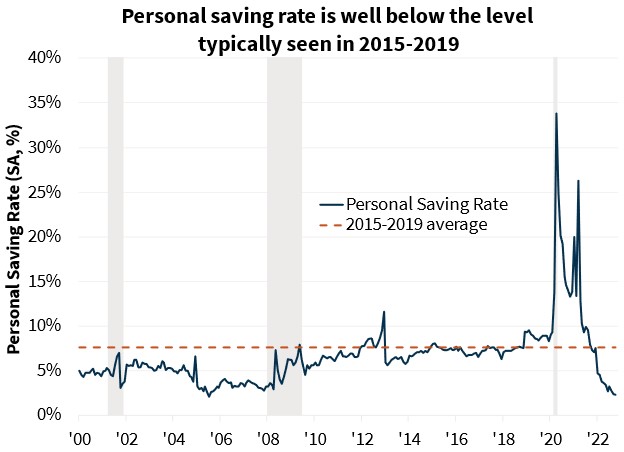
While the decline in gasoline prices and a broader slowdown in inflation has been helpful in supporting recent real income growth and real consumer spending, we continue to see the current pace of consumer spending as unsustainable. In October, the personal saving rate fell to 2.3 percent, the lowest since mid-2005. For comparison, the saving rate has generally hovered from 7 to 9 percent between 2015 and 2019, averaging 7.6 percent. The large decline represents households dipping further into accumulated pandemic- and stimulus check-related savings to fuel consumption, as well as more consumers turning to higher levels of debt financing. The ratio of all non-mortgage consumer debt to personal disposable income rose to 25.1 percent in October, roughly at its pre-pandemic level and just a touch below its all-time high of 25.4 percent set in 2017. While it is difficult to know for certain when consumers will further retrench, we expect this to occur next year as remaining “excess savings” are exhausted, the full effects of higher interest rates weigh on both the labor market and big-ticket purchases and falling home prices reduce “wealth effect”-driven consumption.
Cyclical indicators continue to point to a downturn as well. The inversion of the yield curve, historically one of the better recessionary indicators, continues to deepen. The 2-year/10-year yield curve has now been solidly inverted since early July, and the 3-month/10-year yield curve inverted more recently at the end of October. Furthermore, the recent yield pullback in long-term Treasuries is consistent with growing pessimism regarding the global economic outlook as central banks continue to tighten monetary policy, as well as a simultaneous decline in commodity prices, such as oil. While a “soft landing” continues to be possible, history suggests (and we agree) that a downturn is still likely.

The Conference Board Leading Economic Index® (LEI) has fallen for eight consecutive months as of October. Weakness in this measure has historically been a good predictor of turning points. Also, conditions in the manufacturing sector, a particularly cyclical component of the U.S. economy, have worsened, with the Institute for Supply Management (ISM) manufacturing index slipping below the expansionary threshold of 50 in November and all regional Fed surveys showing recent contractions as well.
Confirmation that Inflation is Slowing
The CPI decelerated sharply for the second consecutive month in November. The topline inflation rate fell to 7.1 percent from 7.7 percent. The core index, which removes food and energy prices, fell to 6.0 percent from 6.3 percent. On a monthly basis, the headline series rose a seasonally adjusted 0.1 percent, while core inflation rose 0.2 percent. Outright deflation from energy prices and many durable goods prices, most notably that of used autos, contributed to the softer-than-expected report. With global demand softening and supply chain issues easing, we expect continued drags on inflation next year stemming from further declines in goods prices. We also read the recent weakness in oil prices to be principally due to softening global demand. In 2021, the jump in gas and used auto prices exaggerated the underlying inflation trend, and now the decline in both categories may mute the underlying core trend.
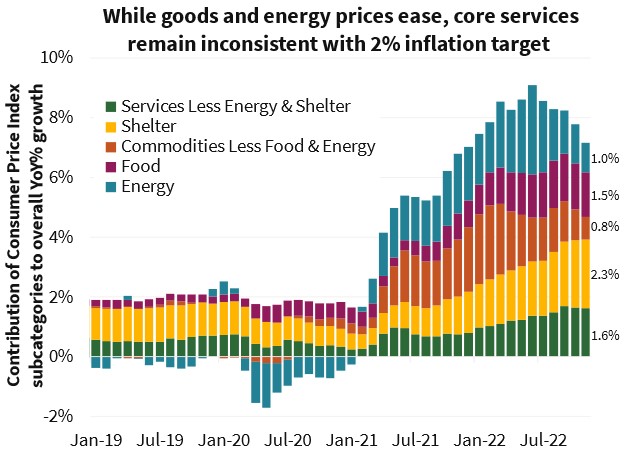
Core services inflation (services less energy services) remained hotter, rising 0.4 percent over the month, but much of this was due to ongoing higher measures of shelter costs. As we have discussed in the past, the measured effects of rental costs and home prices have a significant time lag. With market measures of asking rents and home prices now declining, we expect this source of CPI inflation to diminish around mid-year 2023. Therefore, what remains is the inflation component associated with labor market wage-price dynamics. While not as large to date, this is historically a stickier source of inflation, and the Fed has repeatedly mentioned that a sustained slowing in this source of inflation is needed before any major shift in its current policy. Based on the Employment Cost Index and the unit labor cost measure in the productivity accounts, we estimate current wage growth is consistent with 3 to 4 percent core inflation, a level still above the Fed’s 2 percent target.
The Fed has been consistent in its stated desire to loosen labor market conditions and thus slow nominal wage growth. Therefore, as long as the labor market remains strong and wage growth remains higher than what is consistent with a 2 percent inflation target, we believe the Fed will continue with restrictive monetary policy, further slowing the economy. Employers added 263,000 jobs in November and average hourly earnings accelerated, rising 0.6 percent over the month and 5.1 percent on an annual basis. Other wage trackers, such as that from the Atlanta Fed, also report wage growth above what is usually consistent with the Fed’s inflation target. A significant slowing in wage growth has historically not occurred without meaningful upward movement in the unemployment rate. Therefore, if we believe that the Fed will remain committed to cooling wage growth even as headline inflation decelerates, we can expect continued restrictive monetary policy until that result is achieved.
Market commentary is likely to shift away from discussions of how high the Fed’s terminal rate will be to instead how long they will maintain a restrictive policy stance before cutting. Given the lagging nature of labor markets, the historical downward stickiness of wages, and time lags in measurement, we may not see concrete evidence of slowing wage growth for quite some time, even if a recession does in fact begin in the first quarter of 2023, as we currently predict.
Currently, the most inverted yield curve in more than forty years demonstrates market expectations that the Fed will cut its target rate more quickly than current guidance from the Fed. Given that we are expecting a general downturn to occur, we see market expectations for the Fed to start cutting rates mid-next year as plausible. However, we believe there to be upside risk of longer-run interest rates reflecting a “higher for longer” Fed policy if labor pressures remain and a recession does not occur in the near term, a scenario that could result in mortgage rates over 7% at some point in 2023.
Recent Mortgage Rate Decline Helps Housing, But Sales Still Expected to Slow Further
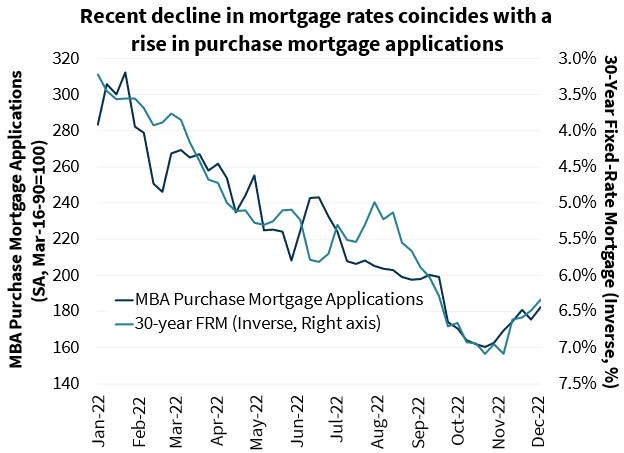
Existing home sales continued to decline in October, falling 5.9 percent to a SAAR of 4.43 million units, 28.4 percent lower compared to a year ago. While we continue to expect existing sales to trend lower in coming months, the sharp pull back in mortgage rates over the past month has led to an upward revision in our sales outlook over the next year. We have upgraded 2023 existing sales to an estimated 4.00 million units from 3.90 million units while also bumping up our Q4 2022 expectation. As of this writing, mortgage rates have fallen approximately 80 basis points since peaking at 7.08 percent in early November, one of the sharpest declines on record. This has coincided with a sharp bump up in purchase mortgage applications, suggesting to us that some potential homebuyers sitting on the sidelines acted once rates began to decline.
Still, affordability remains highly stressed. The share of median household income needed to purchase a median-priced existing home at current mortgage rates remains near the highest levels since before the great financial crisis. This will continue to limit home purchases, especially those of first-time homebuyers. Additionally, most current outstanding mortgage borrowers continue to have mortgage loans with rates well below current market conditions, a strong disincentive to move. We expect this “lock-in” effect to limit sales for the foreseeable future, and when combined with an expected economic slowdown, we are forecasting continued declines in existing sales next year.
In contrast, new home sales unexpectedly increased 7.5 percent to 632,000 annualized units in October. We see this as a temporary bump in what will likely be a continued downward trend in sales in the near term, in part based on continuing weakness in homebuilder confidence measures. Still, we have upgraded our new home sales forecast for the remainder of 2022 and 2023 in part based on the most recent sales pace as well as the lower mortgage rate outlook. Additionally, we believe some of the stronger-than-expected pace of new home sales is due to a distortion in the data caused by an abnormally high cancellation rate in recent months. Homes with cancelled contracts are not taken out of the sales number retroactively, so the same home can be recorded as sold multiple times. Additionally, homebuilders continue to hold large inventories of homes already started and held for sale relative to the recent sales pace. Homebuilders also entered the recent episode enjoying historically elevated operating margins. We therefore expect more aggressive discounting and concessions going forward to help support new home sales relative to existing sales. The “lock-in” effect for existing homeowners limiting the incentive to sell their current homes suggests that first-time buyers may increasingly have to look toward new homes for their purchases.
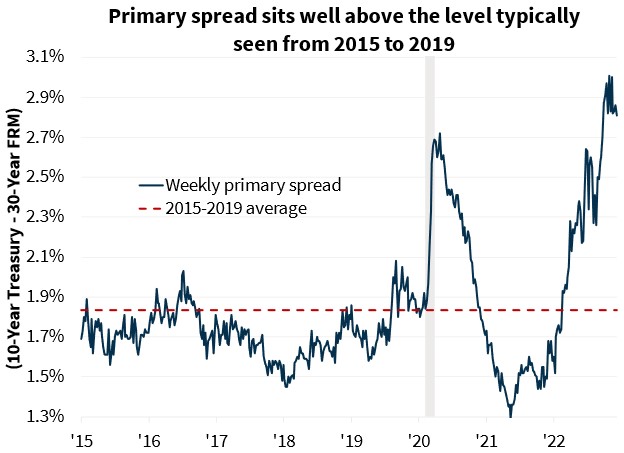
Looking further ahead, with the spread between the 10-year Treasury and 30-year mortgage rates remaining elevated (281 basis points as of this writing, compared to a typical range near 172 from 2015 to 2019), we believe there to be significant room for mortgage rates to eventually drift lower over the next year once the Treasury rate stabilizes. As such, we expect this moderating in the mortgage rate to help support a rebound in home sales after the next business cycle returns to expansion.
Given the continued slowing in rents and signs of slowing household formation, which we expect will help lead to a further increase in vacancy rates, we are projecting multifamily construction to slow next year, especially as multifamily lending standards are likely to tighten as expectations of an economic downturn in 2023 become the consensus expectation. We have downwardly revised our 2023 outlook for multifamily housing starts by 1.9 percent to a total of approximately 376,000 units. Historically, this is still a solid pace of construction, but it would be a major downshift from 2022, for which we are expecting approximately 546,000 units for the year, the highest since 1986.
Only Modest Changes to Originations Outlook
We made minor adjustments to our single-family purchase mortgage originations forecast. We now expect $1.66 trillion in purchase volumes in 2022, an upgrade from last month’s forecast, given the slightly higher expectation for home sales. We expect purchase volumes to fall 20% to $1.33 trillion in 2023, corresponding to declining home sales, before rebounding to $1.53 trillion in 2024 as the housing market recovers.
For single-family refinance originations, we now expect $686 billion in 2022 and $366 billion in 2023, both small downgrades from the prior forecast. These downward revisions were driven by declining refinance volumes in November, as highlighted by our Refinance Application-Level Index (RALI). We expect refinance volumes to grow to $576 billion in 2024 given our projection of a gradual decline in mortgage rates in 2024.
Economic & Strategic Research (ESR) Group
December 14, 2022
For a snapshot of macroeconomic and housing data between the monthly forecasts, please read ESR’s Economic and Housing Weekly Notes.
Data sources for charts: Bureau of Economic Analysis, Bureau of Labor Statistics, Conference Board, Federal Reserve, Fannie Mae, Freddie Mac, Mortgage Bankers Association