Jun 30, 2022 — Central bank leaders warned Wednesday that inflation is going to last longer than some estimated.
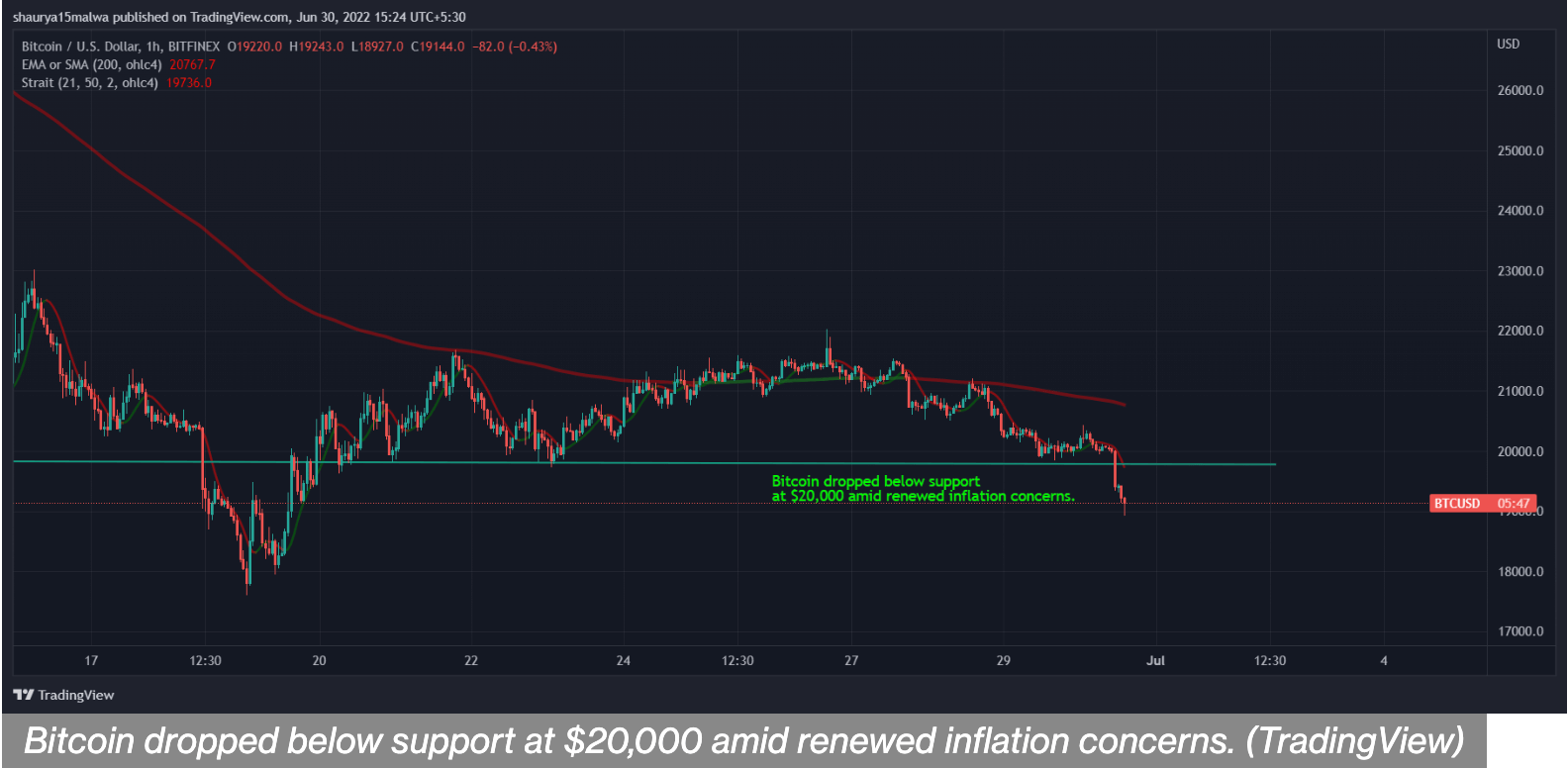
Bitcoin fell toward $19,000 during Asian afternoon hours after central bankers renewed inflation warnings at the European Central Bank’s annual forum on Wednesday.
The asset dropped 5.5% in the past 24 hours, and is on track for a record 40% monthly decline. Other large cryptocurrencies also weakened, with ether dropping 9.9% in the past 24 hours and Solana’s SOL falling as much as 11%. Total cryptocurrency market capitalization fell 4.3%.
Federal Reserve Chairman Jerome Powell reiterated the central bank’s commitment to increasing interest rates to curtail inflation. Speaking at the ECB meeting, he said he was more concerned about the challenge posed by inflation than about the possibility of higher interest rates pushing the U.S. economy into a recession.
“Is there a risk we would go too far? Certainly, there’s a risk,” Powell said. “The bigger mistake to make – let’s put it that way – would be to fail to restore price stability.”
Powell said the Fed had to raise rates rapidly, Reuters reported, adding that a gradual increase could cause consumers to feel that higher prices of commodities would persist. About a week ago, his comments suggested rate hikes could soften before next year.
U.S. equity market futures fell following Powell’s comments, with S&P 500 futures dropping 1.59% and those on the tech-heavy Nasdaq 100 falling 1.9%. Asian markets were in the red with Japan’s Nikkei 225 declining 1.54% and the Asian-focused index Asia Dow falling 1.14%.
Central banks across the globe are weighing interest rate increases amid surging price pressures. Spain reported a 37-year record inflation of 10% earlier this week, while India and China are grappling with the risks of economic contraction.
Such concerns add to already critical selling pressure on bitcoin. The crypto has traded similarly to risky technology stocks in the past few months and has fallen 58% this year.
Contagion risks from within the crypto industry, such as the possible insolvency of crypto lenders and the blowup of prominent crypto fund Three Arrows Capital, have further caused downward pressure on the asset that was otherwise conceived as a potential hedge against inflation.
A father and son in Washington have been sentenced to five years in prison for running an illegal $13 million marijuana business alongside a lucrative Bitcoin-for-cash money laundering scheme.
The 28-year-old Kenneth Warren Rule was first discovered laundering money through an unlicensed crypto exchange back in 2018 after he met with an undercover agent in Starbucks and offered to swap his cash for Bitcoin.
It was later revealed that Warren, along with his 47-year-old father, Kenneth John Rule, was also selling marijuana products, including hash oils, for crypto. The pair racked up $13 million in sales and $2.5 million in net profits all without applying for a state license or paying taxes.
In a statement, US attorney Nick Brown described the operation and what could have been an explosive end to the case:
“Not only did this pair produce and distribute marijuana products on the dark web, in violation of the state’s regulatory scheme, they also illegally laundered immense amounts of bitcoin that their enterprise earned,” he said.
“When law enforcement moved in there were more than a dozen firearms — some loaded and ready to be used to protect their drug trade.”
Based on the sheer firepower at the pair’s disposal and the scale of the operation, presiding District Judge John C. Coughenour said he felt justified in handing them a five-year prison sentence.
Rule ran his Bitcoin for cash scheme from Starbucks
Warren’s laundering operation involved frequent trips to Starbucks. He used the cafe as a spot where he could meet the undercover agent who, at the time, was posing as a human trafficker.
The two of them would discuss laundering cash in exchange for Bitcoin and Warren even shared tips with the agent on how to hide your money using crypto. In the end, Warren exchanged $142,000 worth of Bitcoin for cash with the agent despite believing him to be involved with organized crime.
Last year a similar case was concluded when one California resident was sentenced to three years in jail after laundering $13 million worth of Bitcoin.
Like the Rules, Hugo Mejia operated his own unlicensed crypto exchange through which he laundered Bitcoin for cash between May 2018 and September 2020. Mejia was caught after he laundered more than $250,000 worth of Bitcoin for an undercover agent. Interestingly, the two also met in a coffee shop.
Prosecutors working on the father and son case said, “Perhaps, as is so often true in fraud cases, they were motivated by simple greed. But in running their business in this way, they put a lot of people at risk, and disadvantaged others in the industry who chose to play by the rules.”
Courtesy of Protos.com
Two senators are raising concerns following an announcement by Fidelity that it will allow customers to allocate bitcoin to their 401(k) retirement accounts.
 Sen. Elizabeth Warren (D-MA) and Sen. Tina Smith (D-MN) have sent a letter to Fidelity that cites the volatile nature of bitcoin and that asks the company how it plans to deal with “significant risks such as fraud, theft, and loss” posed by the leading cryptocurrency. Investing in cryptocurrencies is a risky and speculative gamble, and we are concerned that Fidelity would take these risks with millions of Americans’ retirement savings,” the letter states.
The letter goes on to state that “bitcoin’s volatility is compounded by its susceptibility to the whims of just a handful of influencers,” and it specifically cites Elon Musk. In addition the letter asks why Fidelity disregarded the Department of Labor’s (DOL) concerns.
Available in 2023
Boston-based Fidelity Investments had earlier announced it will begin to offer bitcoin as an investment option in its 401(k) plans by the middle of 2023.
Fidelity is the largest 401(k) plan provider in the United States, acting as custodian for 23,000 plans, which have 20.4 million participants. In total, those plans represent $2.7 trillion in assets under management, according to the company.
It is also the first major 401(k) provider to offer cryptocurrency as an investment for retirement savers.
“The bitcoin option, however, will only be on offer to participants whose employers have elected to include it in their plan,” CNN reported, adding Fidelity did not specify how many employers have already signed on.
“But we have a number of clients that have committed and a number of others in the evaluation process,” said Dave Gray, Fidelity’s head of workplace platforms and products.
He expects to hear from more clients now that Fidelity has publicly announced the news, according to CNN.
“As with any other investment in a 401(k) plan, participants can elect to direct a portion of their regular savings contributions into what will be known as their digital asset account (DAA) where their bitcoin will be held,” CNN reported. “They also can elect to transfer money to their DAA from another investment they have within the plan. And they can take distributions from that account.”
Limits to be Set
“But limits will be set on how much they can contribute. Fidelity won’t allow any employer to set that limit higher than 20%,” Gray told CNN. “But employers may set the limit much lower, for example 5%. And that limit will also apply to how much money an employee can transfer into their DAA as a percentage of the 401(k)’s total assets.
There will also be a limit set on how frequently one can make “round-trip trades” into or out of the account. “We designed this from the point of view of investors that look at bitcoin as a long-term retirement savings opportunity. It’s not for intraday trading or someone looking to trade on market swings,” Gray told the news outlet.
The report notes there will be a trading fee, which has yet to be announced. And the annual fee for the administration will be between 75 and 90 basis points of the assets in the account. That’s for custody, accounting and administration of the DAA, Gray added.
Fidelity is also providing plan sponsors with materials and tools to educate participants about the risks and volatility inherent in investing in bitcoin.
Labor Department Warning
The Labor Department has issued a warning that retirement accounts must meet the minimum standards of protection for participants set by the Employee Retirement Income Security Act. The Labor Department said it is very concerned about the prospect of 401(k) participants being exposed to the extreme volatility of crypto trading.
Bitcoin, currently trading just under $40,000, is down nearly 27% in the past 12 months, and is down about 15% this year alone.
(Jan. 22, 2021) President Biden has reportedly determined that Michael S. Barr – a former assistant Treasury secretary for financial institutions (a position that interfaces with credit unions and banks) – will be the next comptroller of the currency. If confirmed, Barr, 56, would serve a five-year term … In other OCC developments, the agency last week issued a national digital bank charter, one of the last acts of outgoing Acting Comptroller Brian P. Brooks. The national trust bank charter for Anchorage Digital Bank of Sioux Falls, S.D., would allow it to continue the custody services it offered as a state bank primarily to institutional investors that transact in digital assets and cryptocurrencies, including but not limited to certain tokenized securities and cryptocurrencies (including Bitcoin and others).
LINK:
OCC Conditionally Approves Conversion of Anchorage Digital Bank