(Dec. 11, 2020) Following up on plans announced in the wake of reported ethics failings by former staffers, the NCUA this week announced the selection of Elizabeth J. Fischmann as its first chief ethics counsel, effective Dec. 21.
Fischmann, the agency said, will oversee the NCUA’s new Office of Ethics Counsel that will certify the agency’s compliance with relevant federal ethics laws and regulations, promote accountability and ethical conduct, and help ensure the success of the NCUA’s ethics programs, including programs designed to prevent harassment, discrimination, and misconduct in the workplace. She will report directly to the NCUA Board and will be supervised by the NCUA chairman.
Currently, Fischmann serves as the associate general counsel for ethics and designated agency ethics official for the U.S. Department of Health and Human Services, where she administers and supervises the HHS-wide ethics program. She has also served as an associate counsel at the U.S. Office of Government Ethics and Deputy Counsel for the U.S. Department of the Navy, the NCUA said. Fischmann earned a Juris Doctorate from Georgetown University Law Center and a Bachelor of Arts from the University of Virginia, according to NCUA; she’s a member of the District of Columbia and Maryland Bars.
NCUA announced plans earlier this year to establish the ethics counsel office in April, about six weeks after a report was made public by the NCUA Office of Inspector General (OIG) substantiated allegations by then-Deputy General Counsel Lara Daly-Sims that she and then-General Counsel Mike McKenna drank alcohol and went to strip clubs during work hours.
LINK:
Elizabeth Fischmann Named NCUA Chief Ethics Counsel
(Dec. 11, 2020) Following passage of the NASCUS DEI Public Policy in August , the NASCUS Regulatory Board and Credit Union Advisory Council voted unanimously to sign the Credit Union Diversity, Equity, and Inclusion Collective Pledge at its Joint Leadership meeting on Dec. 4. The CU DEI Collective believes diversity, equity, and inclusion are fundamental to good business and to a vibrant, relevant, and growing credit union movement. Signing the pledge reflects NASCUS’ long-standing commitment to DEI and newfound solidarity with the broader credit union movement. NASCUS remains committed to a diverse and inclusive workforce and leadership and we proudly join forces with the CU DEI Collective. See the links below for more … NASCUS is still taking applications for the position of Communications and Marketing Director; see the link below for the job’s details, including how to apply.
(Dec. 11, 2020) Texas has a “continuing need” for the state credit union department and it should be sustained for another 12 years, according to a recommendation reached this week by the commission that advises the Lone Star State legislature on whether state agencies are effective and should remain in operation.
NASCUS’ Lucy Ito praised the decision, not only for the decision to retain the Texas Credit Union Department as a separate agency within state government, but also for the state level accountability for regulatory agencies.
In a report issued with the recommendation, the Texas Sunset Advisory Commission asserted that the state “benefits from having a strong credit union industry” and the current organizational structure of the department “is the most efficient and effective approach to regulation at this time.” The commission is charged with periodically evaluating state agencies and departments, and with issuing recommendations for change (if any) to the agency and state legislature.
The report was prepared in advance of today’s decision. The Texas Credit Union Department (headed by Commissioner John J. Kolhoff) was created in 1969 and has been an independent agency since. In 2009, the agency earned “self-directed semi-independent (SDSI)” status, authorizing it to set its own fees, budgets, and performance measures independent of the legislative appropriations process.
As required by state law, the commission examined whether the department’s functions are still needed and whether the current organizational structure is most effective and efficient. The commission may also develop a package of changes (if any) to bring to the Texas legislature, according to the commission’s website.
Notably, the report states that the Texas legislature has considered nine times over the last four decades moving the Credit Union Department to the state’s Finance Commission (which oversees three agencies supervising banks, savings banks and other types of financial institutions and occupations).
“As the recommendation by the Texas Sunset Advisory Commission stated, the Texas Credit Union Department efficiently met its regulatory mission over the sunset period and transferring the department to another agency within state government ‘would have no benefit at this time and the current organizational structure is the best option.’ This report also acknowledges the commission’s belief that credit unions are unique financial institutions deserving of their own, independent regulator,” Ito said. “Additionally, state credit unions welcome the review by the state of its regulatory structure to ensure accountability of the regulator and reassurance that its mission is being carried out.”
Ito pointed out that other states, including Colorado, have similar review and sunset commissions. Colorado is every 10 years, Texas every 12. In fact, the Colorado Division of Financial Services will undergo sunset review in 2022-24.
(Dec. 11, 2020) Two final rules related to “qualified mortgages” (QMs) – one installing a limit on lending based on a loan’s pricing, and the second creating a “seasoned QM” – were released Thursday by the CFPB.
The final rules, the agency said, will “support a smooth and orderly transition away” from the so-called “QM Patch,” which is slated to expire July 1, 2021. The patch covers loans issued by government-sponsored enterprises (GSEs) Federal National Mortgage Association, (Fannie Mae) and the Federal Home Loan Mortgage Corp. (Freddie Mac), most of which are now considered QMs. After July 1, those loans will not automatically be given QM status.
In a release, CFPB said the first of the two rules will replace the current requirement for general QM loans that the borrower’s debt-to-income ratio (DTI) not exceed 43% with a new requirement of a limit based on the loan’s pricing. The second of the rules will establish the “seasoned QM,” which would apply to portfolio loans meeting certain performance requirements over a 36-month seasoning period, including having no more than two delinquencies of 30 or more days and no delinquencies of 60 or more days.
The bureau said it adopted the price-based approach for limiting lending in replacement of the specific 43% DTI limit after determining that a loan’s price is a strong indicator of a consumer’s ability to repay. The bureau called it “a more holistic and flexible measure of a consumer’s ability to repay than DTI alone.” Additionally, CFPB said, conditioning QM status on a specific DTI limit “could impair access to responsible, affordable credit.”
The “seasoned QM” rule, CFPB said, creates a new category for first-lien, fixed-rate covered transactions that have met certain performance requirements, are held in portfolio by the originating creditor or first purchaser for a 36-month period, comply with general restrictions on product features and points and fees, and meet certain underwriting requirements.
A loan becomes eligible as a seasoned QM, the bureau stated, when as a first-lien, fixed-rate loan it has no balloon payments and meets certain other product restrictions. As under the general QM final rule, the bureau said, the creditor must also consider the consumer’s DTI ratio or residual income, income or assets other than the value of the dwelling, “and debts and verify the consumer’s income or assets other than the value of the dwelling and the consumer’s debts,” the bureau said.
The loan must also “season” by meeting certain performance requirements at the end of the seasoning period, CFPB said. Specifically, according to the bureau, the loan can have no more than two delinquencies of 30 or more days and no delinquencies of 60 or more days at the end of the seasoning period. The creditor or first purchaser also generally must hold the loan on portfolio until the end of the seasoning period.
Both rules will take effect 60 days after publication in the Federal Register. The first rule (the general QM final rule) will have a mandatory compliance date of July 1, 2021. However: between the general QM final rule’s effective date and mandatory compliance date, the bureau said, there will be an optional early compliance period during which creditors will be able to use either the current general QM definition or the revised general QM definition.
The seasoned QM final rule will apply to covered transactions for which creditors receive an application on or after the effective date, the bureau said.
LINKS:
General QM final rule
Summary: Debt collection practices (members only)
(Dec. 11, 2020) Two new summaries were posted this week by NASCUS, outlining an NCUA final rule on corporate credit unions and an interagency proposal about codifying the use of “supervisory guidance” from federal agencies. Both are available to members only.
Corporate final rule clarifies provisions
The final rule on corporate credit unions, generally aimed at clarifying a number of provisions in NCUA’s rules, was adopted unanimously by the NCUA Board in October. The rule takes effect next week (Dec. 14), and addresses five key areas:
- permits a corporate credit union to make a minimal investment in a credit union service organization (CUSO) without the service organization being subjected to heightened agency oversight;
- expands the categories of senior staff positions at member credit unions eligible to serve on a corporate credit union’s board;
- removes the “experience and independence” requirement for a corporate CU’s enterprise risk management (ERM) expert;
- clarifies the definition of a collateralized debt obligation;
- simplifies the requirement for net interest income modeling.
Although the proposal did contain two provisions regarding proposed subordinated debt offerings by credit unions, the final rule leaves those out. NCUA decided to remove both of those provisions, noting that both sections would be addressed in a final rule on subordinated debt in the future. The agency added that it does not envision any changes to the proposed definition of a debt instrument included in the proposal.
‘Supervisory guidance’ would be codified
In late October, NCUA joined the federal banking agencies and the CFPB in proposing a rule (for a comment period ending Jan. 4) aimed at clarifying and codifying the role of supervisory guidance from federal financial institution regulators. Under the proposal, the meaning of “supervisory guidance” would be clarified as meaning, essentially, it doesn’t have the force of law. If finalized, the proposal would codify an interagency statement issued by all of the agencies in September 2018. That statement was intended to make clear that, unlike a statute or regulation, supervisory guidance is not the same as statute or regulation. “Supervisory guidance does not have the force and effect of law, and the agencies do not take enforcement actions based on supervisory guidance,” the 2018 statement read.
NCUA has maintained that the proposal will not create a burden for credit unions – partially because, the agency said, NCUA has followed the intent of the proposal for at least the last seven years. NCUA has noted that, at least since 2013, all “documents of resolution” for credit unions have been to specific statutory and regulatory citations – a practice, the agency has vowed, would not change under the proposed rule.
LINKS:
Summary: corporate rule (members only)
Summary: role of supervisory guidance (members only)
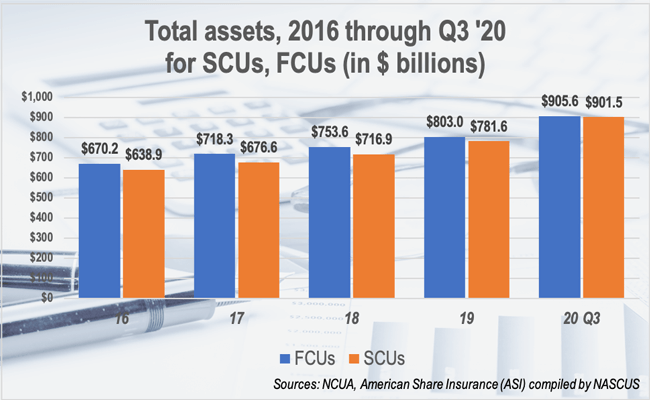
(Dec. 11, 2020) State credit unions maintained their hold of half of all credit union assets during the third quarter, according to the latest quarterly financial results released by NCUA late last week, and other results compiled by NASCUS.
However: asset growth for all charters of credit unions – state (federally and privately insured) and federal – dropped off considerably during the third quarter.
According to the third-quarter results from NCUA (and results from privately insured credit unions collected by private insurer American Share Insurance (ASI) and compiled by NASCUS), state credit unions (SCUs, federally and privately insured) held $901.5 billion in total assets, up 15.3% since the beginning of the year. That accounts for 49.9% of all credit union assets. Federal credit unions, (FCUs) meanwhile, held $905.6 billion in assets, up 12.8% from the year’s start – and accounting for 50.1% of all assets. There were 2,027 SCUs, and 3,213 FCUs, at the end of the third quarter.
Much of the asset growth, however, occurred in the first half of the year – particularly the second quarter – and asset growth slowed in the third quarter. For example, assets for SCUs expanded from year-end 2019 by 12.6% in the first six months of the year (about 8.4% in the second quarter), but only by about 2.7% from the second to the third quarter. FCUs saw a similar growth pattern, with asset growth at mid-year of 10.9% from the end of 2019, but only 1.8% from the second to third quarter.
An influx of savings spurred by stimulus checks to individuals (which were largely recorded in the second quarter), and by payments for enhanced unemployment insurance (UI) and through the Paycheck Protection Program (PPP) payments to workers, is attributed to the asset growth. There were no additional stimulus checks in the third quarter, and enhanced UI came to an end during the quarter.
“Although the 2,037 state-chartered credit unions make up only about 39% of all credit unions across the nation, they have an outsize influence on the lives of their nearly 60 million members who trust these institutions to safeguard their savings and provide them with needed financial services,” said NASCUS President and CEO Lucy Ito, referring to the more than 48% of all credit union members who belong to SCUs.
Other results from the third quarter results show:
- SCU memberships have grown by 3.3% since the beginning the year (1.4% during the third quarter, adding more than 810,000 memberships). FCUs have expanded their memberships by 2.2% since year-end 2019, and less than 1% in the third quarter for 600,000 memberships. Since the end of last year, more than 3.3 million memberships have been added, for a total of 125 million.
- The number of credit unions continued to drop through the first three quarters of the year, with 5,240 reporting their financial results at the end of the third quarter – 107 fewer than at the end of 2019. Of those, 37 were SCUs and 70 FCUs.
LINK:
NCUA Releases Q3 2020 Credit Union System Performance Data
(Dec. 11, 2020) Final approval of the 2021 NCUA budget, which includes a concerning increase in the overhead transfer rate (OTR), will be under consideration when the agency’s board meets for a second time next week, this time on Friday, likely with its full complement of three members.
The meeting is set for Friday, starting at 10 a.m. ET; it will be live streamed via the Internet.
In November, the agency unveiled a $342.5 million budget that is 1.4% smaller than the approved 2020 spending plan. However, for the following year, the agency projects spending could be increased by 6.3%, reaching $364.2 million.
The 2021 budget also includes an increase of 1 percentage point from 2020 in the OTR – the rate at which the agency transfers funds from the National Credit Union Share Insurance Fund (NCUSIF) to cover “insurance-related costs” applied to the agency’s operating budget – to 62.3%. The remainder of the budget is funded by operating fees paid by federal credit unions.
NASCUS, in testimony last week before the NCUA Board at its public briefing about the 2021 budget, urged the agency to consider making changes to how it allocates expenses to insurance-related activities, in order to ensure balance, equity and that more funds are available to cover any losses that may occur due to the financial impact of the coronavirus crisis.
“The 1% increase in the OTR for 2021 means there will be $3.3 million less to cover losses by the fund,” NASCUS’s Lucy Ito told the board. She noted that NASCUS recognized its recommendations cannot be implemented for 2021, but that the state system hopes they would be considered for future budgets. “We want to work with NCUA,” she said.
The agency’s budget, often an annual focal point of comment and criticism from within the credit union system, has been the source of some controversy this year as well. At the November NCUA Board meeting, both Board Member Todd Harper and then-Board Member J. Mark McWatters said they could not support the 2021 budget as proposed, questioning some expenses, the decrease in the total budget in the face of the financial impact of the coronavirus pandemic, and the lack of funding for consumer protection compliance examiner staff. “As long as I remain on the board, I will continue to carefully review the proposed budgets and identify those items that are not truly important to the operations and mission of the NCUA,” McWatters said.
A day later, McWatters submitted his resignation from the board, citing the impending confirmation of his replacement on the panel, Kyle S. Hauptman. The Senate voted Dec. 2, 56-39, to confirm Hauptman to the seat held by McWatters, who had been serving in a holdover capacity since his term expired in August 2019.
Hauptman is expected to be sworn in as a board member before next week’s meetings, and to join in board deliberations at that session (as well as the Thursday session considering various final and proposal regulations, among other things).
LINK:
NCUA Board agenda, Dec. 18 meeting
(Dec. 11, 2020) As the month winds down, as well as the year, the NCUA Board apparently has decided to make the most of it — by scheduling not one but two meetings in the same week, one right after another on Thursday and Friday, including consideration of a final rule on subordinated debt.
Typically, the agency board meets once per month, and typically on the third Thursday of each month; two meetings in a month are rare. There will also (likely) be a new face at the meetings: Kyle S. Hauptman, confirmed by the Senate last week to a seat on the NCUA Board, will be available to join (after he is sworn into office).
The first meeting, on Thursday (getting underway at 10 a.m. ET and to be live streamed via the Internet), has six items on the agenda: five proposed and final rules, including a final rule on subordinated debt, and a board briefing on the 2021 normal operating level for the National Credit Union Share Insurance Fund (NCUSIF).
In January, the board unanimously issued a 275-plus page proposal to give some federally insured credit unions the ability to issue subordinated debt to help them meet their risk-based capital requirements. The proposal, issued for a 120-day comment period, would allow well-capitalized credit unions to count subordinated debt as capital for risk-based net worth purposes (the fundamental capital pool for mitigating credit union risk in their lending and investment portfolios).
Key provisions of the proposal included:
- Permission for low-income-designated credit unions (LICUs), complex credit unions, and new credit unions to issue subordinated debt for purposes of regulatory capital treatment.
- A maximum maturity of 20 years to be imposed on debt issued (with a minimum maturity of 5 years), and a minimum denomination of $100,000. The agency noted the maturity limit helps to clarify that the financial instruments issued are debt – and not equity in the credit unions (which are solely owned by the members; credit unions do not issue stock).
- Prohibitions on a credit union from being both an issuer and investor unless the credit union meets certain conditions related to mergers.
- Addition of a new section addressing new rules and limits for making loans to other credit unions, including investing in subordinated debt at those credit unions.
NCUA has said that federally insured, state-chartered credit unions (FISCUs) would be eligible for applying to issue subordinated debt if their state laws and rules allow it.
NASCUS has long said that subordinated debt should be a part of the risk-based capital framework because it encourages well-managed credit unions to attract additional loss-absorbing forms of capital that they would otherwise forego. Association leader Lucy Ito has noted that the risk-based capital rulemaking itself is intended to increase the capital buffer standing of a credit union before the share insurance fund, and that subordinated debt is consistent with that goal.
In July, NASCUS filed a comment letter in support of the proposal, writing that the development of the rule is an essential complement to the implementation of a risk-based capital rule. “Including Subordinated Debt in risk-based capital ratio calculations is consistent with the statutory purposes of both state and federal credit unions and is sound public policy,” NASCUS wrote. “This rule will help credit unions and their members, protect the share insurance fund, and help place natural person credit unions in the United States on par with credit unions and other depository institutions worldwide.”
Also on the Thursday episode of the two-day schedule of meetings are consideration of:
- A temporary final rule on regulatory relief in response to COVID-19 (Part 701)
- A proposed rule on field of membership shared facility requirements (Part 701, Appendix B, of NCUA rules);
- A proposed rule on mortgage servicing rights (Parts 703 and 721);
- A proposed rule on overdraft policy (Part 701).
The board will also hear a briefing on the 2021 “normal operating level” (NOL) for the NCUSIF, which is the level of reserves to insured savings that the fund is required to operate under (within a range set by law) each year.
LINK:
NCUA Board agenda, Dec. 17 meeting
(Dec. 11, 2020) Shane Foster is the new deputy director of financial institutions at the Arizona Department of Insurance and Financial Institutions (DIFI, a consolidated agency, as of July 1, that includes the former stand-along insurance and financial institutions departments, and the state automobile theft authority). Foster was formerly with the state’s Attorney General’s office, serving as senior litigation counsel in the consumer protection and advocacy section. In a release, the agency said Foster has worked in private practice and has extensive experience in the mortgage industry.