Annual survey of consumer financial health shows downtrends in ability to repay debts
 The Consumer Financial Protection Bureau (CFPB) released a new Making Ends Meet report covering the financial health of American households. Since 2019, the annual Making Ends Meet consumer surveys showed improvement in financial health during the first few years of the COVID-19 pandemic, due in part to a tight labor market, reductions in consumer spending, and access to pandemic-related relief programs. However, data from early 2022 revealed a decline in several key measures, as well as a rapid deterioration in financial health for Hispanic consumers, consumers under the age of 40, and low-income renters. In addition, while unemployment remains low, more than 37% of households were unable to cover expenses for longer than one month if they lost their main source of income.
The 2022 survey was mailed to a sample of consumers in January, with responses collected between January and March. Utilizing data collected from the survey, as well as from the CFPB’s Consumer Credit Panel, today’s report focused on several measures of consumer financial health, including:
- The CFPB’s financial well-being score, which serves as a comprehensive measure of overall subjective financial well-being
- Whether households had difficulty paying bills and expenses in the previous year
- How long households could cover expenses if the main source of income was lost
Many consumers are not financially prepared for a disruption to their main source of income, even as unemployment remains low, according to report findings. Nearly 37% of households report that they could not cover expenses for longer than one month, even with accessing savings, borrowing money, selling assets, or seeking help from family and friends. The report also finds that, in 2022, 1 in 8 households also experienced lost income from unemployment or reduction in work hours, and roughly one-third of households experienced a major unexpected expense, including vehicle repair, unexpected medical expense, or a household repair.
The report discusses how consumers also faced frequent income uncertainties, as income variability increased sharply from 2021 to 2022. The increase was particularly large for Hispanic consumers and consumers under age 40. Also, while racial and ethnic groups applied for credit at similar rates, Black and Hispanic consumers were more likely to be turned down or not receive as much credit as they requested. Black and Hispanic consumers were also much less likely to apply for credit in the first place because they believed they would be turned down.
Among renters, 31% missed at least one rental payment in the previous year and approximately 8% were not current on their rent as of February 2022. Yet only 6% of renters had received rent payment or flexibility since the pandemic began.
Nearly 18% of student loan borrowers have annual incomes under $125,000 and loan balances under $10,000. Under the Department of Education’s proposal for student debt relief, currently on hold due to pending litigation, borrowers with federal student loans who meet these criteria would have their entire student debt balance forgiven.
Read the report, Making Ends Meet in 2022.
December 19, 2022 — We have adjusted our 2022 economic growth expectations to 0.4 percent on a Q4/Q4 basis, up from 0.0 percent following both the upward revision to Q3 2022 Real Gross Domestic Product (GDP) data and a stronger-than-expected personal consumption figure for October. However, we still expect a modest recession to begin in the first quarter of 2023. Our outlook for 2023 is for negative 0.5 percent growth (negative 0.6 percent previously), and in 2024 we expect a return to expansion at 2.2 percent annual growth.
With long-run interest rates pulling back significantly over the past month, and a consequently lower mortgage rate forecast, our latest outlook included a modest increase to our home sales forecast. We now expect total home sales in 2022 to be 5.72 million units, up from 5.67 million in our prior forecast. Sales in 2023 are forecast to total 4.57 million units (previously 4.42 million). We forecast a rebound in 2024 to follow thereafter, with total sales rising 14.7 percent to 5.24 million units (previously 5.25 million) as we expect economic growth to return and mortgage rates to stabilize. Our outlook for overall mortgage originations for the three-year period from 2022 through 2024 is essentially unchanged from last month’s forecast at $2.35 trillion, $1.70 trillion, and $2.11 trillion, respectively.
Consumer Spending Rose as Gas Prices Fell and the Saving Rate Dropped, But Downturn Still Expected
Third quarter GDP was revised three-tenths of a percentage point higher to a seasonally adjusted annualized rate (SAAR) of 2.9 percent. The primary driver was stronger consumer spending. Further, real personal consumption expenditures in October posted their largest monthly gain since January, highlighting continued consumer resilience in Q4. While some of this boost is likely due to one-time stimulus checks in California and a few other states, consumer spending remains stronger than we had anticipated. Therefore, we now expect Q4 2022 real GDP growth to be meaningfully positive at 1.1 percent annualized (up from negative 0.5 percent previously).
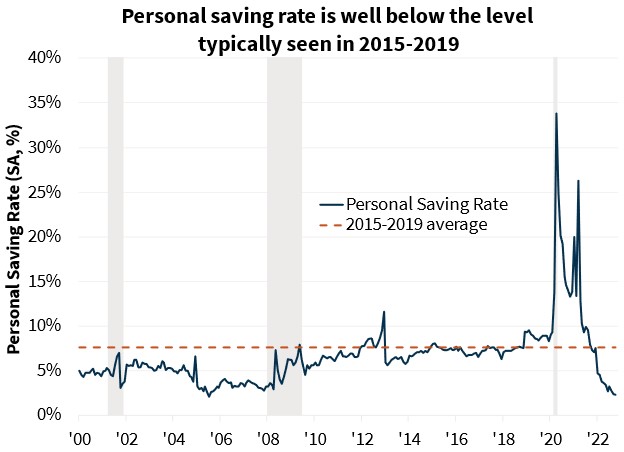
While the decline in gasoline prices and a broader slowdown in inflation has been helpful in supporting recent real income growth and real consumer spending, we continue to see the current pace of consumer spending as unsustainable. In October, the personal saving rate fell to 2.3 percent, the lowest since mid-2005. For comparison, the saving rate has generally hovered from 7 to 9 percent between 2015 and 2019, averaging 7.6 percent. The large decline represents households dipping further into accumulated pandemic- and stimulus check-related savings to fuel consumption, as well as more consumers turning to higher levels of debt financing. The ratio of all non-mortgage consumer debt to personal disposable income rose to 25.1 percent in October, roughly at its pre-pandemic level and just a touch below its all-time high of 25.4 percent set in 2017. While it is difficult to know for certain when consumers will further retrench, we expect this to occur next year as remaining “excess savings” are exhausted, the full effects of higher interest rates weigh on both the labor market and big-ticket purchases and falling home prices reduce “wealth effect”-driven consumption.
Cyclical indicators continue to point to a downturn as well. The inversion of the yield curve, historically one of the better recessionary indicators, continues to deepen. The 2-year/10-year yield curve has now been solidly inverted since early July, and the 3-month/10-year yield curve inverted more recently at the end of October. Furthermore, the recent yield pullback in long-term Treasuries is consistent with growing pessimism regarding the global economic outlook as central banks continue to tighten monetary policy, as well as a simultaneous decline in commodity prices, such as oil. While a “soft landing” continues to be possible, history suggests (and we agree) that a downturn is still likely.

The Conference Board Leading Economic Index® (LEI) has fallen for eight consecutive months as of October. Weakness in this measure has historically been a good predictor of turning points. Also, conditions in the manufacturing sector, a particularly cyclical component of the U.S. economy, have worsened, with the Institute for Supply Management (ISM) manufacturing index slipping below the expansionary threshold of 50 in November and all regional Fed surveys showing recent contractions as well.
Confirmation that Inflation is Slowing
The CPI decelerated sharply for the second consecutive month in November. The topline inflation rate fell to 7.1 percent from 7.7 percent. The core index, which removes food and energy prices, fell to 6.0 percent from 6.3 percent. On a monthly basis, the headline series rose a seasonally adjusted 0.1 percent, while core inflation rose 0.2 percent. Outright deflation from energy prices and many durable goods prices, most notably that of used autos, contributed to the softer-than-expected report. With global demand softening and supply chain issues easing, we expect continued drags on inflation next year stemming from further declines in goods prices. We also read the recent weakness in oil prices to be principally due to softening global demand. In 2021, the jump in gas and used auto prices exaggerated the underlying inflation trend, and now the decline in both categories may mute the underlying core trend.
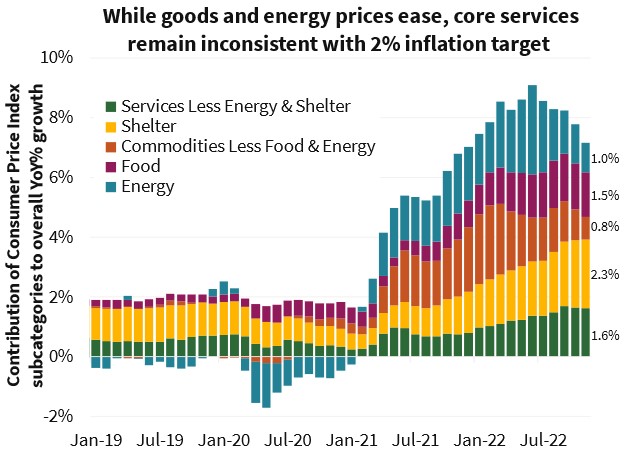
Core services inflation (services less energy services) remained hotter, rising 0.4 percent over the month, but much of this was due to ongoing higher measures of shelter costs. As we have discussed in the past, the measured effects of rental costs and home prices have a significant time lag. With market measures of asking rents and home prices now declining, we expect this source of CPI inflation to diminish around mid-year 2023. Therefore, what remains is the inflation component associated with labor market wage-price dynamics. While not as large to date, this is historically a stickier source of inflation, and the Fed has repeatedly mentioned that a sustained slowing in this source of inflation is needed before any major shift in its current policy. Based on the Employment Cost Index and the unit labor cost measure in the productivity accounts, we estimate current wage growth is consistent with 3 to 4 percent core inflation, a level still above the Fed’s 2 percent target.
The Fed has been consistent in its stated desire to loosen labor market conditions and thus slow nominal wage growth. Therefore, as long as the labor market remains strong and wage growth remains higher than what is consistent with a 2 percent inflation target, we believe the Fed will continue with restrictive monetary policy, further slowing the economy. Employers added 263,000 jobs in November and average hourly earnings accelerated, rising 0.6 percent over the month and 5.1 percent on an annual basis. Other wage trackers, such as that from the Atlanta Fed, also report wage growth above what is usually consistent with the Fed’s inflation target. A significant slowing in wage growth has historically not occurred without meaningful upward movement in the unemployment rate. Therefore, if we believe that the Fed will remain committed to cooling wage growth even as headline inflation decelerates, we can expect continued restrictive monetary policy until that result is achieved.
Market commentary is likely to shift away from discussions of how high the Fed’s terminal rate will be to instead how long they will maintain a restrictive policy stance before cutting. Given the lagging nature of labor markets, the historical downward stickiness of wages, and time lags in measurement, we may not see concrete evidence of slowing wage growth for quite some time, even if a recession does in fact begin in the first quarter of 2023, as we currently predict.
Currently, the most inverted yield curve in more than forty years demonstrates market expectations that the Fed will cut its target rate more quickly than current guidance from the Fed. Given that we are expecting a general downturn to occur, we see market expectations for the Fed to start cutting rates mid-next year as plausible. However, we believe there to be upside risk of longer-run interest rates reflecting a “higher for longer” Fed policy if labor pressures remain and a recession does not occur in the near term, a scenario that could result in mortgage rates over 7% at some point in 2023.
Recent Mortgage Rate Decline Helps Housing, But Sales Still Expected to Slow Further
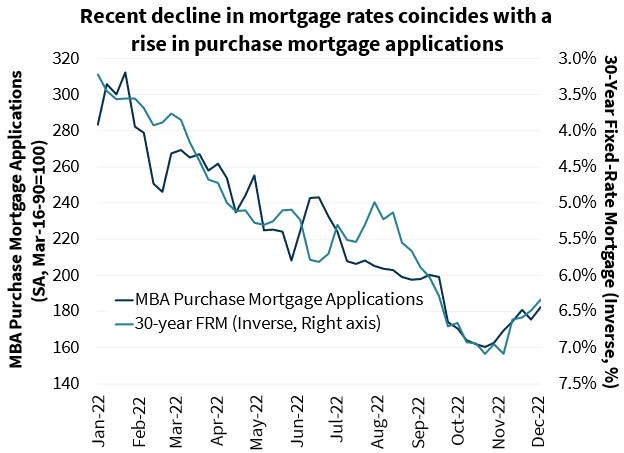
Existing home sales continued to decline in October, falling 5.9 percent to a SAAR of 4.43 million units, 28.4 percent lower compared to a year ago. While we continue to expect existing sales to trend lower in coming months, the sharp pull back in mortgage rates over the past month has led to an upward revision in our sales outlook over the next year. We have upgraded 2023 existing sales to an estimated 4.00 million units from 3.90 million units while also bumping up our Q4 2022 expectation. As of this writing, mortgage rates have fallen approximately 80 basis points since peaking at 7.08 percent in early November, one of the sharpest declines on record. This has coincided with a sharp bump up in purchase mortgage applications, suggesting to us that some potential homebuyers sitting on the sidelines acted once rates began to decline.
Still, affordability remains highly stressed. The share of median household income needed to purchase a median-priced existing home at current mortgage rates remains near the highest levels since before the great financial crisis. This will continue to limit home purchases, especially those of first-time homebuyers. Additionally, most current outstanding mortgage borrowers continue to have mortgage loans with rates well below current market conditions, a strong disincentive to move. We expect this “lock-in” effect to limit sales for the foreseeable future, and when combined with an expected economic slowdown, we are forecasting continued declines in existing sales next year.
In contrast, new home sales unexpectedly increased 7.5 percent to 632,000 annualized units in October. We see this as a temporary bump in what will likely be a continued downward trend in sales in the near term, in part based on continuing weakness in homebuilder confidence measures. Still, we have upgraded our new home sales forecast for the remainder of 2022 and 2023 in part based on the most recent sales pace as well as the lower mortgage rate outlook. Additionally, we believe some of the stronger-than-expected pace of new home sales is due to a distortion in the data caused by an abnormally high cancellation rate in recent months. Homes with cancelled contracts are not taken out of the sales number retroactively, so the same home can be recorded as sold multiple times. Additionally, homebuilders continue to hold large inventories of homes already started and held for sale relative to the recent sales pace. Homebuilders also entered the recent episode enjoying historically elevated operating margins. We therefore expect more aggressive discounting and concessions going forward to help support new home sales relative to existing sales. The “lock-in” effect for existing homeowners limiting the incentive to sell their current homes suggests that first-time buyers may increasingly have to look toward new homes for their purchases.
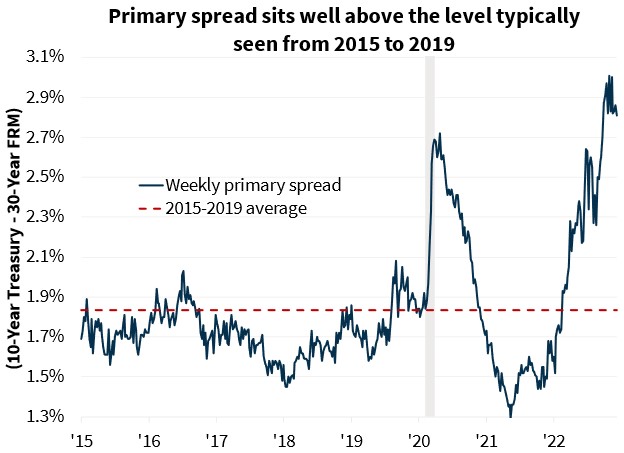
Looking further ahead, with the spread between the 10-year Treasury and 30-year mortgage rates remaining elevated (281 basis points as of this writing, compared to a typical range near 172 from 2015 to 2019), we believe there to be significant room for mortgage rates to eventually drift lower over the next year once the Treasury rate stabilizes. As such, we expect this moderating in the mortgage rate to help support a rebound in home sales after the next business cycle returns to expansion.
Given the continued slowing in rents and signs of slowing household formation, which we expect will help lead to a further increase in vacancy rates, we are projecting multifamily construction to slow next year, especially as multifamily lending standards are likely to tighten as expectations of an economic downturn in 2023 become the consensus expectation. We have downwardly revised our 2023 outlook for multifamily housing starts by 1.9 percent to a total of approximately 376,000 units. Historically, this is still a solid pace of construction, but it would be a major downshift from 2022, for which we are expecting approximately 546,000 units for the year, the highest since 1986.
Only Modest Changes to Originations Outlook
We made minor adjustments to our single-family purchase mortgage originations forecast. We now expect $1.66 trillion in purchase volumes in 2022, an upgrade from last month’s forecast, given the slightly higher expectation for home sales. We expect purchase volumes to fall 20% to $1.33 trillion in 2023, corresponding to declining home sales, before rebounding to $1.53 trillion in 2024 as the housing market recovers.
For single-family refinance originations, we now expect $686 billion in 2022 and $366 billion in 2023, both small downgrades from the prior forecast. These downward revisions were driven by declining refinance volumes in November, as highlighted by our Refinance Application-Level Index (RALI). We expect refinance volumes to grow to $576 billion in 2024 given our projection of a gradual decline in mortgage rates in 2024.
Economic & Strategic Research (ESR) Group
December 14, 2022
For a snapshot of macroeconomic and housing data between the monthly forecasts, please read ESR’s Economic and Housing Weekly Notes.
Data sources for charts: Bureau of Economic Analysis, Bureau of Labor Statistics, Conference Board, Federal Reserve, Fannie Mae, Freddie Mac, Mortgage Bankers Association
The Federal Reserve Board on Friday adopted a final rule that implements the Adjustable Interest Rate (LIBOR) Act by identifying benchmark rates based on SOFR (Secured Overnight Financing Rate) that will replace LIBOR in certain financial contracts after June 30, 2023. The final rule is substantially similar to the proposal with certain clarifying changes made in response to comments.
LIBOR, formerly known as the London Interbank Offered Rate, was the dominant benchmark rate used in financial contracts for decades. However, it was fragile and subject to manipulation, and U.S. dollar LIBOR panels will end after June 30, 2023.
Congress enacted the LIBOR Act to provide a uniform, nationwide solution for so-called tough legacy contracts that do not have clear and practicable provisions for replacing LIBOR after June 30, 2023. As required by the law, the final rule identifies replacement benchmark rates based on SOFR to replace overnight, one-month, three-month, six-month, and 12-month LIBOR in contracts subject to the Act. These contracts include U.S. contracts that do not mature before LIBOR ends and that lack adequate “fallback” provisions that would replace LIBOR with a practicable replacement benchmark rate.
In response to comments, the final rule restates safe harbor protections contained in the LIBOR Act for selection or use of the replacement benchmark rate selected by the Board, and clarifies who would be considered a “determining person” able to choose to use the replacement benchmark rate selected by the Board for use for certain LIBOR contracts. Consistent with the LIBOR Act, the final rule also ensures that LIBOR contracts adopting a benchmark rate selected by the Board will not be interrupted or terminated following LIBOR’s replacement.
The final rule will be effective 30 days after publication in the Federal Register.
 On December 15, the NCUA Board held its final meeting of 2023. The Board was briefed on the Share Insurance Fund’s (SIF) Normal Operating Level, which will remain at 1.33%. The NOL was lowered to 1.33% from 1.38% at the end of 2021. The Board discussed inflation and the current rate environment during the briefing along with the potential impact these factors may have on the SIF in the coming months and years.
The Board was also presented with the proposed 2023-2024 NCUA Budget for a vote. The funding levels in the total 2023 draft budget would be reduced by $6.7 million. The original draft was posted to the NCUA website on September 29, 2022, with an identical version published in the Federal Register on October 5, 2022. The Board voted unanimously to approve the budget. Toward the end of the budget discussion, Chairman Harper inquired as to the impacts of the Financial Transparency Act on the NCUA Budget should NDAA pass. It was noted that should this pass, implementation would be a multi-year effort that NCUA would need to assess.
Finally, the Board unanimously approved a Proposed Rule, NCUA Parts 701 and 714, Financial Innovation – Loan Participation, Eligible Obligations, and Notes of Liquidating Credit Unions. The proposed rule would amend NCUA’s rules and regulations regarding the purchase of loan participations and the purchase, sale, and pledge of eligible obligations and other loans, including notes of liquidating credit unions. The proposed rule is also intended to clarify the NCUA’s current regulations while providing additional flexibility for federally insured credit unions to use advanced technologies and opportunities offered by FinTechs. The NCUA Board praised the proposed rule as a means to keep the NCUA relevant in this space and allow credit unions greater opportunities.
- Board Approves NCUA 2023–2024 Budget; Issues Proposed Rule on Financial Innovation
- NCUA Chairman Todd M. Harper Statement on the Proposed Financial Innovation Rule 12/15/2022
- NCUA Chairman Todd M. Harper Statement on the NCUA’s 2023–2024 Budget 12/15/2022
- NCUA Chairman Todd M. Harper Statement on the Normal Operating Level Briefing 12/15/2022
CFPB & FHFA news release announcing the publication of updated loan-level data for public use collected through the National Survey of Mortgage Originations
The Consumer Financial Protection Bureau (CFPB) and the Federal Housing Finance Agency (FHFA) today published updated loan-level data for public use collected through the National Survey of Mortgage Originations (NSMO). The data also provide updated mortgage performance and credit information for a nationally representative sample of mortgage borrowers from 2013 to 2020.
Key highlights from the updated data are:
- The COVID-19 pandemic shaped the mortgage borrower experience in 2020. A higher share of borrowers reported that a paperless online mortgage process was important to them in 2020 (48 percent) than in 2019 (42 percent). More borrowers reported that the mortgage closing did not occur as originally scheduled in 2020 (21 percent) than in 2019 (17 percent).
- Mortgage borrowers, particularly those refinancing a loan, responded to the low-interest rates in 2020. The share of borrowers who rated themselves very familiar with available interest rates increased from 55 percent in 2019 to 69 percent in 2020. The share who reported being very satisfied that they got the lowest interest rate for which they could qualify increased from 67 percent in 2019 to 75 percent in 2020.
- Borrowers who refinanced in 2020 were more well off financially than those who refinanced in 2019:
- A higher share reported their household income was $175,000 or higher in 2020 (29 percent) than in 2019 (20 percent).
- Similarly, a higher share indicated that they owned stocks, bonds, or mutual funds in 2020 (53 percent) than in 2019 (43 percent).
- Relatedly, 76 percent of borrowers who refinanced were not at all concerned about qualifying for a mortgage in 2020, up from 66 percent in 2019.
 Watch The Consumer Financial Protection Bureau’s Semi-Annual Report to Congress
December 15, 2022
CFPB Amendment to the HMDA Rule
Home Mortgage Disclosure (Regulation C); Judicial Vacatur of Coverage Threshold for Closed-End Mortgage Loans
In April 2020, the Consumer Financial Protection Bureau issued a final rule (2020 HMDA Rule) to amend Regulation C to increase the threshold for reporting data about closed-end mortgage loans. The 2020 HMDA Rule increased the closed-end mortgage loan reporting threshold from 25 loans to 100 loans in each of the two preceding calendar years, effective July 1, 2020.
On September 23, 2022, the United States District Court for the District of Columbia vacated the 2020 HMDA Rule as to the increased loan-volume reporting threshold for closed-end mortgage loans. As a result of the September 23, 2022 order, the threshold for reporting data about closed-end mortgage loans is 25, the threshold established by the 2015 HMDA Rule. Accordingly, this technical amendment updates the Code of Federal Regulations to reflect the closed-end mortgage loan reporting threshold of 25 mortgage loans in each of the two preceding calendar years.
You can access technical amendment here: www.consumerfinance.gov/rules-policy/final-rules/hmda-reg-c-judicial-vacatur-of-coverage-threshold-for-closed-end-mortgage-loans/.
The CFPB is proposing:
- Covered nonbanks would report certain agency and court orders connected to consumer financial products and services: Generally, nonbanks would have to report final agency and court orders and judgments, including consent and stipulated orders, brought under federal consumer financial protection laws or state laws regarding unfair, deceptive, or abusive acts or practices.
- Larger supervised nonbanks would designate a senior executive to attest regarding the firm’s compliance with covered orders: Larger nonbanks that are supervised by the CFPB would be required to designate a senior executive to submit an annual supervisory written statement attesting to the steps taken to oversee the activities subject to the order and whether the executive knows of any violations of, or other instances of noncompliance with, the covered order.
 Prepared Statement of Director Rohit Chopra before the House Committee on Financial Services
The CFPB’s market monitoring and supervision of financial institutions provides one lens into the state of the economy. Consumer demand has rebounded as our country transitions out of pandemic conditions. While the labor market remains strong, household debt has increased rapidly. The rise in household payment burdens from auto loans and credit cards has been particularly pronounced, given rising interest rates, the cost of vehicles, and the impact of inflation on other goods and services in the economy.
As consumers continue to navigate the economic impacts and ripple effects of the pandemic, their financial patterns have adapted and responded to changing conditions – as have the companies that serve them. For example, the CFPB has observed a notable increase in use of Buy Now, Pay Later products over the past few years. As interest rates on credit cards increase – and correspondingly, outstanding balances – a low- or no-interest Buy Now, Pay Later product that spreads the cost of goods over four payments can be particularly appealing. The CFPB’s recent study on Buy Now, Pay Later noted a significant increase in use of these products to fund essential goods and services. The CFPB is working to ensure that Buy Now, Pay Later lenders adhere to the same protocols and protections as other similar financial products to avoid regulatory arbitrage and to ensure a consistent level of consumer protection.
2022 CFPB Research Conference
In person registration is open until December 11th.
Livestream registration is now open.
On December 15–16, 2022, the CFPB will host its sixth research conference on consumer finance. The conference will be held in person at CFPB headquarters at 1700 G Street NW, Washington DC.
The goal of the conference is to connect the core community of researchers and policymakers, with a focus on research from a wide range of disciplines and approaches that can inform both groups on the topic of consumer finance.

Agenda
The two-day conference will feature a keynote address and eight sessions of researchers presenting their work with members of CFPB’s Office of Research serving as discussants.

Call for papers
For this conference, we welcome and encourage the submission of a broad range of research work.
NASCUS Member Benefit: Recent CFPB Resource Summaries
CFPB Consumer Financial Protection Circular 2022-07: Reasonable Investigation of Consumer Reporting Disputes
12 CFR Chapter X
The Consumer Financial Protection Bureau (CFPB) issued this circular to respond to two questions regarding the responsibilities of consumer reporting agencies.
- Are consumer reporting agencies and the entities that furnish information to them (furnishers) permitted under the Fair Credit Reporting Act (FCRA) to impose obstacles that deter the submission of disputes?
- Do consumer reporting agencies need to forward to furnishers consumer-provided documents attached to a dispute?
The Bureau released this circular on its website on November 10, 2022, and the circular can be accessed here.
CFPB Consumer Financial Protection Circular 2022-06: Unanticipated Overdraft Fee Assessment Practices
12 CFR Chapter X
The Consumer Financial Protection Bureau (CFPB) has issued Consumer Financial Protection Circular 2022-06, titled “Unanticipated Overdraft Fee Assessment Practices” to respond to a question posed about whether the assessment of overdraft fees under certain instances would be considered an unfair act or practice under the Consumer Financial Protection Act (CFPA), even if the entity complies with the Truth in Lending Act (TILA) and Regulation Z and the Electronic Fund Transfer Act (EFTA) and Regulation E.
The circular became effective on October 26, 2022 and can be found here.
Notice of Intent to Make a Preemption Determination
The CFPB issued a Notice of Intent to Make a Preemption Determination under TILA. In the Notice, the Bureau explains it has preliminarily determined that TILA does not preempt a New York State law governing commercial financing with respect to certain provisions. Additionally, the Bureau is providing notice that it is considering whether to make a preemption determination regarding State laws in California, Utah, and Virginia that are potentially similar to the New York law.
The Bureau is soliciting public comment on this preliminary preemption determination.
You can access the Notice here: www.consumerfinance.gov/rules-policy/notice-opportunities-comment/open-notices/notice-of-intent-to-make-preemption-determination-under-truth-in-lending-act/.
Blog: Update on state laws on lending to businesses
The CFPB received a request from an industry trade association to determine whether New York’s commercial financing disclosure law is preempted by the federal Truth in Lending Act. Congress has expressly authorized the CFPB to determine whether state laws are preempted by the Truth in Lending Act. The public can request such a determination, or the CFPB can raise the issue on its own. The Truth in Lending Act’s implementing regulations require the CFPB to request public comment before determining whether a state law is preempted.
After carefully considering the request, the CFPB’s preliminary determination is that the New York law is not preempted by the Truth in Lending Act because the New York law regulates commercial financing transactions rather than consumer-purpose transactions. The CFPB is requesting comment on whether it should finalize its preliminary determination that the New York law – as well as potentially similar laws in California, Utah, and Virginia – are not preempted.
Blog: Changes to HMDA’s closed-end loan reporting threshold
On September 23, 2022, the United States District Court for the District of Columbia issued an order vacating the 2020 Home Mortgage Disclosure Act (HMDA) Final Rule as to the loan volume reporting threshold for closed-end mortgage loans. The decision means that the threshold for reporting data on closed-end mortgage loans is now 25 loans in each of the two preceding calendar years, which is the threshold established by the 2015 HMDA Final Rule, rather than the 100 loan threshold set by the 2020 HMDA Final Rule.
The CFPB recognizes that financial institutions affected by this change may need time to implement or adjust policies, procedures, systems, and operations to come into compliance with their reporting obligations. In these limited circumstances, in allocating the CFPB’s enforcement and supervisory resources, the CFPB does not view action regarding these institutions’ HMDA data as a priority. Thus, the CFPB does not intend to initiate enforcement actions or cite HMDA violations for failures to report closed-end mortgage loan data collected in 2022, 2021, or 2020 for institutions subject to the CFPB’s enforcement or supervisory jurisdiction that meet Regulation C’s other coverage requirements and originated at least 25 closed-end mortgage loans in each of the two preceding calendar years but fewer than 100 closed-end mortgage loans in either or both of the two preceding calendar years.
In March 2020, November 2020, and November 2021, the NCUA issued three letters to federal credit unions providing flexibility during the pandemic related to annual meetings.1 In those letters, the NCUA recognized that the COVID-19 pandemic had created challenges for federal credit unions and their members. As a result, the NCUA provided federal credit unions with the flexibility to conduct their membership and board of director meetings completely virtually. This emergency exemption will expire on December 31, 2022.
Specifically, in those actions the NCUA provided that a federal credit union could adopt at any time, by a two-thirds vote of its board of directors, and without additional NCUA approvals, a bylaw amendment to Article IV of the NCUA’s Federal Credit Union Bylaws. The letters to federal credit unions provided specific wording for the bylaw amendment.
In addition, the NCUA has issued several meeting-related notifications to federal credit unions since 2020 in connection with the COVID-19 pandemic. Specifically, the NCUA stated in those notifications that if a federal credit union had adopted the above-referenced bylaw amendment, then it was appropriate for that federal credit union to invoke its provisions for meetings if a majority of its board of directors so resolved for each such meeting. The NCUA noted that general quorum requirements still had to be met for “virtual-only” meetings.
The NCUA does not believe that current circumstances continue to warrant federal credit unions to invoke the subject bylaw provision beyond year-end 2022. Federal credit unions that have already adopted the bylaw amendment may retain it in their bylaws, but it will not be applicable after the end of 2022 unless NCUA issues a new notification allowing federal credit unions to invoke it.
Although “virtual-only” member meetings will no longer be an option, the NCUA reminds federal credit unions that they may choose to hold hybrid meetings if that suits their needs.2 Hybrid meetings consist of a meeting held virtually in conjunction with an in-person component for members who wish to or need to attend that way. While general quorum requirements still must be met for hybrid meetings, federal credit unions may count attendees at both the virtual and in-person components toward those requirements. A hybrid meeting format could preserve federal credit union resources and reduce the effort required to hold meetings without disenfranchising those members for whom virtual attendance is difficult or impossible. Federal credit unions must also consider whether their current bylaws authorize hybrid meetings or whether bylaw changes will be necessary.
Additionally, the NCUA’s Federal Credit Union Bylaws permit federal credit union boards to conduct “virtual-only” meetings for all but one of their board meetings per calendar year. Further, if a quorum of the directors is physically present at the one required in-person meeting, then the remaining directors may attend that meeting virtually.3
Finally, the NCUA’s Federal Credit Union Bylaws permit flexibility for distributing member notices. Specifically, the bylaws provide that notices for member meetings may be sent by electronic mail to members who have opted to receive statements and notices electronically.4 As such, a paper mailing is not required for all members, only those members who have not opted to receive electronic statements and notices.
If you have any questions or concerns, please contact your NCUA Regional Office.
1 Letter to Federal Credit Unions, 20-FCU-02, “NCUA Actions Related to COVID-19 – Annual Meeting Flexibility;” Letter to Federal Credit Unions, 20-FCU-04, “Federal Credit Union Meeting Flexibility During the COVID-19 Pandemic;” Letter to Federal Credit Unions, 21-FCU-06, “Federal Credit Union Meeting Flexibility in 2022 Due to the COVID-19 Pandemic.”
2 12 C.F.R. Part 701, Appendix A, Official NCUA Commentary, Article V.
3 Id. Article VI, § 5.
4 Id. Article IV, § 2.
November 29, 2022 — The Conference of State Bank Supervisors is complaining that none of the nominees for the Federal Deposit Insurance Corp. board has state regulatory experience on the eve of their Senate confirmation hearing.
The Senate Banking Committee is scheduled to consider Wednesday the nominations of Martin Gruenberg for permanent chair of the agency, Travis Hill for vice chair and Jonathan McKernan for an open seat on the board. Gruenberg is a Democrat, and Hill and McKernan are Republicans.
CSBS has repeatedly urged Congress to abide by a 1996 amendment to the Federal Deposit Insurance Act that says at least one of the FDIC’s five board members must have experience as a state banking regulator. None of President Biden’s three picks, nor the two other members of the board, meet that requirement, CSBS said in a letter Tuesday to committee Chairman Sherrod Brown, D-Ohio, and Sen. Pat Toomey of Pennsylvania, the panel’s top Republican.
“The nominees before the Senate may otherwise be qualified for the positions to which they have been nominated,” the letter said. “However, they do not possess the perspective that only an individual with state bank supervisory experience can bring to meet this fundamental statutory obligation.”
The last director with state experience, the CSBS has said, was former Comptroller of the Currency Thomas Curry, who left in 2012.
The FDIC nomination process has been fraught since the beginning, with the White House announcing its two Republican choices before settling on Gruenberg — the acting chair — as its choice to hold the permanent job. The move by the White House stunned observers, who noted that without a confirmed chair, Hill would be in line to become acting chairman of the agency.
Courtesy of Claire Williams, American Banker
- Thursday, December 1 at 10 a.m. ET: The full Committee will convene for a hybrid hearing entitled, “Boom and Bust: The Need for Bold Investments in Fair and Affordable Housing to Combat Inflation.”
- Tuesday, December 6 at 10 a.m. ET: The Subcommittee on Diversity and Inclusion will convene for a hybrid hearing entitled, “Unfinished Business: A Review of Progress Made and a Plan to Achieve Full Economic Inclusion for Every American.”
- Tuesday, December 6 at 2 p.m. ET: The Subcommittee on Investor Protection, Entrepreneurship, and Capital Markets will convene for a hybrid hearing entitled, “E, S, G and W: Examining Private Sector Disclosure of Workforce Management, Investment, and Diversity Data.”
- Wednesday, December 7 at 10 a.m. ET: The Subcommittee on Oversight & Investigations will convene for a hybrid hearing entitled, “An Enduring Legacy: The Role of Financial Institutions in the Horrors of Slavery and the Need for Atonement, Part II.”
- Tuesday, December 13 at 10 a.m. ET: The full Committee will convene for a hybrid hearing entitled, “Investigating the Collapse of FTX, Part I.”
- Wednesday, December 14 at 10 a.m. ET: The full Committee will convene for a hybrid hearing entitled, “Consumers First: Semi-Annual Report of the Consumer Financial Protection Bureau.”
All hearings are livestreamed on https://financialservices.house.gov/live/.
March 28, 2023
NASCUS, the Wisconsin Department of Financial Institutions Office of Credit Unions, and the Wisconsin Credit Union League are hosting this half-day collaborative meeting to bring industry leaders and directors across our state system together to discuss the most pressing issues facing our industry today. Topics covered include:
- NASCUS President/CEO Brian Knight Highlights National Issues Affecting the State System
- Climate Change Impacts with the Filene Research Institute
- Best Practices, Succession Planning, and Board responsibilities with David Reed
Wisconsin credit union board members, committee members, and management should not miss the NASCUS Wisconsin Executive Forum.
This is a virtual event. Please note all times are CST.
Participation Fee:
- $99 for NASCUS Members or WI Credit Union LeagueMembers
- $199 Non-Members
 Biden Asks Supreme Court to Overturn Fifth Circuit’s CFPB Ruling
The Biden Administration on Monday asked the U.S. Supreme Court to overturn an appeals court decision that found that the CFPB’s funding scheme was unconstitutional.
Inside the Petition
“The CFPB’s critical work administering and enforcing consumer financial protection laws will be frustrated,” the administration wrote. “And because the decision below vacates a past agency action based on the purported Appropriations Clause violation, the decision threatens the validity of all past CFPB actions as well.”
Other federal agencies are funded outside the annual appropriations process, according to the administration. “The court of appeals’ novel and ill-defined limits on Congress’s spending authority contradict the Constitution’s text, historical practice, and this Court’s precedent,” the petition states.
Further, administration officials added, “The CFPB’s funding mechanism is entirely consistent with the text of the Appropriations Clause, with longstanding practice, and with this Court’s precedent.”
Additional Support for the CFPB
Biden Administration officials not the only ones blasting the Fifth Circuit and its ruling. During a Senate Banking Committee hearing featuring banking regulators, Sen. Elizabeth Warren, D-Mass., called the Fifth Circuit “the Republicans’ go-to court.” Warren, who is credited with developing the idea of the consumer bureau, said that Congress created independent funding structures for bank regulators to insulate them from political pressure.
Under questioning by Warren, each of the banking regulators—including NCUA Chairman Todd Harper—acknowledged that their agencies are funded outside the appropriations process. The NCUA, for instance, is funded by fees paid by credit unions. READ MORE
The CFPB Finalizes Rule to Increase Transparency Regarding Key Nonbank Supervision Tool
Today, we finalized changes to our nonbank supervision procedural rule. The changes will provide transparency to the public about how we are using an important supervisory tool to keep pace with fast-moving consumer finance markets.
Based on public comments, in this final version of the procedures, we are clarifying the standard we will apply to decide what information is appropriate for public release. We are also extending the amount of time that is available to the nonbank entity to provide us with input about what information we should release.
Agility in Nonbank Supervision
The Consumer Financial Protection Act (CFPA) enables the CFPB to supervise a nonbank covered entity that we have reasonable cause to determine is engaging, or has engaged, in conduct that poses risks to consumers with regard to consumer financial products or services.
This statutory authority gives the CFPB’s supervision program the ability to move as quickly as the marketplace. For instance, fast-growing companies in nontraditional areas of the consumer finance market may be engaged in novel activities that warrant supervisory attention. There can also be supervisory gaps in more traditional areas of the market that ought to be filled. Through the supervisory process, CFPB examiners can work with the company in question to fully understand and manage its risks.
When we make a determination that supervision is warranted, our focus is on identifying risks to consumers, preferably before they manifest in violations of law or consumer harm. READ MORE
CFPB Reports Highlight Problems with Tenant Background Checks
Errors and false information in tenant background checks raise costs and barriers to quality rental housing.
CFPB issued two reports on the tenant background check industry. The reports describe how errors in these background checks contribute to higher costs and barriers to quality rental housing. Too often, these background checks – which purport to contain valuable tenant background information – are filled with largely unvalidated information of uncertain accuracy or predictive value. While renters bear the costs of errors and false information in these reports, they have few avenues to make tenant screening companies fix their sloppy procedures. The CFPB’s analysis of more than 24,000 complaints highlighted the renter challenges associated with the industry’s failures to remove wrong, old, or misleading information and to provide adequate investigations of disputed information.
The tenant background check industry creates reports that include extensive personal information, such as credit history, civil and criminal records, and credit scores, as well as the proprietary risk scores on which many landlords and property management companies base their decision to rent to a prospective tenant. The CFPB’s report on the state of the tenant screening market is an analysis of industry research, legal cases, academic research, the CFPB’s market monitoring, and other third-party sources. The CFPB’s consumer snapshot analyzes more than 24,000 complaints and results from focus groups with 44 renters.
Both reports reveal that people are denied rental housing because negative information is reported that belongs to someone else; outdated information remains on reports; and inaccurate or misleading details about arrests, criminal records, and eviction records are not corrected nor removed from reports. The consumer snapshot reveals that renters submitted more than 16,000 complaints about incorrect information on their reports and another 4,500 complaints about obstacles faced trying to get companies to fix their errors. READ MORE
CFPB Takes Action Against Carrington Mortgage for Cheating Homeowners out of CARES Act Rights
Company wrongly charged fees and inaccurately reported homeowner credit information despite pandemic-era housing protections.
The CFPB investigated Carrington and found they violated the Consumer Financial Protection Act when they misrepresented the requirements of the CARES Act and related federal agency guidelines. The company misrepresented to borrowers that they could not have 180 days of forbearance upon request and that certain borrowers could not have forbearance at all. Carrington also implied that homeowners had to make more detailed attestations than were actually required by law, and the company imposed late fees when they were not permitted.
Specifically, the CFPB found that Carrington:
- Wrongly charged late fees: Carrington deceived certain borrowers, stating they were required to pay late charges they did not owe while their accounts were in forbearance. Carrington also falsely told borrowers in forbearance that they would “be assessed” or had “been assessed” late charges. In some cases, Carrington did wrongfully charge late fees.
- Repeatedly provided false information about pandemic protections: Carrington told certain homeowners that they were required to remit their monthly payments “immediately” and could be facing foreclosure proceedings if they did not do so. In fact, no payment was required nor could the homeowners face foreclosure proceedings. The company also misrepresented to homeowners that they needed to provide specific reasons in order to obtain a forbearance when they only needed to attest to financial hardship during the pandemic. Carrington also told homeowners that to get a forbearance of more than 90 days, they had to make another request after the first 90 days.
- Botched homeowners’ credit reports: Carrington illegally furnished information to consumer reporting companies that certain borrowers’ accounts were delinquent, rather than current, even though the homeowners’ accounts were current entering forbearance. Carrington also inaccurately furnished reports on the delinquency of certain homeowners in forbearance who were delinquent at the time they entered forbearance. Carrington failed to promptly notify the big three credit reporting companies about the errors.