The Cooperative Interstate Agreement for the Supervision of State-Chartered Credit Unions is a regulatory framework developed in collaboration with NASCUS to facilitate coordinated supervision of state-chartered credit unions operating in multiple states.
The agreement enhances collaboration between a credit union’s Home State (where it is chartered) and Host States (where it conducts or plans to conduct operations), improving efficiency in regulatory oversight. This structure provides consistent guidance regarding field of membership (FOM) expansion and the establishment of new branches across state lines.
The most recent version of the Interstate Agreement was adopted in 2023, following earlier agreements in 2015 and 2009. A map of signatory states is available; however, some states may follow similar practices without formal adoption due to differences in statutory language.
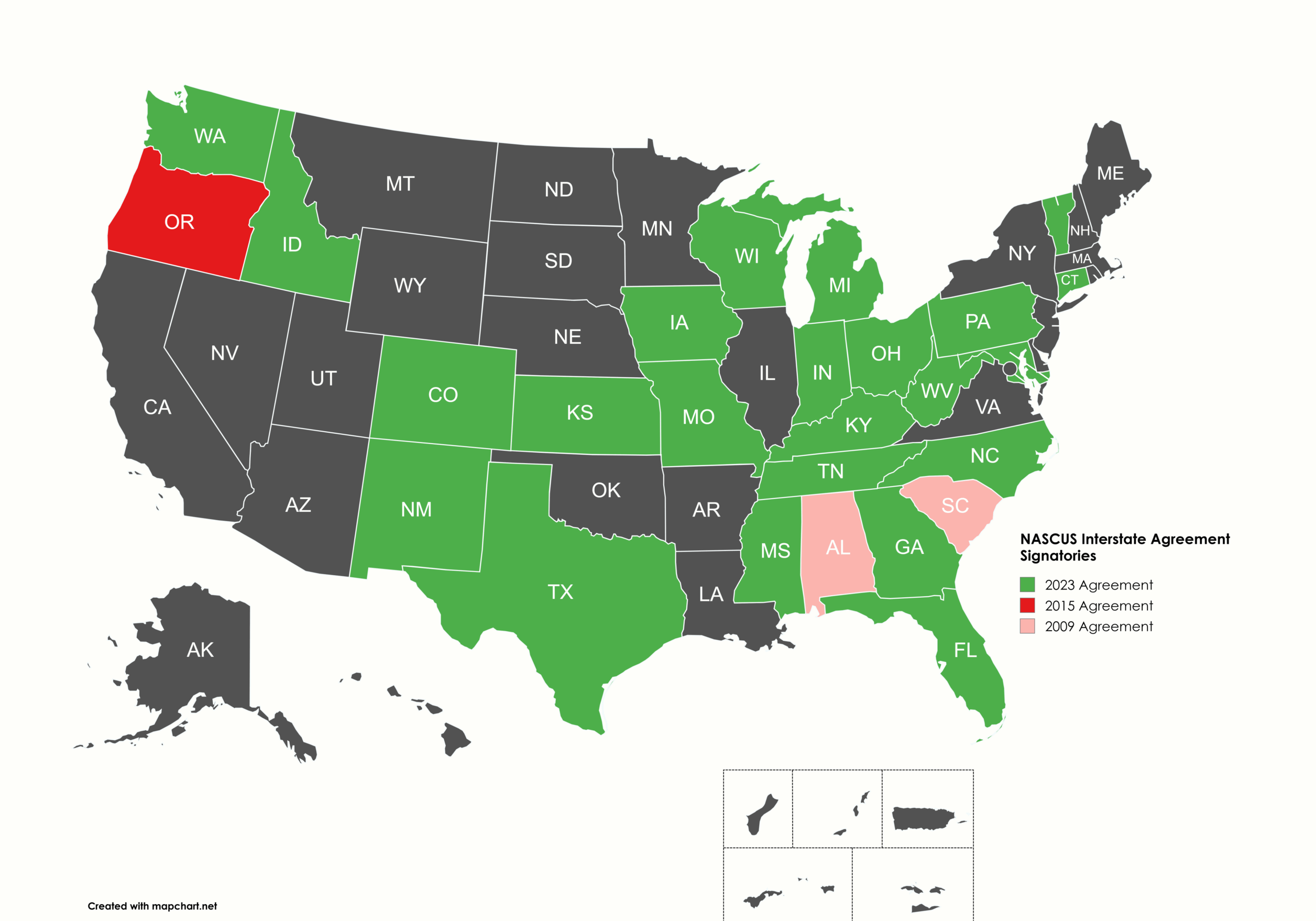
Key Provisions of the Agreement:
-
State Law Compliance: The agreement does not override state law. Multistate credit unions must comply with applicable legal requirements in both the Home and Host States.
-
Field of Membership and Branching: States recognize the authority of credit unions to expand fields of membership, add new groups, open branches, and offer services, provided these actions are consistent with the laws of both the Home and Host States. The agreement does not extend to credit union service organizations (CUSOs).
-
Supervision and Examinations: The Home State supervisor retains primary regulatory responsibility. Host State inquiries, including those from share or deposit insurers, are directed to the Home State.
-
Enforcement Coordination: Home and Host State supervisors are required to promptly share information on material enforcement actions or significant regulatory concerns, including circumstances that may result in a downgrade to a composite CAMELS rating of 4 or 5. Ongoing communication between supervisors is maintained until such issues are resolved.
-
Supervisory Information Sharing: Participating states may exchange supervisory information, including examination documents and regulatory reports, to enhance regulatory oversight. Such information remains confidential and the property of the originating supervisory authority. Disclosure by the receiving state is not permitted without written authorization, unless otherwise required by law or court order.
-
Joint Examinations: Host State supervisors may participate in joint examinations with the Home State. Findings and documentation from Host State participation are treated as confidential supervisory information under the jurisdiction of the Home State, which retains overall supervisory authority.
This agreement supports a unified approach to multistate supervision while preserving the sovereignty of individual state regulatory frameworks.