By Corin Cesaric, CNET
Click here to read the entire article
Personal information for both customers and drivers was exposed after an employee fell for a social-engineering scam.
Food delivery is becoming increasingly popular, but here’s the delivery of bad news for users of one popular company. DoorDash confirmed that it suffered a recent data breach. According to the company, the accessed information includes customer names, phone numbers, email addresses and physical addresses, but “no sensitive information” was obtained.
It’s unclear when exactly the breach occurred, but DoorDash released its statement on the incident on Nov. 13.
How did the data breach occur?
DoorDash stated that an employee with the company “was recently targeted in a social engineering scam.” Information on delivery drivers and customers was exposed.
After discovering the scam, the company’s response team removed access from the unauthorized party and reported the incident to law enforcement. DoorDash has since “implemented additional training and awareness for our employees around various social engineering scams,” the company says.
Is my credit card information at risk?
According to DoorDash, the criminals didn’t access bank or payment card information, but they did get customer names, phone numbers, email addresses and physical addresses.
Click here to continue reading the entire article
By TSCA at Keller and Heckman Keller and Heckman LLP;
Published in the National Law Review, November 13, 2025, Volume XV, Number 317
A coalition of 39 state and territory attorneys general recently submitted a letter to congressional leaders requesting clarification of the federal definition of “hemp” under the Agricultural Improvement Act of 2018 (commonly known as the 2018 Farm Bill).
The letter, coordinated by the National Association of Attorneys General (NAAG), expresses concern over what the signatories describe as the unintended consequences of the current statutory language, particularly regarding the proliferation of hemp-derived intoxicating products.
The 2018 Farm Bill federally legalized hemp by defining it as cannabis containing no more than 0.3% delta-9 tetrahydrocannabinol (THC) on a dry weight basis. This definition was intended to distinguish non-intoxicating industrial hemp from marijuana, which remains a Schedule I controlled substance under federal law.
However, the bill did not explicitly address other cannabinoids derived from hemp, such as delta-8 THC, delta-10 THC, THC-O, and others. These compounds, while chemically distinct from delta-9 THC, can also produce psychoactive effects and are often synthesized from cannabidiol (CBD) extracted from hemp.
According to the letter, the attorneys general assert that certain manufacturers are exploiting ambiguities in the Farm Bill’s definition of hemp to produce and sell synthetic THC products that they claim fall within the legal scope of the law. The AGs argue that these products are often more intoxicating than marijuana and are being marketed in ways that appeal to minors, including as gummies, candies, and beverages.
The attorneys general are urging Congress to act either through the Fiscal Year 2026 appropriations process or the upcoming reauthorization of the Farm Bill. Specifically, they seek a revision to the definition of hemp that would make clear that intoxicating hemp-derived THC products are not legal under federal law. They emphasize that such clarification would not affect the cultivation of industrial hemp for non-intoxicating uses, which they support.
Visa is running pilot trials of USD-backed stablecoin payouts to creators and gig workers.
The pilot allows businesses and platforms to send payouts directly to recipients’ stablecoin wallets, instead of sending to a card or bank account.
For businesses using Visa Direct, payouts can be funded in fiat currency, while recipients can choose to receive their funds in USD-backed stablecoins like USDC.
“Launching stablecoin payouts is about enabling truly universal access to money in minutes – not days.” says Chris Newkirk, president, commercial & money movement solutions, Visa. “Whether it’s a creator building a digital brand, a business reaching new global markets or a freelancer working across borders, everyone benefits from faster, more flexible money movement.”
Recent research from Visa shows that faster access to funds is ranked as the top reason digital content creators prefer using digital payment methods. Fifty-seven percent (57%) cited instant access as their leading motivation for choosing digital payment methods to get paid for content creation work.
This latest pilot advances Visa’s land-grab in stablecoin-powered payments. In September, Visa Direct announced a stablecoin pre-funding pilot for back-end treasury: letting businesses fund payouts using stablecoins instead of only fiat.
Today’s pilot extends that proposition, enabling payouts to end recipients, like consumers, in stablecoins – putting digital dollars directly in recipients’ wallets. Visa says it is in the process of onboarding select partners, with wider access projected for 2026.
By Robert Crow, the Cool Down.
Click here to read the entire article.
A growing number of extreme weather events and natural disasters have pushed insurance markets to the brink, potentially impacting millions of homeowners across the United States.
What’s happening?
Politico Pro reported on an insurance crisis that has impacted several states, most notably California. An increased risk of wildfires and other severe weather events has caused some private insurance companies to raise their rates to levels that are unsustainable for many people, or to leave states completely. In 2023, State Farm announced it would no longer offer new homeowner’s insurance policies in California because of the increased risk of fire and other disasters.
To counter this, California created a state-chartered insurance plan called the FAIR Plan, which uses policy premiums to pay out claims when needed. The number of policies under the FAIR Plan, however, has nearly doubled, and its total liability is nearly $700 billion, which has many experts questioning if the plan will soon run out of money, forcing insurance companies and policyholders to pay out claims.
For example, January’s deadly Southern California wildfires created so many insurance claims that the state assessed insurers and policyholders $1 billion. Rob Moore, director of climate adaptation with the Natural Resources Defense Council, told Politico Pro that policymakers “have a huge challenge ahead of them. And it’s a climate resilience and climate risk challenge they’re facing.”
Why is this concerning?
That risk has only grown because of human-caused pollution. As we burn dirty fuels, we release massive amounts of heat-trapping pollution into the atmosphere. That pollution has caused global temperatures to increase to record-breaking levels, with the last decade seeing the 10 warmest years in recorded history.
Those temperature increases cause more frequent and severe weather events, such as hurricanes, floods, and wildfires. The connection is so strong that one expert likened increasing global temperatures to “steroids for weather.”
Click here to read the entire article.
By Esteban Camargo, published in CUSO Magazine
We are wrapping up another Cybersecurity Month here at CUSO Magazine. We have learned about the rise of AI scams, RFID skimming, got a refresher on password hygiene, and were reminded how important board literacy training is for credit union cyber health.
As we close out the month, it’s time to talk about another attack vector bad actors use to confuse and exploit members and staff alike: website spoofing.
What is website spoofing?
Spoofing is the act of cleverly disguising fraudulent websites as trusted ones. Regardless of how the faked website is sent to members and staff—and we’ll get to the specifics shortly—the important idea here is that the URL of a fraudulent website is made to look like something you know and recognize. Sometimes this is done by doing something as simple as replacing an ‘m’ with ‘rn’ (e.g. cusornag.com instead of cusomag.com). Sometimes an extra letter is inserted where it might not be noticed by the reader. Depending on the font used, it might be glaringly obvious (if you’re looking for it), but sometimes it’s disguised so cleverly by the font, it’s nearly impossible to tell.
Getting an unsuspecting target to click on a bad link is only step one for scammers. Maybe the site the user is directed to delivers a nasty payload to that person’s device. Another option though is that the individual is presented with a very convincing replica of the site they thought they were visiting. From there maybe they’re presented with a “confidential” web form asking for sensitive information the bad actor can use to access accounts, take over emails or phones, and in general wreak havoc. Either way, avoiding these websites is the first and most important countermeasure.
How are these spoofed sites presented?
Spoofed sites are delivered in a variety of ways using a variety of methods to convince you to click. Chances are you have received a text saying you owe money for this or that. Sometimes it’s a package that can’t be delivered and they need new information (despite the fact that you weren’t expecting anything). Whatever it is, text scams rely on you clicking on a link that has either been spoofed to look like something you know or is designed to look like something that might be legitimate.
Click here to read the entire article.
Conference of State Bank Supervisors
In separate letters to the U.S. Treasury Department and the federal banking agencies, CSBS outlined important policy considerations to foster a national regulatory framework for stablecoins and tokenized deposits that protects consumers, promotes financial stability, and provides a level playing field for traditional financial institutions and new payment stablecoin issuers.
“Stablecoin and tokenized deposit efforts should proceed in tandem,” said CSBS President and CEO Brandon Milhorn. “All financial institutions that choose to innovate – from community banks to stablecoin issuers – should have the benefit of regulatory clarity so they can bring responsible blockchain-based financial products to market.”
CSBS’s letter to Treasury provides a blueprint for achieving the GENIUS Act’s vision of a robust state-federal regulatory framework that facilitates a dynamic and resilient stablecoin market in the United States. Importantly, the CSBS comments:
- Reinforce that the GENIUS Act’s “substantial similarity” standard creates a federal floor, not a requirement for nationwide uniformity;
- Encourage Treasury to maintain vital flexibility that allows issuers to choose between federal and state frameworks based on their organizational structures and business strategy; and,
- Argue for strict compliance with GENIUS Act limitations on financial activities by payment stablecoin issuers, along with robust capital and resolution planning requirements and federal rules that prevent evasion of the “interest” and “yield” prohibitions in the GENIUS Act.
Click here to read the entire release.
By Wesley Grant, published in PaymentsJournal, click here to read the entire article.
There are now more superprime and subprime borrowers, leaving fewer consumers in the middle of the credit market.
According to TransUnion, the share of super prime borrowers—low-risk consumers with exceptional credit scores—increased from 37.1% in Q3 2019 to 40.9% in Q3 2025, representing roughly 16 million additional customers.
At the other end, the subprime segment also saw an uptick after contracting during the pandemic, when many consumers paid down debt. Together, the super prime and subprime groups drove higher origination volumes and overall growth in the credit card market.
“TransUnion always has great card-level data based on information furnished by lenders,” said Brian Riley, Director of Credit and Co-Head of Payments at Javelin Strategy & Research. “Here we see consumer polarization between good scores and weak scores, and everything in between. Super prime cards are booming, and you can expect to see more with Amex, Chase, and Citi’s amped up offers.”
An Avalanche of Offerings
The premium card market has heated up as economic conditions continue to batter the average consumer. To reach more affluent—and potentially more stable—customers, American Express and Chase have both recently enhanced their premium card benefits and raised annual fees.
Citi followed suit with the launch of its premium-tier Strata Elite card, and an avalanche of offerings aimed at the super prime market has followed. Even Klarna launched subscription tiers for its debit/BNPL card, designed to offer luxury perks without the debt associated with traditional credit cards.
More Stress Is Ahead
Meanwhile, the spiraling credit card balances have pushed many consumers, especially in the subprime segment, toward BNPL cards. However, the TransUnion report found that despite the significant amount of existing debt and credit growth in the subprime segment, delinquencies have continued to decline.
This may reflect improving consumer credit health, but issuers have also played a role, most notably by tightening credit lines. The average new account credit limit has dropped, and TransUnion found that subprime credit limits were down 5% year-over-year. Still, even with the drop in delinquencies, credit card issuers aren’t out of the woods yet.
Click here to read the rest of the article.
Published in PYMNTS.com, click here to read the entire article.
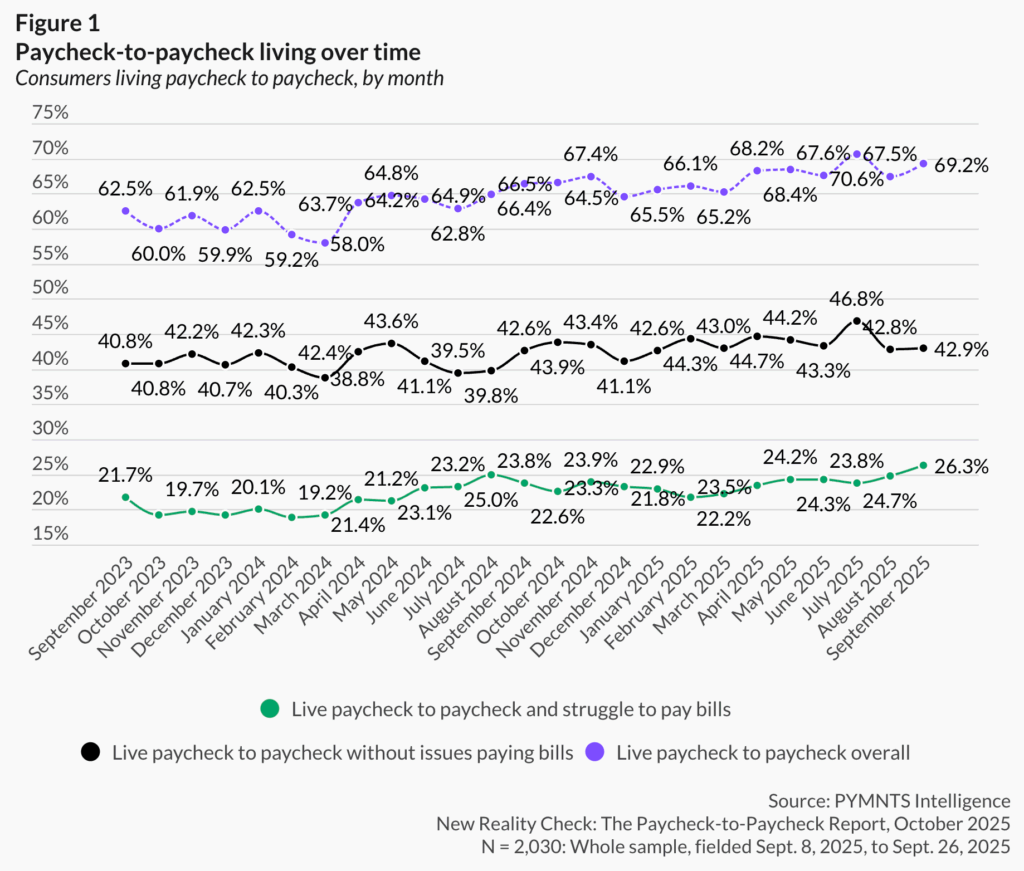
Rising prices and uncertain job prospects are shaking Americans’ sense of financial stability. As everyday costs climb and paychecks stretch thinner, many consumers are losing confidence in their ability to stay afloat—signaling deepening concerns about the health of both household finances and the broader economy.
Today, more consumers are struggling to get by. More than one in four, or 26%, had difficulties paying their bills last month—the highest share in at least two years. Overall, nearly seven in 10 consumers are now living paycheck to paycheck, with varying degrees of difficulty in paying monthly bills—the second-highest level over two years and nearly equal to the record high this summer.
Some groups are hit harder than others. For instance, 34% of consumers living in rural areas struggle to pay their bills. This share is far higher than the 24% of suburban individuals who report the same. In fact, even among high-income consumers in households earning $100,000 annually or more, financial pressure persists in rural areas.
Other lifestyle factors are also linked to financial strain. Forty-four percent of single adults with children are having difficulties paying their monthly bills. They are more than twice as likely as married individuals without children to face such challenges. Age plays a role, too. Bridge millennials—the cusp generation spanning older millennials and younger Gen X individuals—are struggling more than other generations.
Click here to read the rest of the article.
Published in Security Week, click here to read the entire article.
Ribbon Communications, an American company that provides backbone technology for communication networks, has been targeted by hackers.
Ribbon provides communications and networking solutions that enable organizations to reliably run phone calls and data networks.
The firm says its solutions are used by service providers, enterprises and critical infrastructure organizations. Its website lists BT, Verizon, Deutsche Telekom, CenturyLink, TalkTalk, Softbank, and Tata as its customers, along with the US Department of Defense and the City of Los Angeles.
In a quarterly financial report submitted recently to the SEC, Ribbon said it discovered unauthorized access to its IT network in early September 2025.
An investigation showed that the hackers may have gained initial access as early as December 2024, but the probe is still ongoing.
Ribbon has not shared any technical details on the incident, but said a nation-state threat actor is believed to be behind the attack.
At the time of the quarterly report’s submission Ribbon had not found any evidence that the hackers accessed or exfiltrated material information, but the company admitted that “several customer files saved outside of the main network on two laptops do appear to have been accessed by the threat actor”.
Impacted customers have been notified. While the company expects to incur some costs as a result of its investigation into the cybersecurity incident, it does not expect the hack to have a material impact.
Click here to read the rest of the article.
Published in CUInsight, click here to read the entire article.
Financial decisions are deeply personal, categorically unique, and multi-dimensionally complex. Whether applying for a first-time home loan, managing one’s credit score, or saving for a child’s education, personal finances require the utmost care and attention from financial institutions. It is what customers demand and deserve. Will the growing AI adoption disrupt this delicate relationship between consumers and financial institutions?
When personalized financial care falls short, trust and loyalty can quickly weaken. For credit union members, an AI-automated loan denial, flagged transaction, or even a misaligned targeted product offer can profoundly jeopardize their perception of their institution.
There is a thoughtful, measured, and member-centric approach to incorporating AI technology within the credit union service ecosystem. As AI-powered digital banking services gain popularity, the delicate balance between automation, transparency, and privacy protection becomes increasingly clear. Credit union members expect their financial services to feel tailored by those who have served them well for years. Should that level of customer care begin to feel replaced by faceless algorithms, members may start to wonder: Was I treated fairly? How is my data being used? Were my privacy preferences respected? Do I understand why a financial decision was made or what each online banking feature means for me? Can I challenge the outcome if it feels wrong?
In this environment, protecting the harmony between technical efficiency and member trust is a challenge that grows as digital banking accelerates in both competition and automation. Enter hyper-transparency. Our research clearly indicates that transparent, explainable AI-driven financial decisions, combined with responsible data practices, offer the clearest path forward. By making institutional decisions direct and understandable, while being open about how member data is collected, used, and kept secure, credit unions protect both people and the financial data about them. This balance builds trust through clarity, fairness, and meaningful human oversight.
Click here to read the entire article
Published in PYMNTS, click here to read the entire article.
Consumers in the United States may be strapped, but not everyone feels the same financial strain. The difference often comes down to how they budget.
The June edition of PYMNTS Intelligence’s Paycheck-to-Paycheck Report, “Consumers Say They Want Budgeting Tools but Aren’t Using Them,” finds that the ways U.S. consumers manage their money says almost as much about their peace of mind as how much they earn.
PYMNTS Intelligence surveyed 2,040 U.S. consumers in May and found that nearly 7 in 10 of them live paycheck to paycheck. The tools they use to track spending divide them into three distinct financial personas that not only reflect income and age, but also reveal contrasts in confidence, control and comfort with money.
Most reporting about financial stress focuses on inflation or wages. The overlooked story here is behavioral. Consumers’ financial well-being often depends on their relationships with their own budgets, or their avoidance of them.
Financial Personas Revealed by Budgeting Approaches
According to the report, the three types of budgeters are:
- Advanced Budgeters (37%): These consumers use specialized apps such as Quicken Simplifi or Credit Karma’s budgeting tools. Even though many of them live paycheck to paycheck, 47% describe themselves as financially comfortable. Among those struggling to pay bills, 53% still report they’re comfortable. That’s several times higher than other groups. They tend to be younger and higher-income, as 45% earn more than $100,000 a year, and more than half of Generation Z consumers fall into this category.
- Basic Budgeters (44%): This group relies on simpler bank apps or spreadsheets to manage bills and spending. Only 34% say they feel financially comfortable. They are more likely to be middle-income households using automatic bill pay or basic dashboards without advanced analytics or alerts. For them, budgeting is largely a record-keeping exercise, not a daily habit.
- Non-Budgeters (19%): Nearly 1 in 5 consumers fall into this group, and their approach is as hands-off as it sounds. They use no digital tools and often underestimate the impact of small spending decisions. Roughly 39% feel comfortable with their finances. That’s slightly better than basic budgeters, but this likely reflects higher income or lower complexity, and not better discipline.
The data indicates that advanced budgeting doesn’t necessarily eliminate stress; it confronts it. By forcing users to track expenses closely, advanced tools create more visibility, and sometimes discomfort. But that discomfort may be productive. As the report says, “Knowledge is power, but not necessarily comforting.”
Click here to read the rest of the article.
Published in Security Week, click here to read the entire article.
SquareX has shown how malicious browser extensions can impersonate AI sidebar interfaces.
Enterprise browser security firm SquareX has demonstrated how malicious browser extensions can impersonate AI sidebar interfaces for phishing and other nefarious purposes.
The attack method, named AI Sidebar Spoofing, has been demonstrated against Perplexity’s Comet and ChatGPT Atlas, OpenAI’s new web browser. However, SquareX contends this is a systemic flaw; not only AI browsers, but also Edge, Brave and Firefox, are susceptible.
AI sidebars are AI chat windows integrated into web browsers, typically displayed on the side of the screen, processing content on the current page or performing actions based on user prompts.
ChatGPT Atlas and Comet are dedicated AI browsers, but applications such as Edge and Chrome also integrate AI assistants powered by Copilot and Gemini. Firefox and Brave also have an AI sidebar, but they use third-party chatbots rather than having their own proprietary LLM.
SquareX researchers have shown how threat actors can spoof trusted AI sidebars in browsers by getting the targeted user to install a malicious browser extension. The extension can be created by the attacker from scratch and disguised as a harmless tool or it can be a legitimate extension that has been compromised and modified.
It’s worth noting that the malicious extension requires host and storage permissions, but the security firm pointed out that these are common permissions required by many popular extensions.
When the victim opens a new browser tab, the malicious extension injects JavaScript into the page to create a fake sidebar that is a perfect replica of the legitimate AI sidebar.