Published in CUToday
Click here to read the entire article.
Senate Banking Committee Ranking Member Elizabeth Warren (D-MA) is pressing NCUA Chairman Kyle Hauptman to turn over the legal analysis behind the agency’s position that one board member can constitute a quorum, warning the agency’s deregulation project could weaken the credit union system, American Banker reported.
In a Monday letter, Warren said NCUA’s effort to repeal or scale back 31 rules raises “serious questions” because Hauptman has been acting as the agency’s sole board member since President Trump removed Todd Harper and Tanya Otsuka in 2025, American Banker reported. NCUA has said it has “precedent and standing delegations of authority” to operate with one board member and cited former Chairman Dennis Dollar’s solo actions in 2001-2002, according to a previous NCUA staff message.
Warren said the deregulatory moves could threaten the stability of the broader credit union system, particularly because a large credit union failure could strain the National Credit Union Share Insurance Fund, American Banker reported.
The legal question remains separate from the ousted board members’ removal fight. American Banker reported the Supreme Court’s Monday decision in Trump v. Slaughter weakened Harper and Otsuka’s reinstatement arguments, but did not resolve whether NCUA can legally finalize policy with only one board member.
Meanwhile, John Crews, nominated to replace Hauptman, testified before the Senate Banking Committee last week and is expected to face a full committee vote next month. Chairman Tim Scott (R-SC) said the hearing was about getting qualified leaders in place, while Warren said credit unions need a stable regulator during a period of AI, crypto and board-independence questions, according to Senate Banking Committee statements.
Washington credit union advocate John McKechnie commented on Warren’s letter.
“Senator Warren voicing displeasure at any regulatory relief in the financial sector is no surprise,” stated McKechnie. “I suspect she wouldn’t have liked the proposals that came out of NCUA whether they emanated from a one-person board, a three-person board, or a 23-person board. I’m not trying to be disrespectful, but her philosophy is very well known.”
Brandy Bruyere, partner at Honigman, LLP, believes NCUA is aware of possible legal challenges from operating as a single-member board, given the “somewhat technical nature” of much of its deregulatory agenda that has rolled out over the past year.
Click here to continue reading.
By Ken McCarthy, Tyfone/Published in the Financial Brand
Click here to read the entire article.
For decades, community banks and credit unions could rely on a simple advantage: they were the primary window into a customer’s financial life.
That advantage is disappearing.
In a five-part white paper series, Siva Narendra, CEO of Tyfone, argues that a combination of data aggregation, artificial intelligence and emerging payment technologies is steadily eroding many of the traditional strengths community financial institutions have long viewed as defensible. The result, he contends, is not a single competitive threat but a broader restructuring of how consumers interact with financial services.
The papers, written for bank and credit union boards and executive teams, describe a future in which institutions risk becoming increasingly disconnected from the information, relationships and transactions that once anchored customer loyalty.
“The information advantage your institution was built on is gone,” Narendra writes in the opening paper. “The sooner a board accepts that, the sooner it can stop defending the wrong hill.”
At the center of the argument is a shift that has been building for years. Consumers no longer keep most of their financial lives within a single institution. Checking accounts, credit cards, mortgages, retirement accounts and investments are often spread across multiple providers, creating a fragmented financial landscape that no individual institution can fully see.
Data aggregators such as Plaid have accelerated that trend by allowing consumers to connect accounts from thousands of institutions into a single interface. Narendra argues that this has fundamentally changed the value of financial information itself.
What was once a competitive asset has become widely available.
To illustrate the point, Narendra describes connecting 28 accounts across eight financial institutions to an AI-powered platform through Plaid. The process, he writes, took roughly 30 minutes and produced a consolidated view of his finances that was more comprehensive than anything available from any single institution holding his accounts.
The broader implication, according to the paper, is that customers can increasingly obtain a clearer picture of their finances from third-party platforms than from the institutions that actually hold their money.
That shift, Narendra argues, creates what he calls an “aggregation trap.” Institutions that freely share data may accelerate their own commoditization, while those that restrict access risk frustrating customers and falling behind market expectations.
Either way, he suggests, ownership of information is becoming less valuable than the ability to interpret it.
Click here to continue reading.
By Frank Diekmann, CU Daily
Click here to read the entire article.
Auto lending remains the bread and butter of many credit unions, but U.S. auto sales could decline significantly over the next 15 years as demographic shifts, rising vehicle costs and changing consumer behavior reduce the number of people buying new cars, according to a new analysis.
CNBC reported that consulting firm Bain & Company projects annual U.S. light-vehicle sales could fall by more than 2 million units by 2040, creating a more competitive environment for automakers.
The U.S. market last reached a record 17.6 million vehicle sales in 2016. Some forecasts now suggest sales may never return to that level.
“The competition in the U.S. is going to be ferocious,” Bain partner Mark Gottfredson told CNBC. “There’s too many automakers and too many brands competing for the consumers. The market is going to have to consolidate.”
Demographics Drive Changes
According to CNBC, Bain attributes much of the expected decline to slowing population growth. Key factors cited include:
- The U.S. fertility rate fell to about 1.6 births per woman in 2025, below the replacement rate of 2.1, according to the Centers for Disease Control and Prevention.
- Bain expects restrictive immigration policies to cut historical net migration roughly in half over the next 15 years.
- The consulting firm said the combination would reduce the number of future vehicle buyers.
- “The population numbers…are baked in,” Gottfredson told CNBC, noting the number of future driving-age Americans is already largely determined by current birth rates.
Younger Buyers Purchase Fewer Cars
CNBC reported younger Americans are delaying or forgoing vehicle purchases. Among the trends:
- About 50% of 16-year-olds now have driver’s licenses, down from nearly 70% between 1966 and 1984, according to Bain.
- S&P Global Mobility found new vehicle registrations among consumers ages 18 to 34 declined from 12% in the first quarter of 2021 to less than 10% by mid-2025.
- Buyers 55 and older now account for nearly half of all new vehicle registrations and have held the largest share for eight consecutive quarters.
- “The engine behind it is affordability,” Craig Daitch, founder and president of automotive research firm Telemetry, told CNBC, noting monthly payments on new vehicles have climbed about 30% over the past four years and nearly one in five new vehicles now carries a monthly payment exceeding $1,000.
Robotaxis & Longer Lasting Vehicles
CNBC reported Bain believes widespread adoption of autonomous ride-hailing services could further reduce vehicle ownership.
Click here to continue reading.
Published in FinTech Global
Click here to read the entire article.
Artificial intelligence is transforming the fight against financial crime. However, it’s also giving criminals powerful new tools. As banks, regulators, and technology providers race to harness AI for fraud detection, AML, and risk management, cybercriminals are using the same technology to launch more convincing scams, automate attacks, and evade detection.
The result is an escalating AI arms race, where success depends not just on adopting the technology, but on staying one step ahead of those using it for the opposite purpose.
How GenAI is changing financial crime
How is Generative AI changing the sophistication and scale of financial crime? In the view of Bhavin and Pooja Shah, founder and CEO, and director of product and client solutions at Sherlocq, respectively, the tools that promised to transform compliance are now being weaponized by the very criminals they were designed to stop. Both sides of the fight are running the same technology, and across every major financial center, the gap between attack and defense is widening.
They said, “We are no longer debating whether generative AI will reshape financial crime. It already has. The question confronting regulators, compliance leaders, and technology providers: from London and Frankfurt to Singapore, Dubai, and New York, is whether defenses can evolve fast enough to keep pace, or whether we have entered a genuine arms race with no clear winner.”
For many decades, financial crime followed easy-to-follow patterns: fraud required effort, money laundering required human networks and sanctions evasion required specialist knowledge. “Each constraint acted as a natural brake on scale. Generative AI has removed the brakes,” said the Sherlocq pair.
Generative AI, they added, allows criminal networks to personalize attacks at scale, test them against live defenses, iterate in real-time, and deploy across jurisdictions simultaneously.
They added, “Large language models are crafting hyper-personalized phishing campaigns, generating synthetic identities that pass traditional KYC checks, and probing AML detection systems to identify thresholds and exploit blind spots. US fraud losses climbed to $12.5 billion in 2025, with AI-assisted attacks contributing significantly to the increase. The pattern is not uniquely American: authorized push payment fraud in the UK, invoice fraud across the EU’s single market, and trade-based money laundering in APAC corridors are all exhibiting similar AI-assisted acceleration.
GenAI also enables attackers to deploy AI agents to automate and scale social engineering attacks at volume, conduct deepfake video calls to authorize fraudulent transactions, generate forged documents indistinguishable from real ones, and simulate legitimate transaction patterns to evade detection. “These capabilities mean that financial crime is no longer just more frequent, it is more adaptive, targeted, and difficult to identify,” said Bhavin and Pooja.
Click here to continue reading.
By Tom Nawrocki, Payments Journal
Click here to read the entire article.
Financial institutions are sitting on vast reservoirs of customer and transaction data—but for many, that data still behaves more like scattered archives than a strategic asset. As banks look to compete on personalization and speed, data strategy is shifting from a back-office IT concern to a core driver of business value.
They have learned to reduce operational silos so they can share data more effectively, creating a more complete and actionable view of customer behavior. While many banks have taken advantage of these new capabilities, others still have not, or are only analyzing a small subset of the available data.
In the Debit Payment Data: A Business Strategy, Not Just an Initiative report, Ben Danner, Senior Analyst of Debit at Javelin Strategy & Research, examines how financial institutions can maximize the enormous amounts of customer and transaction data they hold.
“Large institutions are already making moves to bring customer data into their apps through services like Plaid and budgeting and forecasting tools, which used to be only in the domain of third parties,” Danner said. “Mid-size banks and community banks cannot wait with data strategy.”
A Wealth of Information
Product managers for offerings like debit and credit cards are familiar with key performance metrics such as the percentage of deposit accounts that have a debit card attached, how many of those debit card holders are actively using the card, average ticket size, and so forth. These are important transaction data points that anyone in product management should tracking for card products, even though each bank may analyst its data somewhat differently. However, the best banks are moving beyond these basic metrics.
“That’s a good first step,” Danner said, “But if you’re really looking to understand the market better, you’re going to have to go deeper than just looking at basic performance metrics on your card program.”
Deeper segmentation is where product managers and analyst teams can really excel, drilling down into areas like merchant categories, transaction types, and ATM usage. Every bank is sitting on a gold mine of transaction data that describes the habits of its customers. Historically, the challenge has been that banks haven’t had the right tools or enough time to dig deeply and make sense of all that data.
“You can have terabytes of servers worth of processing data, but it’s meaningless until you start digging in and doing the analytical work and interpretation of it,” Danner said. “This isn’t mind-blowing stuff, but there are important segmentations to look at, like breaking down your spend types.”
Challenges for Smaller Banks
Large institutions are already integrating artificial intelligence agents directly into their analytics and intelligence platforms. That leaves smaller banks needing to accelerate their modernization efforts to remain competitive.
Many of these smaller banks simply don’t have the resources or analytical tools to fully exploit this data. While organizations like Chase or U.S. Bank can dedicate teams to these initiatives, mid-tier and smaller banks don’t necessarily have an easy way to achieve the same outcomes. A smaller bank might have one product manager overseeing multiple offerings, or a single card lead responsible for the entire debit and credit card portfolio.
Click here to continue reading.
Published in FinTech Global
Click here to read the entire article.
Europe’s Anti-Money Laundering Authority is moving away from process-heavy compliance and towards a results-driven model, according to Napier AI’s analysis of AMLA’s inaugural public conference in Frankfurt. The event covered a broad range of topics, from artificial intelligence and cross-border financial crime to public-private partnerships and the future of AML supervision across the EU. But one message ran through every session: AML must become more effective, not more complicated.
Napier AI noted that financial crime is evolving faster than the frameworks built to combat it. Criminal networks operate across borders, funds move at speed, and technology is creating opportunities for both bad actors and those working to stop them. Yet compliance budgets and operational capacity cannot keep pace indefinitely, placing pressure on the entire ecosystem to work smarter.
A central theme at the conference was the quality of financial intelligence. AMLA signaled that harmonizing reporting across member states is among its earliest priorities. The authority made clear that success should not be measured by the volume of alerts generated or suspicious activity reports filed, but by whether those reports produce actionable intelligence that genuinely helps identify criminal activity. For an industry grappling with data overload, reducing noise and improving signal quality is becoming a strategic imperative.
Collaboration also featured prominently. Speakers consistently returned to the need for stronger ties between regulators, financial institutions, financial intelligence units, and RegTech providers. Harmonization, often associated with added regulatory burden, was reframed by AMLA as a route to simplification. A common rulebook and consistent supervisory expectations could ultimately reduce the fragmentation faced by organizations operating across multiple jurisdictions.
Napier AI highlighted one particularly notable observation: AMLA is arguably the first European AML supervisor designed from the ground up in the era of AI. Rather than modernizing legacy infrastructure, it has the opportunity to build processes with modern technology in mind. AI was positioned throughout the conference not as an end in itself, but as an enabler of better detection, smarter resource allocation, and stronger intelligence.
The broader shift, as Napier AI framed it, is from activity to outcomes. AML programs have long been measured by volume, alerts raised, reports submitted, and reviews completed. AMLA appears to be asking a more fundamental question: is any of this actually reducing financial crime?
For more insights, read the full story here.
By Kevin Townsend, Security Week
Click here to read the entire article.
From defending networks to enabling attacks, artificial intelligence is changing every aspect of cybersecurity. Here’s what dozens of experts say security leaders need to understand now. T
To better understand the current state of artificial intelligence (AI) in cybersecurity, SecurityWeek spoke with dozens of security practitioners, researchers, vendors, analysts, and AI experts. The result is a comprehensive snapshot of how AI is being used across the security landscape today.
Organized into five key topic areas, this report examines the role of AI through multiple lenses: whether it can be trusted, how organizations are using it, how it can be misused by legitimate insiders, how it is being exploited by cyber adversaries, and where the technology is likely headed next.
The five topics are:
- Generative AI (gen-AI)
- Agentic AI
- Shadow AI
- Machine learning (ML)
- Artificial general intelligence (AGI)
Taken together, these perspectives provide a practical assessment of AI’s opportunities, risks, and likely evolution in cybersecurity.
Generative AI
Generative AI (gen-AI) is the bedrock of contemporary AI, although it is technically and potentially born out of earlier machine learning (ML, see below).
It does what it says: it generates new content (most commonly text) from an AI model (most usually a large language model or LLM). Chatbots are the users’ interface to the LLM, enabling questions (known as prompts) to be applied and responses received in natural language, and answers to be received in natural language. Chatbots are the interface, and LLMs are the reasoning engine. For most people in most direct use the two seem inseparable – just one big gen-AI application.
“Gen-AI trains on massive data sets, learns statistical and relationship patterns, and then uses those patterns to synthesize original output from a prompt,” explains Ahmad Shadid, co-founder and CEO at ORGN.com. This is important. It does not create factually correct answers to prompts; it predicts probable answers based on the relationship patterns it has learned – but it does create linguistically correct and compelling responses.
Four deep learning architectures power the training for modern gen-AI variants. Transformer architecture (the ‘T’ in GPT and BERT) is used for the LLMs such as ChatGPT, BERT and Claude.
Diffusion training generates the variants that focus on creating high quality images and also audio and video. Fundamentally, this process starts with random noise. Mathematically (guided by the user’s prompt) it reduces and reshapes the noise into the required clear result. Diffusion reverses the process of destruction. The generated result is again based on probability – in this case, the probably correct distribution of pixels.
Classic diffusion is evolving into diffusion transformer technology (Sora) and ‘flow matching’ (DALL-E 3 and Midjourney) which can be described as next-gen diffusion.
Generative adversarial networks (GANs) are trained via two adversarial networks locked in a feedback loop. One creates fake data, while the other learns to detect flaws by repeatedly suggesting flaws and feeding them back to the creation. Both improve until the detector can find no more flaws in the creation.
This approach is good at creating images, video and audio, but has largely been superseded by diffusion technology for business use. However, criminals still use GAN-based simple, fast, real‑time face‑swap and voice‑clone models to create deepfakes.
The fourth architecture, variational autoencoders (VAEs), use an encoder-decoder architecture for synthetic data generation, data compression, and anomaly detection. “Their main applications are in medical imaging and molecular generation for drug discovery,” comments Shadid.
Trust in gen-AI
“Gen-AI is a prediction engine. It generates what’s statistically plausible based on patterns it has seen before,” explains Emanuel Salmona, CEO and co-founder at Nagomi Security. “This makes it good at exploration: generating exploit hypotheses, trying different inputs, and connecting a strange behavior to known vulnerability patterns,” expands Albert Ziegler, head of AI at XBOW.
“It’s a tool companies can use to automate creative labor,” adds David Karandish, CEO and founder at Capacity. And because of this, “It is becoming closely embedded into security teams’ workflows, from summarizing incident reports to helping draft response plans,” continues Devvret Rishi, general manager of AI at Rubrik.
Click here to continue reading.
By the National Consumer Law Center
Click here to read the entire article.
With Federal Protections Rolled Back, States Can Take Action as Banks Increasingly Charge Struggling Families Overdraft Fees
Since the Trump Administration and Congress’s decision to roll back limits on overdraft and nonsufficient funds (NSF) fees, many of the country’s largest banks have begun to ratchet up their overdraft fee take. Overall, struggling families paid over $12 billion in overdraft and NSF fees in 2025. A new report from the National Consumer Law Center (NCLC) outlines steps states can take to limit fees and abusive practices imposed on the people who can least afford them. A new issue brief analyzes the 2025 overdraft fee revenue of the 20 largest consumer banks and spotlights several in the “Overdraft Hall of Shame.”
About a quarter of people live in households that pay overdraft fees each year. The fees fall disproportionately on Black households, people with lower incomes, and people with limited education.
“With Congress and the Trump Administration reversing protection against abusive and unfair bank practices that multiply overdraft fees, some banks are seizing the opportunity to turn struggling families into a profit center,” said Lauren Saunders, senior attorney at the National Consumer Law Center. “While Washington turns its back on people struggling with the affordability crisis, state leaders must seize the opportunity to push back against predatory overdraft fee practices.”
A 2024 rule from the Consumer Financial Protection Bureau (CFPB) was expected to save households $5 billion a year – $225 a year for families that pay overdraft fees. In the lead up to the rule, many banks had made voluntary changes to reduce or eliminate fees as a result of regulatory pressure. But the CFPB overdraft fee rule was reversed by Congress in 2025, and the Trump Administration has also reversed enforcement actions and guidance against unfair overdraft and NSF fee practices. With the federal pressure off, fees are trending up.
Several banks stand out in the 2025 data for their high or rising overdraft fee revenue:
- JP Morgan Chase and Wells Fargo each charged about $1 billion per year in overdraft fees in 2025.
- Much smaller PNC Bank was third, with fees up 8 percent from 2023 to 2025 to $279 million.
- USAA Federal Savings Bank, which caters to the military community, has dramatically increased its overdraft fee revenue since 2023, by a larger percentage than any other bank, primarily by introducing overdraft fees in late 2023.
- On a per account basis, Regions Bank had the most overdraft fee revenues among large banks, $30 a year on average, and many families paid far more.
- Overdraft revenues are no longer available for credit unions after the National Credit Union stopped requiring reporting of that data, but in 2024 Navy Federal Credit Union had $28 in overdraft fees per account, higher than all but one of the top 20 banks.
Notably, some national players charge no overdraft fees, including Capital One, Citibank, American Express, and Ally Bank, and none of the top 20 banks charges NSF fees.
Click here to continue reading.
By Amanda Silberling, TechCrunch
Click here to read the entire article.
It happened to me: I opened a Google Doc to write an article, and I was immediately confronted with a text box inviting me to “write with Gemini.” I looked for some button to swipe away the garish AI display, but I could not find it. It made me mad.
Now, instead of writing the article I’m supposed to be working on, I am writing about how to get the AI pop-ups off of your Google Docs screen, since it took me some time to figure out. You’re welcome.
The first fix is pretty straightforward:
- Click “Gemini” on the top menu bar above your document.
- On the drop-down menu, select “bottom bar preferences.”
- You can choose to turn off that bottom bar, which will get rid of that AI box at the bottom of your screen.
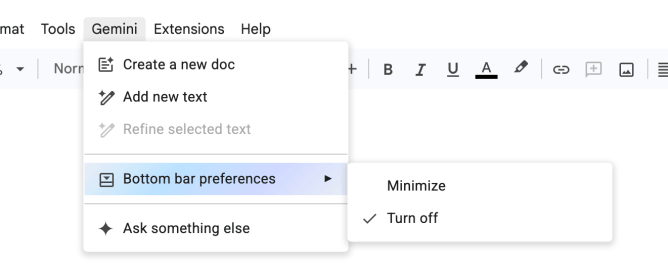
Full disclosure: I was so enraged when I set out to find “bottom bar preferences” that I initially missed it entirely. Instead, I clicked “Ask something else” and asked Gemini to help me remove itself from my life. AI may not be human, but Gemini seemed to have some sort of survival instinct, because it told me to click the “X” icon. That does not remove Gemini. It simply closed the conversation, the one in which I was asking it how to turn itself off. Suspicious!

Other aggrieved Google Docs users have reported features that I have yet to encounter, like a “help me write” feature that hovers over your cursor while you work. This seems like something that would upset me, so it’s probably worth nipping that in the bud before it’s too late. Benjamin Franklin once said, “An ounce of prevention is worth a pound of cure.” (He was talking about fire safety. I am talking about product design.)
Instead of turning off each individual AI feature like a game of whac-o-mole, we can disable “smart features” across our Google workspace via Gmail.
Click here to continue reading.
By Rajashri Chakrabarti, Gabriel Leonard, Donald P. Morgan, Thu Pham, and Lee Seltzer; Federal Reserve Bank of New York/Liberty Street Economics
Click here to read the entire article.
In imperial China, 3 percent was the maximum legal monthly loan rate; charging more was punishable by 40 to 100 blows with the “light cane.” (Rockoff 2003) Centuries later, many U.S. states are imposing the same cap (without corporal penalties) on alternative credit providers, such as payday, installment, and auto-title lenders, with the goal of lowering credit costs and delinquency for the high-risk borrowers that rely on these funding sources.
A concern, however, is that lenders will simply refuse to lend to these borrowers at lower interest rates. Our recent Staff Report studies how interest rate caps have played out in several states that recently adopted them. Using household-level data from a major credit bureau, we find that loan balances for the riskiest borrowers declined substantially relative to counterparts in states without caps. Despite taking on less debt, these borrowers did not experience an improvement in delinquencies.
The Resurgence of Usury Limits
Usury limits have waned over the centuries in the U.S, but their recent resurgence on the consumer side was triggered by payday lenders’ entry into the small dollar loan market in the mid-1990s (Rockoff 2003). In 2007, rates on loans to military staff were capped at 36 percent—marking the first-ever national usury limit in the U.S. A bill currently before Congress, the Predatory Loan Elimination Act, would extend the 36 percent cap across the entire U.S.
Saunders (2021) traces the 36 percent standard back to credit reform in the early 20th century. Concerned that prevailing usury limits were too low, the Russell Sage Foundation promulgated a Uniform Small Loan Law recommending a higher cap of 3.5 percent per month. Thirty-four states raised caps to between 36 and 42 percent over the next few decades (Anderson et al. 2015).
Cheaper Credit…or Less Credit?
Opponents of rate caps predict that they will lower the supply of credit for riskier borrowers rather than drive down the cost of credit. The textbook credit model below illustrates this effect. In this model, lenders separately provide credit for high-risk borrowers (sH) and low-risk borrowers (sL). At market equilibrium, lenders charge high-risk borrowers i, which is higher than what they would charge low-risk borrowers; lenders charge high-risk borrowers a higher interest rate to compensate for higher expected loan losses. However, a usury cap requires lenders to charge no higher than icap for interest, which is lower than the equilibrium rate i. As a result, lenders contract the quantity of loans supplied, as shown.
In fact, if profits from loans to high-risk borrowers don’t cover the fixed cost of providing them, lenders may entirely refuse to make any loans to high-risk borrowers, which is referred to as credit rationing. This is particularly likely as less creditworthy borrowers are also typically more likely to take out relatively small loans.
Note that icap is higher than the equilibrium interest rate for low-risk borrowers, and under standard model assumptions, lending to lower-risk borrowers does not change. However, under certain conditions, the rate cap could also have implications for low-risk borrowers, a situation we examine in the next post in this series.
Click here to continue reading.
Ravie Lakshmanan, The Hacker News
Click here to read the entire article.
Microsoft has warned of an active cryptojacking campaign that makes use of artificial intelligence (AI) chatbot interactions as a mechanism for surfacing malicious download sites.
“This emerging delivery technique extends social engineering beyond conventional search results and increases the visibility of malicious software recommendations,” Microsoft Defender Experts and the Microsoft Defender Security Research Team said in a report published Tuesday.
The activity, per the tech giant, impersonates legitimate system utilities like CrystalDiskInfo, HWMonitor, Display Driver Uninstaller, FurMark, K-Lite Codec Pack, and PDFgear, likely in an attempt to target users who own high-performance GPUs. The idea is to focus on compromising systems with higher mining value than indiscriminately infecting a large number of machines, it added.
The goals of the campaign are not merely financially motivated. The threat actors have also been found to establish persistent remote access to compromised hosts through ScreenConnect deployments, which could then be leveraged for follow-on activity, such as data theft, lateral movement, or ransomware.
The attack chain is more deliberate than other typical cryptocurrency mining efforts, strategically opting for endpoints that help maximize GPU mining yield per compromised device. The Windows maker said it detected and blocked activity associated with the campaign.
It all begins when users search for trusted system utilities and hardware-monitoring software on search engines, which surface malicious sites that have been gamed via techniques like search engine optimization (SEO) poisoning. Subsequent iterations observed in April 2026 indicate that users are being directed to these sites not through search engine results, but rather via interactions with large language model (LLM)-based tools.
“In these cases, users querying AI chatbots for software download recommendations were presented with links to attacker-controlled domains within generated responses,” Microsoft said. “While this behavior is based on observed patterns and correlated data sources, it’s consistent with emerging techniques in AI search result poisoning, representing an extension of traditional SEO poisoning beyond conventional search engines.”
Each of these sites contains a prominent download button that retrieves a ZIP archive from a campaign-specific subdomain of gleeze[.]com, which is hosted by infrastructure associated with Dynu, a dynamic DNS provider frequently used by threat actors. More than 150 malicious domains have been identified serving the malicious tools.
Click here to continue reading.
Kayla Selhorst, SVP/Chief Operations Officer, CME Federal Credit Union
Published by the Ohio Credit Union League
Amid the recent decision by Hicksville Bank to sell to Interra Credit Union, you may have seen a series of misstatements and misdirection from the Bank Lobby surrounding credit unions and the credit union model that serves the financial needs of more than 3.3 million Ohioans.
We’re here to set the record straight as part of a four-part series: Credit Union Myth Busters. Today’s topic is the unlevel playing field for credit unions versus banks.
While banks are publicly claiming that credit unions enjoy an unfair economic advantage as not-for-profit financial institutions, the truth is that banks enjoy several economic advantages that credit unions do not.
Examples of these credit union industry disadvantages include:
- Capped Business Lending: While federal law caps credit union member business lending at 12.25% of total assets, banks face no such limit on business lending.
- Restricted Membership: While credit unions are bound by defined and often narrow fields of membership, banks are free to serve any customer and expand without these limitations.
- Limited Access to Public Deposits: Unlike banks, credit unions do not have access to public deposits, which constrains balance sheet growth and liquidity options.
- Constrained Capital Formation: Credit unions cannot issue stock and have only limited access to supplemental capital, restricting their ability to compete.
Credit unions are proud of our collective Movement and our ability to serve Ohio’s 3.3 million credit union members with flexibility and agility. And we’ll continue to do so.
However, any claims that credit unions enjoy an ‘unfair advantage’ are not only false, but also only serve to highlight the ways in which credit unions often operate at a distinct disadvantage when compared to banks and other financial institutions.
Instead of punishing credit unions, as the bankers propose, lawmakers should be rewarding credit unions for stepping up and providing community-based financial services even when banks will not.
The credit union model values ‘people over profit,’ which is why 3.3 million Ohioans choose to belong to a credit union. And while others seek to distract and divide from that mission, Ohio credit unions remain laser-focused on serving our members and the financial needs of every Ohio community.