The company says new consumer loans to be made by its Square bank through the digital wallet are a less expensive alternative to predatory short-term financing.
The payments giant Block is positioning its Square bank to offer short-term consumer loans through its Cash App digital wallet as an alternative to payday lending, targeting borrowers who are unable to access traditional credit.
Loans made through its Cash App Borrow program, which were previously originated by Salt Lake City-based First Electronic Bank, will be administered by Block’s industrial bank, Square Financial Services, after the company received FDIC approval to offer consumer loans, the company said Wednesday in a news release.
The Cash App loans are about one-sixth the cost of a typical payday loan, a Block spokesperson contended in an email announcing the FDIC approval. The spokesperson declined to elaborate. Consumers are charged a one-time set-up fee for Cash App Borrow loans that usually equal 5% of the loan, the Block spokesperson said in an email.
Based on state law limitations, a typical two-week payday loan might have an annual interest rate approaching 400%, the Consumer Financial Protection Bureau said in a May 2024 post on its website, citing a loan that charged $15 for $100.
The average Cash App loan is less than $100 and roughly one month in duration, Block’s release said. The app originated roughly $9 billion in loans in 2024 through First Electronic Bank, the release said. Block and First Electronic Bank began working together in 2022.
Square Financial Services, which is based in Salt Lake City, launched operations in 2021 and also offers business loans. Consumer advocates have long criticized the payday loan industry for trapping low-income families and cash-strapped borrowers in cycles of debt and perpetuating poverty.
The payday lender industry has argued that it offers credit products to those who can’t get traditional loans.
Click here to read the entire article
Courtesy of Patrick Cooley, Payments Dive
The Office of the Comptroller of the Currency (OCC) today took action to reaffirm that a range of cryptocurrency activities are permissible in the federal banking system.
The OCC published Interpretive Letter 1183 to confirm that crypto-asset custody, certain stablecoin activities, and participation in independent node verification networks such as distributed ledger are permissible for national banks and federal savings associations. The letter also rescinds the requirement for OCC-supervised institutions to receive supervisory nonobjection and demonstrate that they have adequate controls in place before they can engage in these cryptocurrency activities.
Read the NASCUS Summary on Interpretive Letter 1183 (login required)
“The OCC expects banks to have the same strong risk management controls in place to support novel bank activities as they do for traditional ones,” said Acting Comptroller of the Currency Rodney E. Hood. “Today’s action will reduce the burden on banks to engage in crypto-related activities and ensure that these bank activities are treated consistently by the OCC, regardless of the underlying technology. I will continue to work diligently to ensure regulations are effective and not excessive, while maintaining a strong federal banking system.”
Consistent with Interpretive Letter 1183, the OCC also withdrew its participation in the joint statement on crypto-asset risks to banking organizations and the joint statement on liquidity risks to banking organizations resulting from crypto-asset market vulnerabilities.
Related Link: Interpretive Letter 1183 (PDF)
Regulatory scrutiny of the bank-fintech relationship intensified last spring after middleware provider Synapse collapsed, leaving thousands of online customers’ deposits in the lurch.
Last summer, federal banking agencies released an interagency statement providing guidance for banks working with third parties on deposit products, as well as a request for information related to the bank-fintech relationship. In September, the Federal Deposit Insurance Corporation (FDIC) proposed new recordkeeping rules for banks that take deposits from fintech customers.
Several consent orders against banks concerning their partnerships with fintechs followed. In the first half of 2024 alone, over a quarter of the FDIC’s enforcement actions were found to have targeted bank sponsors involved in embedded finance partnerships.
Though the bank-fintech honeymoon may be over, it’s less certain what will come next. Lumping all fintech providers together and placing additional burdens on the smaller lenders that disproportionately rely on their services isn’t the answer. Done wisely, fewer—and more effective—regulatory bodies and rules would make for a more innovation-friendly environment.
Though much remains to be seen, this year may offer something of a clean slate following the flurry of activity in 2024—presenting an opportunity to develop smarter policies moving forward.
A New “Regulation-Lite” Framework is Needed
2024 saw plenty of promising bank-fintech regulatory developments. But we also witnessed overregulation and indiscriminate application of rules that sowed further uncertainty.
Community banks, in particular, have suffered in the aftermath of Synapse’s failure, as regulatory bodies threatened to paint every institution with the same brush regarding their third-party partnerships. At the same time, some FDIC field examiners have been interpreting rules differently depending on the examination in question.
Before advancing any additional regulation, it’s critical that regulators focus their efforts on the real culprit rather than placing all fintech-bank partnerships in the same bucket. In other words, deposit-oriented solutions—and related consumer protection and money laundering risks—should be prioritized, given the complexity of ongoing reconciliations and the potential fallout for consumers (e.g. with Synapse).
Other functions, like digital loan participation platforms, should be treated differently, as they represent a healthy model of strong bank-fintech governance and partnership.
Once they’ve homed in, regulators should consider a “regulation-lite” framework that encourages ongoing innovation and collaboration while ensuring both parties meet appropriate standards. This could take the form of a relatively simple checklist for both parties that factors in relevant questions, such as:
- Do you have robust due diligence programs in place (e.g., related to anti-money laundering, know-your-customer, and adequate recordkeeping for deposits received from third-party/non-bank entities)?
- Do you have full visibility into relevant ledgers and your partner’s financial performance?
- Do you have a contingency plan in place should the partnership fail?
- Are roles and responsibilities clearly assigned between you and your bank/fintech partner?
- Have you identified an appropriate scope and frequency of reporting (e.g. on partner’s performance, risk management audits)?
Best Industry Practices
Several organizations offer useful blueprints for others to follow. Banking-as-a-service vendor Treasury Prime fully integrates its ledgers with its client banks’ core systems and holds its application programing interface’s underlying code in escrow—so if the company went offline, banks would still have access to the fintech’s database and could continue leveraging its API.
Similarly, Chime Financial designs its relationships with banks to protect its customers in case of failure.
“Not only does each of our partner banks have complete access to the relevant ledger, they also each have full visibility into Chime’s financial performance, enabling them to plan for and anticipate potential disruptions,” Chime said in response to the federal agencies’ RFI last year. “Consequently, our members would be protected in the event of an operational disruption.”
Similarly, Chime Financial designs its relationships with banks to protect its customers in case of failure.
“Not only does each of our partner banks have complete access to the relevant ledger, they also each have full visibility into Chime’s financial performance, enabling them to plan for and anticipate potential disruptions,” Chime said in response to the federal agencies’ RFI last year. “Consequently, our members would be protected in the event of an operational disruption.”
On the bank front, a recent report from law firm Troutman Pepper suggests that compliance teams should focus on “ledgering hygiene” that requires fintech firms to have separate accounts that “more clearly delineate funds for customers, operations, payment fees to third parties, contingency reserves, and network settlement.”
More Collaboration Equals More Innovation
Fortunately, last year’s tumult stimulated more cooperation and information sharing. This is a positive indicator of where the bank-fintech relationship could be heading.
For instance, since launching in the fall of 2024, the Coalition for Financial Ecosystem Standards has worked among its members and alongside regulators to develop standards for third-party relationships.
Yet more can be done. As I’ve previously argued, bringing back regulatory sandboxes in this area would allow fintech to gain needed experience in the banking world while fostering continued innovation in a safe, monitored, and risk-averse manner.
Though there may be more twists and turns ahead, banks and fintechs need each other more than ever. A regulation-lite framework that fosters innovation, transparency, and proactive engagement among key stakeholders can help both parties reach their full potential.
 Today, the U.S. Department of the Treasury’s Financial Crimes Enforcement Network (FinCEN) issued a Geographic Targeting Order (GTO) to further combat the illicit activities and money laundering of Mexico-based cartels and other criminal actors along the southwest border of the United States. The GTO requires all money services businesses (MSBs) located in 30 ZIP codes across California and Texas near the southwest border to file Currency Transaction Reports (CTRs) with FinCEN at a $200 threshold, in connection with cash transactions.
“Today’s issuance of this GTO underscores our deep concern with the significant risk to the U.S. financial system of the cartels, drug traffickers, and other criminal actors along the Southwest border,” said Secretary of the Treasury Scott Bessent. “As part of a whole-of-government approach to combatting the threat, Treasury remains focused on leveraging all our available tools and authorities to better identify and counter these criminal activities.”
Combatting drug cartels and stopping the flow of deadly drugs into the United States is one of the Administration’s highest priorities. In January, President Donald J. Trump issued an Executive Order creating a process by which certain cartels and other organizations would be designated as Foreign Terrorist Organizations (FTOs) and/or Specially Designated Global Terrorists (SDGTs). Accordingly, in February, the U.S. Departments of the Treasury and State designated eight organizations, including six major Mexico-based drug cartels, as FTOs and SDGTs. These designations will allow the United States to take further steps to deny individuals and entities associated with these groups access to the U.S. financial system.
The terms of the GTO are effective beginning 30 days after the date on which the order is published in the Federal Register. The terms are effective for 179 days thereafter.
The order covers the following ZIP codes across seven counties in California and Texas:
- Imperial County, California: 92231, 92249, 92281, 92283
- San Diego County, California: 91910, 92101, 92113, 92117, 92126, 92154, 92173
- Cameron County, Texas: 78520, 78521
- El Paso County, Texas: 79901, 79902, 79903, 79905, 79907, 79935
- Hidalgo County, Texas: 78503, 78557, 78572, 78577, 78596
- Maverick County, Texas: 78852
- Webb County, Texas: 78040, 78041, 78043, 78045, 78046
FinCEN appreciates the assistance of MSBs in defending the United States from Mexico-based cartels, especially those trafficking fentanyl, and in otherwise protecting the U.S. financial system.
Any questions about the GTO should be directed to www.fincen.gov/contact.
A copy of the GTO is available here.
The banking industry wants a federal appeals court review in New York’s case against Citibank, arguing that a judge has injected uncertainty into the wire transfer market.
Courtesy of Justin Bachman, Payments Dive
A New York federal court’s recent ruling that a wire transfer can be cleaved into component parts – with consumer transfers subject to the Electronic Funds Transfer Act – has alarmed banks, which are seeking a quick review by a federal appeals court.
The banks argue the court’s finding that consumer-initiated transfers fall within the EFTA, and not a less-stringent regulation they’ve been using, introduces uncertainty that could require costly changes to their operations or cause banks to restrict consumers’ access to online wire transfers.
District Judge J. Paul Oetken ruled Jan. 21 on Citibank’s motion to dismiss the complaint filed last year by New York Attorney General Letitia James. He granted parts of the motion, but upheld the state’s view that the EFTA covers consumer wire transfers that use a bank’s electronic platform.
Citibank and a half dozen industry groups have asked Oetken to allow for a review of his ruling and central questions of law in the case before it proceeds further. Oetken has set an initial conference for March 13, according to court documents. Banks have operated for decades under what the industry’s brief calls a “settled legal regime” that wire transfers do not fall under the EFTA’s purview. That law, for one thing, would impose greater regulatory burdens and costs on the industry.
“The Act specifically requires financial institutions to provide lengthy written disclosures to certain customers, investigate and resolve allegedly unauthorized electronic fund transfers, and, in many instances, assume liability for the bulk of consumer losses stemming from such unauthorized transactions,” attorneys at the law firm Katten wrote last month in a client advisory.
The New York AG sued Citibank in Jan. 2024, alleging that the bank failed to impose robust data security and anti-breach practices, costing bank customers millions of dollars in losses to fraudsters. The bank also had inadequate monitoring systems and did not properly investigate fraud claims or respond quickly to customer complaints, according to the lawsuit.
The suit seeks to collect restitution for fraud victims over six years, penalties and disgorgement. The Consumer Financial Protection Bureau filed a brief last May supporting the state’s legal position.
Wire transfers involve a financial institution sending funds to another financial institution on a wire network like Fedwire or the Clearing House Interbank Payments System (CHIPS), unlike traditional electronic fund transfers to or from a customer account, the Katten lawyers wrote.
Citibank and its peers argue that the EFTA doesn’t apply because of a provision within the Uniform Commercial Code, Article 4A, governing wire transfers.
The court’s finding “would require banks to upend their wire-transfer programs or risk additional legal liability for the thousands of consumer wire transfers that they execute every day,” Citibank said in its Feb. 18 motion for appellate review. “At a minimum, appellate guidance is warranted before Citibank and the entire financial-services industry are forced to make such a drastic change based on the NYAG’s novel reading of the statute.”
The 1978 EFTA limits consumer liability for unauthorized electronic fund transfers to $500 or less if a customer notifies their financial institution of the suspect transaction within 60 days.
Click here to read the entire article
The Federal Trade Commission (FTC) said Monday (March 3) that its lawsuit led a federal court to temporarily halt the operations and freeze the assets of a “phantom debt collection” scheme and its operators.
The commission’s complaint alleges that the operators of the scheme are Ryan and Mitchell Evans and their affiliated companies that have operated under the names Blackrock Services, Blackstone Legal Group, Capital Legal Services, Quest Legal Group, Viking Legal Services, and others, according to a Monday press release.
The complaint alleges that the scheme also operated under the names of unaffiliated existing businesses and law firms, per the release.
The FTC complaint alleges that debt collectors working for the operators and their affiliated companies called or wrote to consumers to collect on debts that never existed; threatened legal action that they had no basis to undertake; and falsely claimed that the fictitious debt could damage consumers’ credit and that a payment to settle the debt would lessen that harm, according to the release.
“The complaint notes that letters sent by the operators often contain a wealth of sensitive personal information about the consumer, including the last four digits of their Social Security number, leading consumers to believe the letter may be legitimate,” the release said.
In its complaint, the FTC asks the court to stop the defendants’ alleged unlawful conduct and provide redress to consumers they harmed, per the release.
In another, separate case, the FTC said Dec. 10 that it began sending over $540,000 in refunds to consumers harmed by a debt collection scheme.
The refunds followed the FTC’s filing of lawsuits in September 2020 and reaching settlements in March 2021 and December 2021 with National Landmark Logistics and Absolute Financial Services, which also operated under other names.
In the settlements, the defendants were permanently banned from the debt collection industry and were required to pay money to compensate the consumers.
In November, the FTC took action against Global Circulation and its owner, Kenneth Redon, III, alleging that the debt collector tricked consumers into paying more than $7.6 million in bogus debt by threatening them with unlawful actions.
Women are driving innovation and shaping cannabis market trends, which could be the way to reinvigorate the struggling industry.
As more women embrace cannabis for wellness purposes such as stress relief, sleep improvement and pain management, some brands are pivoting to meet their needs, creating products that are tailored to a health-conscious audience. From wellness-focused edibles to beauty and self-care cannabis products, the industry can tap into this growing demographic to drive sales and innovation in a competitive market.
“Women are leading the way in purposeful cannabis use, focusing on wellness goals like stress relief and improved sleep,” said David Kooi, CEO of Los Angeles-based cannabis discovery app Jointly. “They’re seeking out products that fit into a healthier lifestyle, and cannabis is becoming an important tool in their wellness tool kit.”
Jointly, which reports that 55% of its users are women, found that women are more likely than men to consume marijuana with their significant other (28% versus 19%). Also, among Jointly users, women experience a nearly 10% higher success rate than men when using cannabis for recovery and pain management.
“In our experience, women are increasingly sophisticated consumers of cannabis, using it with intention,” Kooi said.
In 2023, women between the ages of 19 and 30 reported consuming more cannabis than men for the first time since 1975, when the University of Michigan’s Institute for Social Research began its “Monitoring the Future” study. Formulating products that support women’s lifestyles in formats they already incorporate into their daily routines, such as lotions, balms and low-dose beverages, is key, said Chloe Steerman, chief operations officer at Denver-based cannabis marketing and public relations agency Grasslands.
“Labeling something for women or throwing a pink or purple package on it is not enough anymore,” Steerman said. “Women consumers see right through that stuff, and we know what we want.” The trick is getting executives for cannabis brands to listen. It’s not always easy, but it’s not impossible. “I know that there are countless brilliant marketing and business leaders who are women in the cannabis space with really great ideas about what women want and need and the passion to bring those products to market,” Steerman said. “But at the end of the day, it’s the men in the leadership role who make the final call.”
Products for women’s specific needs
As chief development officer at Michigan-headquartered Exclusive Brands, Narmin Jarrous was able to create Neno’s Naturals, a product that helped relieve her endometriosis symptoms. Jarrous said her situation at Exclusive Brands is different than what most women in the cannabis industry experience because she was the one making decisions. She knew she was addressing a need beyond just creating a product for herself.
“You think it’s obvious, and then you walk into a room and start pitching to someone and you realize that it’s not,” she said. Jarrous encourages cannabis businesses to start thinking more about what women are looking for to treat conditions such as endometriosis, menstrual cramps and pain. “It was really empowering to be able to create that when all the doctors and acupuncturists and holistic medicine people failed me,” Jarrous said.
“If they’re not already targeting women, they’re really missing the mark. “Not only do women make up more than half of consumers of cannabis, but women also make the purchasing decisions at homes in America. They’re picking out groceries and appliances. “Why wouldn’t you be catering to them?”
Click here to read the entire article | Courtesy of Margaret Jackson, MJBizDaily
The House Financial Services Committee on March 5 took the first step toward repealing the CFPB’s overdraft rule, adopting a resolution under the Congressional Review Act.
The resolution, H. J. Res 59, sponsored by committee Chairman Rep. French Hill, R-Ark., was adopted, 30-19. The resolution simply repeals the overdraft rule.
As we previously noted, it now goes to the House floor, where it can be adopted by a simple majority. Senate Banking Committee Chairman Sen. Tim Scott, R-S.C. has introduced the resolution in the Senate, where it may be adopted by a simple majority without the threat of a filibuster. It then would go to President Trump for his signature.
By Ballard CFS Group on March 6, 2025
 U.S. Treasury Secretary Scott Bessent on Tuesday argued that the U.S. economy is more fragile under the surface than economic metrics suggest and vowed to “re-privatize” growth by cutting government spending and regulation.
In his first major economic policy address at the Australian embassy in Washington, Bessent said that interest rate volatility, sticky inflation and reliance on the public sector for job growth have hobbled the U.S. economy despite positive top-line GDP growth and low unemployment.
In the wide-ranging speech, Bessent blamed “prolific overspending” under former President Joe Biden and regulations that have hindered supply-side growth as the main drivers of “sticky inflation.”
“The previous administration’s over-reliance on excessive government spending and overbearing regulation left us with an economy that may have exhibited some reasonable metrics but ultimately was brittle underneath,” he said.
Bessent said that 95% of all job growth in the past 12 months has been concentrated in public and government-adjacent sectors such as health care and education, jobs offering slower wage growth and less productivity than private-sector jobs.
Meanwhile, he said jobs in manufacturing, metals, mining and information technology all contracted or flatlined over the same period.
“The private sector has been in recession,” Bessent said. “Our goal is to re-privatize the economy.”
Bessent said President Donald Trump’s administration was working to bolster the private sector’s contribution to job creation, partly by slashing regulations, extending tax cuts and rebalancing the U.S. economy through tariff policies.
Bessent said Trump’s planned tariffs were an essential part of this plan, with three main goals.
“First, tariffs can increase U.S. industrial capacity, create and protect U.S. jobs, and improve our national security, he said. “Second, tariffs can be an important source of government revenue, which can help fund investments that benefit American families and companies.”
He also cited it as a tool to correct and manage internal imbalances in other economies, and deter excess production and supply from other countries, such as China. He said that China could not be allowed to export deflation to major Western economies as it struggles with its own internal economic problems.
“China really needs more consumption,” he said.
In deciding on reciprocal tariff rates, Trump’s administration, including the Treasury, will examine a wide range of factors, including other countries’ tariff rates, non-tariff barriers and currency practices, Bessent said.
Asked about how Australia, which has a free-trade agreement with the U.S., was doing in this regard, Bessent said, “so far, so good, but I’m not USTR.”
He said he discussed Australia’s request to be exempted from Trump’s restored 25% global steel and aluminum tariffs during a meeting with Australian Treasurer Jim Chalmers. He added however that that was a matter for the Commerce Department and USTR to decide.
Courtesy of By David Lawder and Andrea Shalal, Reuters

Rohit Chopra, the former director of the Consumer Financial Protection Bureau (CFPB), argued Monday that shutting down the agency is “begging for another financial crisis,” as the Trump administration takes aim at the CFPB.
“We had this experiment before, in the years leading up to the subprime mortgage crisis. And as we all know, it was an absolute catastrophe,” Chopra told MSNBC. “We had a whole set of mortgage lenders and other companies that had basically no oversight, and we saw trillions of dollars of wealth in our country disappear.”
“It just feels like shutting down the CFPB is begging for another financial crisis. … At the end of the day, I don’t see any reason why we shouldn’t enforce the laws on the books,” he continued.
The agency was created in the wake of the 2007-08 financial crisis. It has long been a target of conservatives, who argue it has overstepped its authority and the bounds of the Constitution.
The CFPB saw a flurry of action over the weekend, shortly after Russell Vought, the newly confirmed director of the Office of Management and Budget, was tapped to lead the agency.
Vought reportedly ordered employees to “cease supervision and examination activity” on Saturday, before telling staff Monday to “stand down from performing any work task.” The agency’s chief operating officer also informed employees Sunday that the CFPB’s headquarters would be closed for the week.
The series of events closely mirrors those taken at the United States Agency for International Development (USAID) last week, making employees and observers nervous about what comes next.
At USAID, the Trump administration similarly told staff to cease work and not come into headquarters before attempting to place thousands of employees on administrative leave. The move was blocked by a federal judge Friday, however.
Courtesy of Julia Shapero, the Hill
An active campaign from a threat actor potentially linked to Russia is targeting Microsoft 365 accounts of individuals at organizations of interest using device code phishing.
The targets are in the government, NGO, IT services and technology, defense, telecommunications, health, and energy/oil and gas sectors in Europe, North America, Africa, and the Middle East.
Microsoft Threat Intelligence Center tracks the threat actors behind the device code phishing campaign as ‘Storm-237’, Based on interests, victimology, and tradecraft, the researchers have medium confidence that the activity is associated with a nation-state operation that aligns with Russia’s interests.
Device code phishing attacks
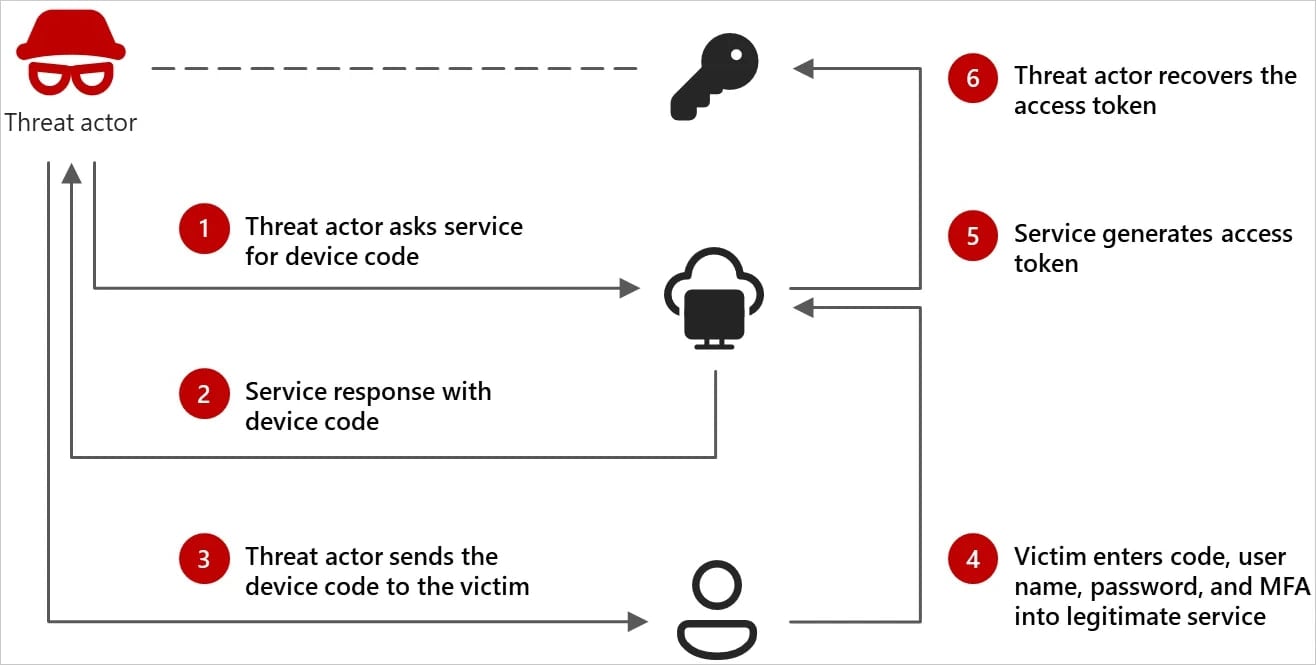
Input constrained devices – those that lack keyboard or browser support, like smart TVs and some IoTs, rely on a code authentication flow to allow allowing users to sign into an application by typing an authorization code on a separate device like a smartphone or computer.
Microsoft researchers discovered that since last August, Storm-2372 abuses this authentication flow by tricking users into entering attacker-generated device codes on legitimate sign-in pages.
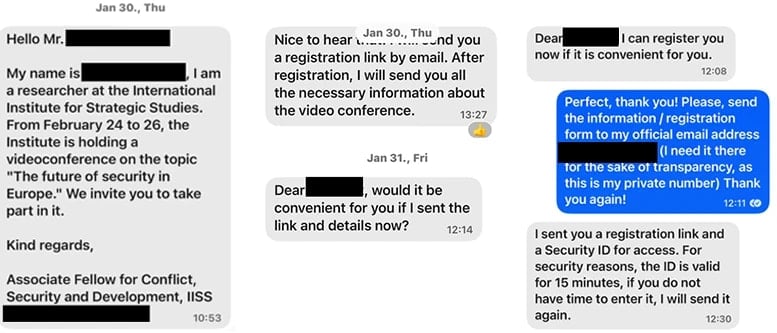
The operatives initiate the attack after first establishing a connection with the target by “falsely posing as a prominent person relevant to the target” over messaging platforms like WhatsApp, Signal, and Microsoft Teams.
Source: Microsoft
The threat actor gradually establishes a rapport before sending a fake online meeting invitation via email or message.
Input constrained devices – those that lack keyboard or browser support, like smart TVs and some IoTs, rely on a code authentication flow to allow allowing users to sign into an application by typing an authorization code on a separate device like a smartphone or computer.
Microsoft researchers discovered that since last August, Storm-2372 abuses this authentication flow by tricking users into entering attacker-generated device codes on legitimate sign-in pages.
The operatives initiate the attack after first establishing a connection with the target by “falsely posing as a prominent person relevant to the target” over messaging platforms like WhatsApp, Signal, and Microsoft Teams.
Source: Microsoft
The threat actor gradually establishes a rapport before sending a fake online meeting invitation via email or message.
According to the researchers, victim receives a Teams meeting invite that includes a device code generated by the attacker.
“The invitations lure the user into completing a device code authentication request emulating the experience of the messaging service, which provides Storm-2372 initial access to victim accounts and enables Graph API data collection activities, such as email harvesting,” Microsoft says.
This gives the hackers access to the victim’s Microsoft services (email, cloud storage) without needing a password for as long as the stolen tokens remain valid.
Source: Microsoft
However, Microsoft says that the attacker is now using the specific client ID for Microsoft Authentication Broker in the device code sign-in flow, which allows them to generate new tokens.
This opens new attack and persistence possiblities as the threat actor can use the client ID to register devices to Entra ID, Microsoft’s cloud-based identity and access management solution.
“With the same refresh token and the new device identity, Storm-2372 is able to obtain a Primary Refresh Token (PRT) and access an organization’s resources. We have observed Storm-2372 using the connected device to collect emails” – Microsoft
Defending against Storm-2372
To counter device code phishing attacks used by Storm-2372, Microsoft proposes blocking device code flow where possible and enforcing Conditional Access policies in Microsoft Entra ID to limit its use to trusted devices or networks.
If device code phishing is suspected, immediately revoke the user’s refresh tokens using ‘revokeSignInSessions’ and set a Conditional Access Policy to force re-authentication for affected users.
Finally, use Microsoft Entra ID’s sign-in logs to monitor for, and quickly identify high volumes of authentication attempts in a short period, device code logins from unrecognized IPs, and unexpected prompts for device code authentication sent to multiple users.
Courtesy of Bill Toulas, Bleeping Computer
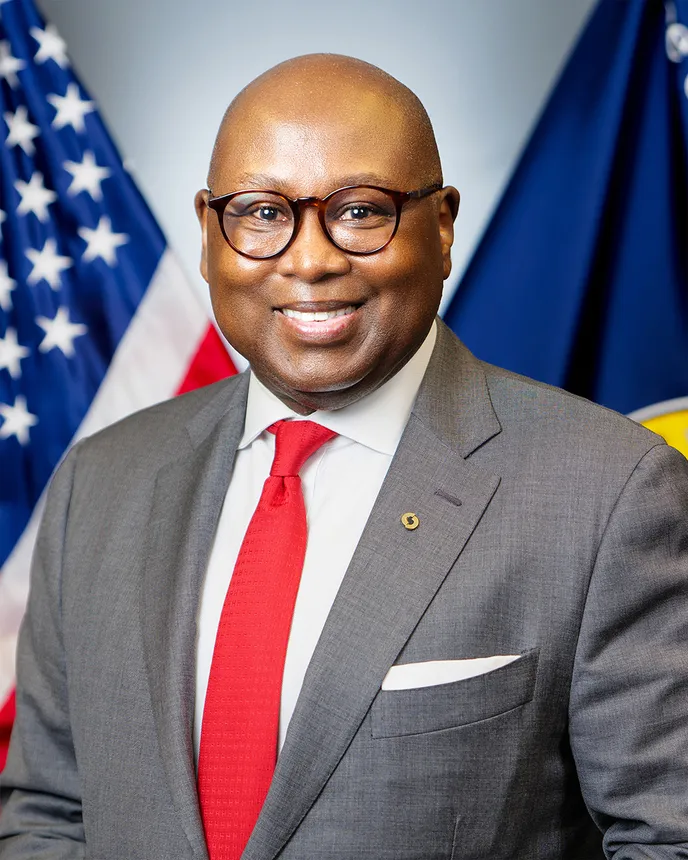 The regulator outlined his top priorities – including financial inclusion, technology, and cybersecurity – while speaking at a conference for community bankers.
Rodney Hood, the new acting head of the Office of the Comptroller of the Currency, outlined his priorities Tuesday and emphasized his commitment to reducing regulatory burdens on community banks and strengthening the financial system.
While speaking at the American Bankers Association’s Conference for Community Bankers in Phoenix, Hood touched on several topics, including financial inclusion, technology, cybersecurity and compliance with the Bank Secrecy Act.
Hood, the former chair of the National Credit Union Administration, was named acting comptroller this month. President Donald Trump has since tapped OCC vet Jonathan Gould to lead the agency, pending confirmation by the Senate.
Here are the five key takeaways from Hood’s first public appearance as the head of the OCC.
Financial inclusion
Hood noted that 40% of U.S. households cannot obtain a $400 emergency loan and estimated that 70 million people are “credit-invisible.”
“I continue … to believe that financial inclusion is undeniably the civil rights issue of our time,” Hood said.
Hood also highlighted the need to provide wealth management and investment opportunities beyond basic checking and savings accounts to clients.
One size doesn’t fit all
Hood stressed the importance of tailoring regulations to bank size and complexity and advocated for a principles-based approach when fighting cyber fraud. He highlighted ongoing threats from malicious actors and urged banks to implement multifactor authentication while emphasizing the importance of operational risk management based on bank asset size.
Hood said the OCC would offer better clarity and guidance on regulatory frameworks that will contain differences between smaller banks with around $100 million in assets and larger institutions with more than $1 billion. Hood said it’s unfair to think that a $100 million-asset bank should use the same risk weights and level of due diligence as that of a multibillion-dollar bank.
In “my time as acting comptroller” – and not an “inactive” one, Hood said, “I will certainly be going through the rules to make sure that we are looking at appropriate opportunities to reduce regulatory burden by determining what needs to be adjusted, and again, not looking at everything through a one-size-fits-all approach.”
Raising the BSA reporting threshold
Hood said he wants to focus on the OCC’s efforts to police banks’ exposure to bad actors amid the greater use of digital assets and cryptocurrencies. Click here to read more